Key Takeaways
- Wade Litigation represents San Francisco clients in divorce, child custody, support, and property division matters, with a structured, litigation-ready approach.
- San Francisco family law cases are heard at the Civic Center Courthouse under the San Francisco Superior Court's Unified Family Court.
- California is a no-fault, community property state, and high-asset San Francisco divorces frequently involve equity compensation, real estate, and closely held businesses.
- Contested custody matters in San Francisco County require participation in Family Court Services mediation before a judge will hear the dispute.
- Family Code Section 3044 creates a rebuttable presumption against awarding custody to a parent with a recent domestic violence finding.
Family law disputes in San Francisco rarely stay confined to a courtroom. They shape where children live, how a household's assets get divided, and what a person's financial life looks like once a marriage or partnership ends. In a city where equity compensation, real estate, and dual-income households complicate even straightforward separations, the stakes of getting a filing, a negotiation, or a hearing wrong can follow a family for years.
Wade Litigation represents clients throughout San Francisco in contested divorce, child custody disputes, child and spousal support matters, and property division, including cases involving significant or complex assets. We approach every matter with thorough preparation and the readiness to litigate when negotiation does not produce a fair result. Whether a case resolves through settlement or trial, our focus remains the same: protecting our client's parental relationships, financial position, and long-term stability.
How Wade Litigation Helps San Francisco Families Navigate Family Law Matters
San Francisco family law cases move through a court system with its own local procedures, mediation requirements, and calendar pressures, layered on top of statewide Family Code rules. We bring a client-centered approach to matters throughout the city, combining knowledge of the San Francisco Superior Court's Unified Family Court with a strategy built around each client's specific circumstances.
A San Francisco Family Law Firm Built Around Preparation and Client Communication
Our approach begins with thorough fact-gathering: financial disclosures, communication records, prior agreements, and any documentation relevant to custody or support. From there, we pursue negotiated resolutions where they serve the client, while preparing every case as though it may proceed to a contested hearing. Each client works with a dedicated point of contact who provides case updates and answers procedural questions, while our attorneys handle legal strategy and courtroom advocacy.
We handle matters ranging from straightforward uncontested divorces to complex, high-asset property divisions and contested custody disputes involving allegations of domestic violence or parental relocation. Throughout representation, we emphasize transparent billing and responsive communication, so clients understand both the legal posture of their case and the costs involved in pursuing it.
California Family Law Issues We Handle in San Francisco
California's Family Code governs the legal relationships between spouses, domestic partners, parents, and children, and San Francisco Superior Court judges apply these statewide rules within the city's own local procedures. For a broader look at how California family law works statewide, our California family law resource covers those foundational rules in more depth. The primary categories of family law disputes we handle in San Francisco include the following.
Divorce and Legal Separation in San Francisco County
California operates as a no-fault divorce state, meaning neither spouse has to prove wrongdoing to end a marriage. The only legal ground required is irreconcilable differences. To file in San Francisco County, at least one spouse must have lived in California for the six months immediately before filing and in San Francisco County for the three months before filing.
The standard divorce process in San Francisco generally includes the following steps.
- Filing a petition for dissolution with the San Francisco Superior Court and formally serving the other spouse
- Exchanging Preliminary Declarations of Disclosure, which require both spouses to fully and accurately disclose assets, debts, income, and expenses
- Negotiating or litigating contested issues, including custody, support, and division of property
- Finalizing a marital settlement agreement or, when issues remain unresolved, proceeding to trial
California also imposes a mandatory six-month waiting period from the date the respondent is served before a divorce can be finalized, regardless of how quickly the parties reach agreement. Legal separation offers an alternative for couples who wish to divide finances and live apart without formally ending the marriage, often for reasons related to health insurance, retirement benefits, or religious considerations. For a full breakdown of the San Francisco divorce process, timelines, and costs, see our San Francisco divorce attorney page.
Child Custody and Visitation in San Francisco Family Court
Custody in California divides into two categories. Legal custody covers the authority to make decisions about a child's health, education, and general welfare. Physical custody determines where a child primarily lives day to day. Courts may award either category jointly or solely to one parent, depending on the circumstances of the case.
California law expresses a preference for arrangements that give children frequent and continuing contact with both parents, provided no safety concerns exist. When San Francisco parents cannot agree on a parenting plan, the court requires participation in mediation through San Francisco Family Court Services before a judge will hear a contested custody matter. A trained mediator meets with both parents to attempt to develop a workable plan; if the parents reach agreement, that plan typically becomes the basis for the court's order. When no agreement results, the mediator may submit a recommendation to the judge.
Relocation requests, allegations of parental alienation, and disputes over school enrollment or medical decision-making frequently complicate San Francisco custody cases. Each of these issues requires its own evidentiary showing, and a parent's position is strengthened substantially by clear documentation and consistent co-parenting conduct in the months leading up to a hearing. For more on how custody evaluations, relocation requests, and parenting plans work in San Francisco specifically, see our San Francisco child custody attorney page.
Child Support and Spousal Support Under California Law
California calculates child support using a statewide guideline formula that accounts for each parent's income and the percentage of time each parent spends with the children. San Francisco courts apply this formula through standardized software that produces a presumptively correct support figure, though judges retain discretion to deviate from the guideline when statutory factors justify a different result.
Spousal support, often called alimony, follows a different analysis. Family Code Section 4320 lists more than a dozen factors courts must weigh when setting the amount and duration of support, including the length of the marriage, each spouse's earning capacity, contributions made to the other spouse's education or career, and the standard of living established during the marriage. For marriages under ten years, San Francisco courts often consider a support duration of roughly half the length of the marriage, though outcomes vary significantly based on the specific facts. In longer marriages, courts may retain jurisdiction over spousal support indefinitely, without setting a fixed termination date at the time of judgment.
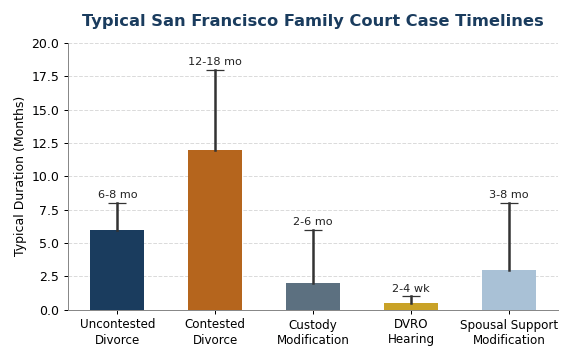
Every San Francisco family law case moves at its own pace, and the ranges above reflect general patterns rather than a guarantee for any individual matter. Court calendar congestion, the complexity of the underlying issues, and how cooperative both parties are during discovery all affect how quickly a case actually resolves.
the Wade Litigation difference
Request Your Free Case Evaluation Now!
Property Division in San Francisco Divorces
Community Property and Separate Property Under California Law
California follows community property principles: assets and debts acquired during the marriage generally belong equally to both spouses, regardless of whose name appears on the account or title. Property acquired before marriage, after the date of separation, or through gift or inheritance typically remains separate property belonging to one spouse alone.
The distinction sounds simple in theory but grows complicated in practice. Commingling occurs when separate and community funds mix, which can convert what began as separate property into a community asset, or create a reimbursement claim. A home purchased before marriage but paid down using income earned during the marriage is a common example that requires careful tracing and, often, a forensic accountant.
High-Asset and Complex Property Division in San Francisco Divorces
San Francisco's concentration of technology, finance, and professional-services employment means that high-asset divorces here often involve compensation structures and holdings that do not divide as cleanly as a bank account balance. Equity compensation in particular requires attention to vesting schedules, exercise windows, and whether specific grants were earned before or during the marriage.
- Stock options, RSUs, and other equity compensation, where vesting dates and grant dates affect what counts as community property
- Family-owned or closely held businesses requiring formal valuation and forensic accounting
- Retirement accounts, pensions, and deferred compensation earned during the marriage
- Real property, including the family residence and any investment or rental holdings
- Investment portfolios, carried interest, and other complex financial instruments
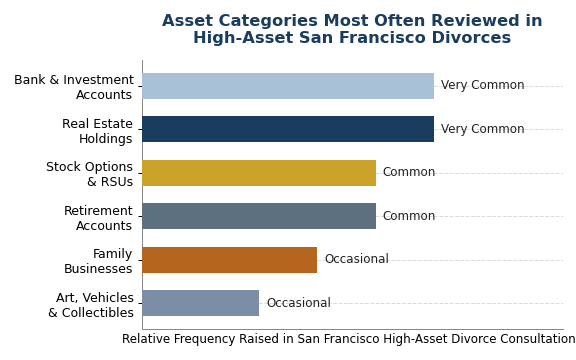
Proper handling of these assets requires coordination between family law counsel and financial professionals, including forensic accountants and valuation experts where a business or complex compensation package is involved. When a business valuation dispute threatens the underlying business itself rather than just the divorce settlement, a San Francisco business litigation attorney may need to get involved separately. Mistakes made during property division, particularly around equity compensation with multi-year vesting schedules, can have financial consequences that last well beyond the divorce itself.
Domestic Violence Protections in San Francisco Family Law
Credible evidence of domestic violence carries substantial weight in San Francisco family law proceedings and can affect custody determinations, visitation arrangements, and support orders. California law provides several protective mechanisms for parties who have experienced abuse.
Restraining Orders and Emergency Protection
Individuals facing domestic violence may seek emergency protective orders, temporary restraining orders, or permanent restraining orders, depending on the urgency and circumstances involved, and our California restraining order attorney can help evaluate protective options in urgent situations. San Francisco Superior Court's family law division processes domestic violence restraining order requests for San Francisco County. Emergency orders provide immediate protection, typically lasting only a few days until a hearing can occur. Temporary orders then extend protection until a full hearing takes place, which California law requires within 21 days of the request, or 25 days for good cause.
How Domestic Violence Findings Affect Custody
Family Code Section 3044 establishes a rebuttable presumption that awarding sole or joint custody to a parent who has committed domestic violence within the preceding five years is detrimental to a child's best interests. Once a court makes such a finding, the burden shifts to the parent found to have committed the abuse to demonstrate that custody or unsupervised visitation would not harm the child. Recent changes to California law also require courts, in cases involving a domestic violence finding, to state specific reasons in writing when awarding custody or unsupervised visitation to the restrained parent.
San Francisco's Family Court System: What to Expect
San Francisco Superior Court's Unified Family Court hears divorce, custody, support, and domestic violence matters at the Civic Center Courthouse. Understanding the local process, separate from the substantive law, helps clients anticipate what a case will actually look like week to week.
- Family law filings and hearings are handled through the Unified Family Court at the Civic Center Courthouse
- Contested custody matters must go through Family Court Services mediation before a judge will hear the dispute
- The court's Self-Help Center assists self-represented litigants with forms, though it does not provide legal advice or advocacy
- Requests for Order (RFOs), used to bring most contested issues before a judge between the initial filing and final judgment, require a minimum notice period before the hearing date
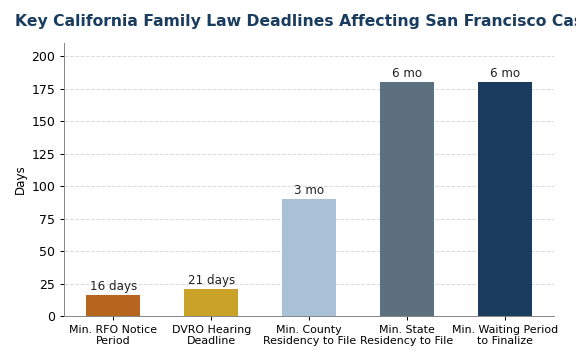
These figures reflect general statutory and procedural minimums under California law and San Francisco Superior Court practice. Specific deadlines can shift based on how a case is served, whether good cause is shown, or local court scheduling.
What Family Law Representation Typically Costs in San Francisco
Attorney fees in San Francisco family law matters vary widely based on the complexity of the issues involved, whether a case settles or proceeds to trial, and how contentious discovery becomes. An uncontested divorce with no minor children and modest assets generally costs far less than a contested, high-asset matter involving custody disputes, business valuation, or equity compensation tracing.
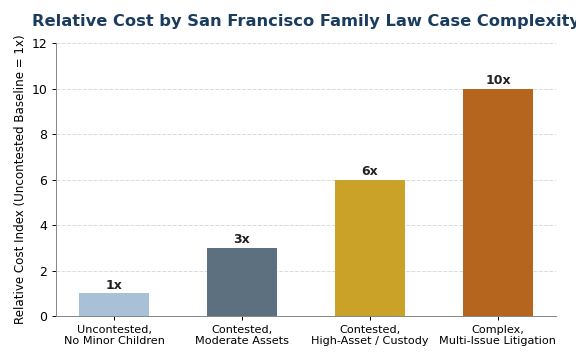
Wade Litigation provides transparent billing throughout representation, with invoices reviewed internally before being sent to clients. Discussing fee structure and likely costs during an initial consultation helps clients plan and understand the financial commitment a case may require before it begins.
Local Resources for San Francisco Family Law Matters
| Resource | Purpose | Contact / Location |
|---|---|---|
| SF Superior Court – Unified Family Court | Filing, hearings, and case management for divorce, custody, and support matters | Civic Center Courthouse, 400 McAllister St, San Francisco, CA 94102 |
| SF Family Court Services | Mandatory mediation for contested custody and visitation disputes | Civic Center Courthouse |
| SF Superior Court Self-Help Center | Form assistance for self-represented litigants (no legal advice or advocacy) | Civic Center Courthouse |
| San Francisco Bar Association LRIS | Attorney referral service for residents seeking family law counsel | sfbar.org |
| California Department of Child Support Services | Child support case establishment, modification, and enforcement | San Francisco local child support agency |
Why Choose Wade Litigation as Your San Francisco Family Law Attorney
Choosing a family law attorney in a city as competitive and high-stakes as San Francisco means finding a firm that can both negotiate effectively and litigate credibly when negotiation fails. Wade Litigation's founder, Amiel Wade, has been recognized as a Top Ten California Family Law Attorney by the National Academy of Family Law Attorneys, reflecting a firm-wide commitment to attentive, ethical representation.
We combine that recognition with practical structure: dedicated client liaisons who keep communication consistent, attorneys who handle every strategic and courtroom decision personally, and a preparation-first approach that treats every filing as though it may eventually be tested in front of a judge. For San Francisco clients navigating divorce, custody disputes, support modifications, or complex property division, that combination of responsiveness and litigation readiness often makes the difference in how a case resolves. And if a family court ruling later needs to be challenged, our San Francisco appeals attorney can evaluate whether the decision can be contested.
FAQs About San Francisco Family Law
How do I file for divorce in San Francisco?
A divorce case begins by filing a Petition for Dissolution of Marriage with the San Francisco Superior Court and formally serving the other spouse. At least one spouse must meet California's six-month state residency requirement and San Francisco County's three-month residency requirement before filing. Both spouses must then exchange Preliminary Declarations of Disclosure covering all assets, debts, income, and expenses before the case can move toward settlement or trial.
How much does a divorce cost in San Francisco?
Costs vary significantly based on whether a case is contested, how many assets require division, and whether custody is at issue. An uncontested divorce with no minor children and straightforward finances typically costs far less than a contested matter involving business valuation, equity compensation, or a custody dispute. Discussing fee structure during an initial consultation helps set realistic expectations for a specific case.
Where do I file divorce papers in San Francisco?
Divorce petitions and related family law filings in San Francisco County are filed with the San Francisco Superior Court's Unified Family Court, located at the Civic Center Courthouse. The court's Self-Help Center can assist with form completion, though it does not provide legal advice or represent either party.
How do I obtain a copy of a divorce decree or divorce records in San Francisco?
Certified copies of divorce judgments and related court records are available through the San Francisco Superior Court Clerk's Office. Requests generally require the case number, and parties who do not have their case number on hand may need to search court records or contact the clerk's office directly for assistance locating it.
What branch of court hears child custody cases in San Francisco?
Child custody disputes in San Francisco County are heard by the San Francisco Superior Court's Unified Family Court, which handles divorce, custody, support, and related domestic relations matters at the Civic Center Courthouse.
Do I need an attorney for an uncontested divorce in San Francisco?
California law permits individuals to represent themselves in divorce proceedings, including uncontested cases. However, even an uncontested divorce requires accurate court forms, complete financial disclosures, and compliance with procedural deadlines. Errors can delay finalization or create problems enforcing or modifying orders later, which is why many San Francisco residents still have an attorney review settlement terms before filing.
How does San Francisco County handle child custody mediation?
San Francisco requires parents involved in a contested custody or visitation dispute to attend mediation through Family Court Services before a judge will hear the matter. A trained mediator works with both parents to attempt to develop a parenting plan. If the parents reach agreement, that plan generally becomes the basis for the court's order; if not, the mediator may submit a recommendation to the assigned judge.
What factors affect spousal support duration in California?
Family Code Section 4320 lists more than a dozen factors courts must weigh, including the length of the marriage, each spouse's earning capacity, contributions to the other spouse's education or career, and the standard of living established during the marriage. For marriages under ten years, courts often consider a support duration of roughly half the marriage's length, though outcomes vary. In longer marriages, courts may retain jurisdiction over spousal support without setting a fixed end date.
How do I modify an existing custody or support order in San Francisco?
Modifying a custody or support order requires showing a material change in circumstances since the existing order was issued, such as a significant change in income, a parent's relocation, or a shift in a child's needs. The process begins with filing a Request for Order along with supporting documentation, after which the court schedules a hearing to evaluate whether a modification is warranted.
What happens at a domestic violence restraining order hearing in San Francisco?
After a temporary restraining order is issued, California law requires a full hearing within 21 days, or 25 days for good cause. At that hearing, both parties may present evidence and testimony. The judge then determines whether to issue a permanent restraining order, which can last up to five years, and whether the finding should affect custody or visitation under Family Code Section 3044.
Can I get divorced in San Francisco if my spouse lives in another state?
California courts can grant a divorce as long as the filing spouse meets the state and county residency requirements, even if the other spouse lives elsewhere. However, the court's ability to make binding orders on issues like property division, support, or custody involving an out-of-state spouse can depend on additional jurisdictional factors, which is worth raising with an attorney early in the case.
Take Action by Consulting a San Francisco Family Law Attorney Today
Family law matters in San Francisco rarely improve with delay. Financial records become harder to reconstruct, custody arrangements can solidify by default, and equity compensation can vest or expire while a case sits unresolved. Working with an experienced San Francisco family law attorney early helps protect parental relationships, financial position, and the ability to negotiate from strength rather than urgency.
the Wade Litigation difference
Request Your Free Case Evaluation Now!
Wade Litigation represents San Francisco residents facing divorce, custody disputes, support matters, and property division, including cases involving significant or complex assets. Our approach combines thorough preparation with responsive client communication, and our founder's recognition among California's top family law attorneys reflects a firm-wide commitment to that standard.
Contact Wade Litigation today for a free case evaluation to discuss your San Francisco family law matter.
This page is for general informational purposes only and does not constitute legal advice. Prior results do not guarantee a similar outcome. Contact Wade Litigation directly to discuss the specific facts of your case.