Key Takeaways
- Wade Litigation represents San Francisco individuals and businesses in civil disputes seeking monetary recovery or a court order rather than criminal penalties.
- California civil cases are sorted by dollar value into small claims, limited civil, and unlimited civil, each with its own procedures and limits.
- California’s statute of limitations varies by claim type, from two years for personal injury and oral contract claims to four years for written contract claims.
- Discovery, motion practice, and settlement negotiation typically make up the bulk of a civil case’s timeline, with only a small share of cases actually reaching trial.
- Mediation and arbitration can resolve many San Francisco civil disputes faster and at lower cost than a full trial.
Civil disputes rarely announce themselves on a convenient schedule. A contract falls apart, a business relationship sours, or an incident causes real financial harm, and suddenly there are deadlines to track and decisions to make while everyday life keeps moving. Wade Litigation represents San Francisco individuals and businesses through this process, from an initial case evaluation through negotiation, alternative dispute resolution, and litigation when it becomes necessary.
Civil litigation covers considerable ground, and the right strategy depends heavily on what kind of dispute is actually at issue. This page walks through how the process works in San Francisco generally; for a deeper look at a specific practice area, our San Francisco real estate litigation and San Francisco appeals pages cover those claim types in more depth.

What Is Civil Litigation?
Civil litigation is the legal process used to resolve disputes between individuals, businesses, or organizations, with the goal of securing monetary relief or a court order rather than a criminal penalty. A civil case begins when one party, the plaintiff, brings a claim against another, the defendant, seeking to recover for harm, a breach of contract, or other unlawful conduct.
Common Types of Civil Litigation in San Francisco
San Francisco’s civil courts handle a wide range of dispute types, and the volume tends to cluster around a handful of recurring categories.
Contract and business disputes make up a large share of San Francisco’s civil docket given the concentration of companies and commercial activity in the city, while personal injury claims often arise from incidents on the city’s streets, transit system, or commercial properties.
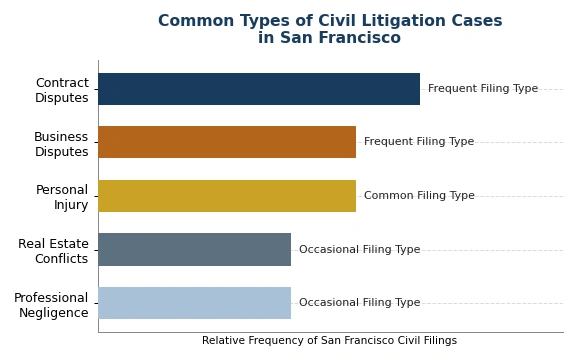
When a dispute specifically involves a company’s operations, ownership, contracts, or commercial relationships, our San Francisco business litigation attorneys handle those business-focused claims in greater depth.
California’s Civil Court System: Where Your Case Gets Filed
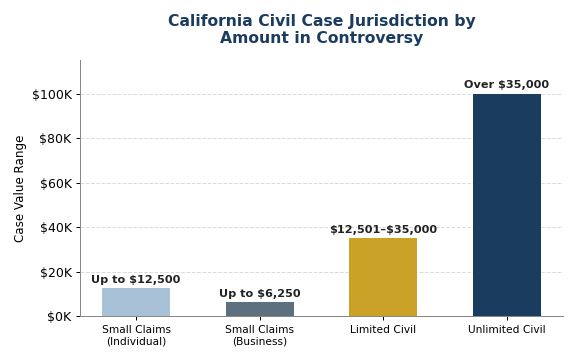
California sorts civil cases by dollar value into three tiers, and where a case gets filed shapes everything from the available procedures to how quickly it moves.
Small claims court handles the simplest, lowest-value disputes without attorneys at the hearing itself, and it caps individual claims at $12,500 and business claims at $6,250. Limited civil cases cover claims between $12,501 and $35,000 and use somewhat simplified procedures compared to a full unlimited case. Unlimited civil cases, for claims above $35,000, allow the full scope of discovery and motion practice, and this is where most significant business, real estate, and personal injury litigation in San Francisco ultimately proceeds. A case filed in the wrong tier can face real consequences later. A personal injury claim filed as limited civil, for example, can find itself capped at $35,000 in recoverable damages even after the true value of the claim becomes clear through discovery, and reclassifying a case mid-litigation adds delay and expense that careful case value assessment at the outset can avoid.
Understanding California’s Statute of Limitations
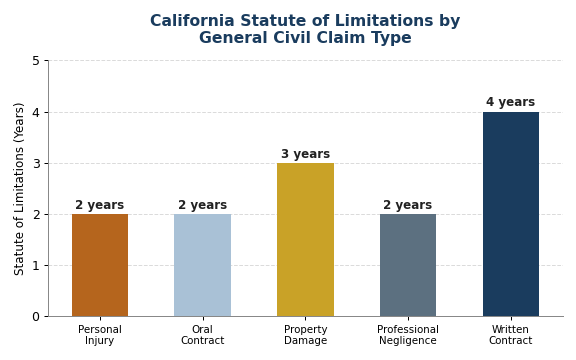
Every type of civil claim in California comes with a filing deadline, and courts dismiss late-filed cases regardless of how strong the underlying facts are.
Personal injury claims generally allow two years from the date of injury under Code of Civil Procedure Section 335.1. Written contract claims allow four years, while oral contract claims allow only two. Property damage claims generally allow three years, and professional negligence claims typically allow two years from when the harm was discovered or reasonably should have been. Certain situations, known as tolling, can pause this clock, such as claims involving a minor or a delayed discovery of harm, but these exceptions apply narrowly and shouldn’t be assumed without confirming they actually fit the facts of a specific case.
For a broader overview of California’s civil litigation system, our California civil litigation lawyer resource explains how civil claims, court procedures, deadlines, and common dispute types are handled statewide.
The Stages of a San Francisco Civil Lawsuit
A civil lawsuit follows a structured path from initial investigation through resolution, and each stage serves a distinct purpose.
- Pre-litigation investigation and a demand letter outlining the alleged wrongdoing and requested resolution
- Filing the complaint and formally serving the defendant so the case can proceed
- The defendant’s answer, which admits or denies the allegations and may raise defenses
- Discovery, where both sides gather evidence through depositions, interrogatories, and document requests
- Motion practice, including potential summary judgment motions asking the court to decide an issue without trial
- Settlement negotiations, which can occur at any point and often intensify once discovery reveals the strength of each side’s position
- Trial, if no settlement is reached, followed by post-trial motions or an appeal if either side challenges the outcome
If you have been served with a lawsuit or need to initiate a civil claim, our San Francisco lawsuit attorneys can provide guidance on the litigation process and available options.
These ranges reflect general patterns rather than a guarantee for any individual case. Court calendar congestion, the volume of discovery required, and how cooperative the opposing party proves to be all affect how quickly a specific matter resolves.
What Damages Can You Recover in a San Francisco Civil Case?
Courts award damages to address losses caused by another party’s conduct, and the available categories depend on the claim and the evidence presented. Economic damages cover measurable losses such as medical bills, lost income, and repair costs, generally supported by records and receipts. Non-economic damages address harder-to-quantify losses like pain and loss of enjoyment of life, though medical malpractice cases fall under MICRA, which places statutory limits on these amounts. Punitive damages, available under Civil Code Section 3294 in cases involving oppression, fraud, or malice, exist to punish and deter particularly serious misconduct rather than simply compensate the injured party.
Evidence and Discovery in Civil Litigation
Evidence forms the backbone of any civil case, and California’s discovery rules give both sides real tools to gather it before trial. Depositions allow attorneys to question witnesses under oath outside of court, while interrogatories and document requests compel the other side to answer written questions and produce relevant records. Electronic discovery, covering text messages, emails, and other digital records, has become a routine part of nearly every modern civil case.
Preserving evidence matters from the earliest stages of a dispute, often before a lawsuit is even filed. Attorneys frequently send preservation letters to opposing parties directing them to retain documents and digital data relevant to an anticipated dispute, since records lost through routine deletion or a system update can be difficult or impossible to recover later.
Alternative Dispute Resolution in San Francisco Civil Cases
Not every civil dispute needs to go all the way through trial. Mediation uses a neutral third party to help both sides work toward a resolution, and many San Francisco courts actively encourage it to reduce cost and court congestion. Arbitration places the dispute before a private decision-maker who issues a binding or non-binding decision depending on the parties’ agreement. ADR tends to work best for cases with relatively clear facts or an ongoing business relationship worth preserving, while litigation remains the better path when a party refuses to negotiate in good faith or the case turns on a genuinely disputed legal question.
Venue and Jurisdiction: Filing in the Right Court
Filing a civil case in the wrong venue can cost real time even when the underlying claim is strong. Venue generally depends on where the defendant resides, where a business defendant’s principal place of business sits, or where the events giving rise to the dispute actually occurred. A contract dispute involving a company headquartered in San Francisco but performed elsewhere, for instance, can raise a legitimate question about whether San Francisco Superior Court is even the correct venue, and a defendant can move to transfer a case filed in the wrong place.
Jurisdiction over a defendant is a separate question from venue. California courts generally have personal jurisdiction over anyone who resides in the state or a business that transacts substantial activity here, but suing an out-of-state individual or company can require showing a sufficient connection between that party’s conduct and California before the case can proceed against them here.
Suing or Defending Against a Business Entity
Civil disputes in San Francisco frequently involve a corporation, LLC, or partnership rather than an individual, and that distinction affects how a case unfolds. Serving a business entity generally requires delivering the summons and complaint to its registered agent for service of process, a specific person or company on file with the California Secretary of State, rather than simply serving any employee. Piercing the corporate veil, holding individual owners personally liable for a company’s debts or conduct, is possible but requires showing the business was used to perpetrate a fraud or that its corporate separateness was never really respected in the first place, which is a higher bar than simply showing the company caused harm.
Civil Litigation Costs and Attorney Fees
Understanding the cost structure of civil litigation helps clients plan realistically from the outset. Most attorneys in San Francisco civil litigation bill by the hour, though fee arrangements can vary by case type. Court costs, including filing fees, service fees, and transcript expenses, add to the overall cost regardless of the fee arrangement. Under the American Rule, each side generally pays its own attorney fees regardless of outcome, though specific statutes or contract provisions can shift that responsibility to the losing party in certain cases. Weighing the likely cost of litigation against the expected recovery is a routine part of deciding whether, and how aggressively, to pursue a claim.
How Wade Litigation Can Help
Wade Litigation supports San Francisco clients through every stage of civil litigation, from the initial investigation and demand letter through discovery, negotiation, and courtroom advocacy when a case proceeds to trial. Our team focuses on accountability and thorough preparation, whether the dispute involves a contract dispute in the Financial District or a business disagreement in Chinatown.
For matters involving a specific practice area, our San Francisco real estate litigation and San Francisco appeals pages go deeper into the claim-specific rules, deadlines, and strategy that apply to those types of disputes.
Local Resources for San Francisco Civil Litigation
| Resource | Purpose | Contact / Location |
|---|---|---|
| SF Superior Court – Civil Division | Filing and hearings for limited and unlimited civil cases | Civic Center Courthouse, 400 McAllister St, San Francisco, CA 94102 |
| SF Superior Court – Small Claims Division | Filing and hearings for claims up to $12,500 (individuals) or $6,250 (businesses) | Civic Center Courthouse |
| SF Superior Court Self-Help Center | Form assistance for self-represented litigants (no legal advice or advocacy) | Civic Center Courthouse |
| San Francisco Bar Association LRIS | Attorney referral service for residents seeking civil litigation counsel | sfbar.org |
Why Choose Wade Litigation as Your San Francisco Civil Litigation Attorney
Wade Litigation’s founder, Amiel Wade, brings a background as a former San Jose Police Officer to every case, an investigator’s eye for detail that shapes how our attorneys build a record and prepare for negotiation or trial. Clients work directly with attorneys who personally handle case strategy, filings, and courtroom advocacy rather than delegating the matter to unsupervised staff.
For San Francisco individuals and businesses facing a civil dispute, that combination of careful preparation and genuine litigation readiness often shapes whether a case resolves efficiently or drags on longer than it needs to.


FAQs About San Francisco Civil Litigation
Contact a San Francisco Civil Litigation Attorney Today
Civil disputes come with real deadlines, and evidence can become harder to gather the longer a dispute sits unaddressed. Wade Litigation offers steady advocacy and careful preparation tailored to San Francisco’s civil courts, from an initial case evaluation through negotiation, alternative dispute resolution, and trial when it becomes necessary.
Contact Wade Litigation today for a free case evaluation to discuss your San Francisco civil litigation matter.
This page is for general informational purposes only and does not constitute legal advice. Prior results do not guarantee a similar outcome. Contact Wade Litigation directly to discuss the specific facts of your case.