Key Takeaways
- Wade Litigation represents San Francisco business owners and partners in disputes over contracts, partnerships, trade secrets, and unfair competition.
- California generally voids non-compete agreements under Business and Professions Code §16600, so businesses rely on confidentiality and non-solicitation agreements instead.
- Trade secret misappropriation claims under the California Uniform Trade Secrets Act must be filed within three years of discovery.
- Written business contracts allow four years to sue for breach in California, while oral contracts allow only two.
- Mediation and arbitration can resolve many San Francisco business disputes faster and with less disruption to ongoing operations than a full trial.
Business disputes put real pressure on the people who built something with years of work and personal investment. When a partner stops pulling their weight, a competitor misuses confidential information, or a client refuses to pay for completed work, the strain reaches beyond spreadsheets into daily operations and, often, personal relationships. Wade Litigation represents San Francisco business owners and partners through these disputes, from an initial demand letter through mediation, arbitration, and litigation when negotiation fails.
This page covers the business-specific claims and California statutes that come up most often in San Francisco commercial disputes. For general civil procedure, from filing a complaint through discovery and trial, our San Francisco civil litigation attorney can walk you through that process in more depth. For a broader look at business litigation across California, our California business litigation lawyer team provides guidance on the general filing process, applicable case law, and the strategies involved in complex commercial disputes.
What Is Business Litigation?
Business litigation covers legal disputes tied to commercial activity, whether between separate companies or among the owners and partners inside a single business. These conflicts typically surface when an agreement breaks down or when one party claims harm caused by another's conduct, and litigation becomes the structured path forward once private negotiation stops working.
the Wade Litigation difference
Request Your Free Case Evaluation Now!
Common Sources of Business Disputes in San Francisco
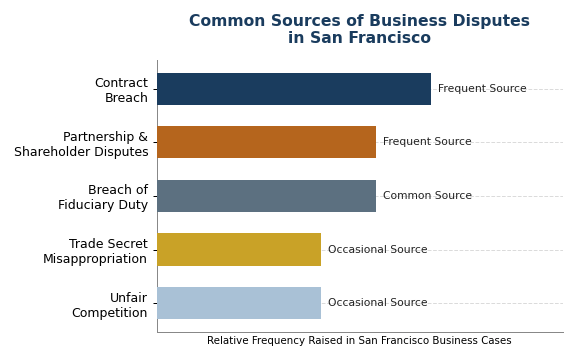
San Francisco's dense concentration of startups, established companies, and professional services firms produces a fairly consistent set of recurring dispute types.
Breach of Contract Claims
Contracts form the backbone of nearly every business relationship, and a breach occurs when one party fails to perform as promised, whether that means a supplier stopping deliveries without justification or a client withholding payment for completed work. Written contracts give courts a clear record of intent and scope, while oral contracts, though enforceable in many situations, become considerably harder to prove without supporting documentation like emails, invoices, or amendments.
An enforceable contract requires an offer, acceptance, consideration exchanged by both sides, and a lawful purpose. Missing any of these elements can weaken or defeat an otherwise reasonable-sounding claim, which is why reviewing the underlying agreement carefully, not just the alleged breach, matters from the outset.
Partnership and Shareholder Disputes
Disagreements among business owners often center on profit distribution, management authority, or the terms of an eventual exit. Tension escalates quickly when one partner feels excluded from key decisions or believes another acted for personal gain at the company's expense, and closely held or family-owned San Francisco businesses see these disputes intensify faster given how personal relationships and business roles tend to overlap.
Breach of Fiduciary Duty
Officers, directors, and partners owe a fiduciary duty of loyalty and care to the business, and sometimes to each other directly. Self-dealing, misuse of company assets, or a secret side arrangement that benefits one owner at the company's expense can all support a breach of fiduciary duty claim, which carries different legal standards than a straightforward contract dispute.
Trade Secrets and Non-Compete Issues in California
California's approach to protecting confidential business information looks different from most other states, largely because the law strongly favors employee mobility even while still protecting legitimate business interests.
Protection Under the California Uniform Trade Secrets Act
Trade secrets, covering formulas, processes, customer lists, and business strategies that derive value from staying confidential, receive protection under CUTSA. The law allows a business to seek both injunctive relief and monetary damages when a competitor or former employee improperly acquires or discloses this information, though a claim must be filed within three years of when the misappropriation was discovered or reasonably should have been.
Non-Compete Agreements Are Generally Void in California
Business and Professions Code Section 16600 voids most agreements that restrain someone from engaging in a lawful profession, trade, or business, with narrow exceptions tied to the sale of a business or its dissolution. This puts California businesses in a different position than companies in most other states: rather than relying on a non-compete to prevent a departing employee from working for a competitor, San Francisco businesses generally have to rely on well-drafted confidentiality and non-solicitation agreements instead, which restrict the use of specific proprietary information and outreach to customers or employees without broadly restricting where someone can work.
Unfair Business Practices Under Business and Professions Code Section 17200
California's Unfair Competition Law, commonly cited as Section 17200, reaches unlawful, unfair, or fraudulent business practices, including deceptive advertising, misuse of confidential information, or conduct that distorts fair competition in a given market. Because the statute defines unfair competition broadly, it often gets pleaded alongside a more specific claim like breach of contract or trade secret misappropriation, and courts can order both a change in conduct and repayment of improperly obtained funds under this law.
Business Dissolution and Buy-Out Disputes
Not every business dispute involves an ongoing relationship both sides want to preserve. When partners or shareholders can no longer work together, the dispute often shifts to how the business winds down or how one owner buys out another. California law and most partnership or operating agreements provide a process for valuing a departing owner's interest, but disagreements over that valuation, or over whether a dissolution is even warranted, frequently end up in litigation.
Minority shareholders in a closely held corporation have specific statutory protections against oppressive conduct by majority owners, including the right to seek a buyout of their shares in certain circumstances rather than being forced to remain in a business relationship that has broken down. These disputes tend to move faster than typical contract litigation once filed, since an ongoing, contested ownership structure creates operational uncertainty that neither side usually wants to prolong.
Statute of Limitations for Business Claims in California
Each type of business claim carries its own filing deadline, and courts generally dismiss late-filed claims regardless of merit.
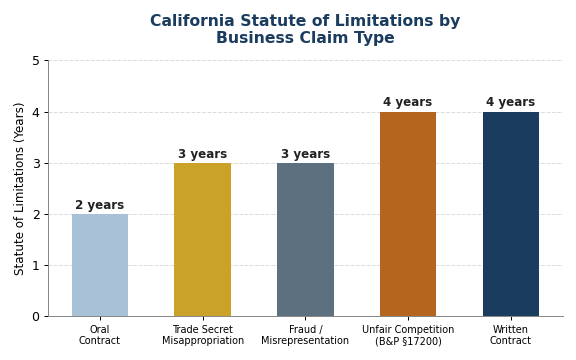
Written contract claims generally allow four years to file, while oral contract claims allow only two. Fraud and misrepresentation claims generally allow three years from discovery, matching the same three-year discovery-based deadline that applies to trade secret misappropriation claims under CUTSA. Unfair competition claims under Section 17200 generally allow four years. Certain circumstances, such as a defendant temporarily leaving the state, can toll these deadlines, but these exceptions apply narrowly and shouldn't be assumed without confirming they fit the specific facts at hand.
Resolving a San Francisco Business Dispute: Timeline and Process
Most business disputes move through a similar general sequence, starting with a demand letter that outlines the claim and requested resolution. When that doesn't prompt a reasonable response, the matter can move to mediation or arbitration, which many San Francisco commercial contracts require or at least encourage before litigation, or proceed directly to a filed complaint if the contract doesn't require ADR first.
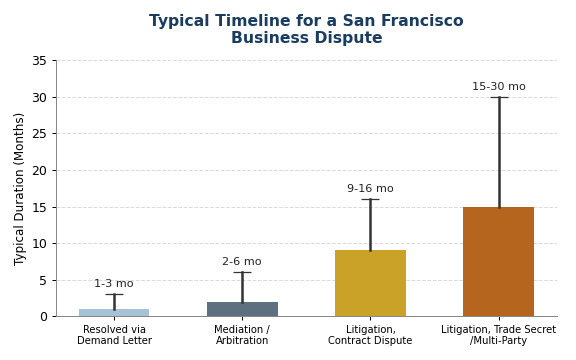
These ranges reflect general patterns rather than a guarantee for any individual dispute. The number of parties involved, how much discovery the case requires, and whether expert testimony on damages or trade secret valuation becomes necessary all affect how long a specific matter takes.
Alternative Dispute Resolution for Business Disputes
Mediation involves a neutral third party who facilitates discussion without deciding the outcome, and it tends to work particularly well for disputes involving an ongoing partnership or a business relationship worth preserving. Arbitration, by contrast, assigns decision-making authority to a private arbitrator whose ruling usually carries binding force, and many San Francisco commercial contracts include a mandatory arbitration clause that both sides agreed to well before any dispute arose. Both options generally move faster and cost less than a full trial, which matters for businesses that need to keep operating while a dispute works its way toward resolution.
What Remedies Are Available in Business Litigation?
Courts have several tools available to address a business dispute once it reaches a ruling.
Compensatory damages address measurable financial harm like lost profits or unpaid amounts, generally supported by financial records and expert analysis. Injunctive relief orders a party to stop specific harmful conduct, such as continuing to use a misappropriated trade secret, while specific performance requires a party to actually fulfill a contractual obligation rather than simply pay damages for failing to do so. Attorney's fees are recoverable in some cases, but generally only when a specific contract clause or statute allows it, since California's default rule requires each side to bear its own legal costs. Punitive damages remain the exception rather than the rule, available only where the evidence shows oppression, fraud, or malice rather than an ordinary business dispute gone wrong.
How Wade Litigation Can Help
Wade Litigation approaches every business dispute by first listening carefully and reviewing the contracts, records, and communications at the center of the disagreement. That early review identifies genuine strengths and risks before significant time and cost go into a case, and it gives clients an honest, practical assessment rather than a rushed recommendation.
From there, our attorneys build cases through detailed document review and targeted discovery, advocate for clients through demand negotiations, mediation, and arbitration, and move a case forward with purpose when the opposing party delays cooperation or refuses a reasonable resolution. Throughout the process, we keep business realities in view, since a legal dispute doesn't pause the need to run day-to-day operations, manage cash flow, and plan for what comes next. And if a business dispute ultimately proceeds to trial and results in an unfavorable judgment, our San Francisco appeals attorney can evaluate whether the ruling can still be challenged.
Local Resources for San Francisco Business Litigation
- SF Superior Court – Civil Division: Filing and hearings for business litigation matters. Civic Center Courthouse, 400 McAllister St, San Francisco, CA 94102
- California Secretary of State – Business Search: Verifying registered agents and business entity status for service of process. sos.ca.gov/business-programs
- SF Superior Court Self-Help Center: Form assistance for self-represented litigants (no legal advice or advocacy). Civic Center Courthouse
- San Francisco Bar Association LRIS: Attorney referral service for businesses seeking litigation counsel. sfbar.org
Why Choose Wade Litigation as Your San Francisco Business Litigation Attorney
Wade Litigation's founder, Amiel Wade, brings a background as both a former San Jose Police Officer and in-house counsel, a combination that shapes a disciplined, practical approach to business disputes from both the litigation and the operational side. Clients work directly with attorneys who personally handle case strategy and negotiation rather than delegating the matter to unsupervised staff.
For San Francisco business owners and partners facing a contract dispute, a partnership disagreement, or a trade secret concern, that combination of practical business judgment and genuine litigation readiness often shapes whether a dispute resolves efficiently or drags on longer than the business can comfortably absorb.
FAQs About San Francisco Business Litigation
How much does business litigation cost in California?
Costs vary based on the scope and duration of the case, including how much discovery is required, whether motions are filed, and whether the case proceeds to trial. Clear planning at the outset helps a business budget realistically for what a dispute may require.
Can I resolve my business dispute without going to court?
Many business disputes resolve through negotiation, mediation, or arbitration, particularly when both sides participate in good faith and there's an ongoing relationship worth preserving. Litigation becomes necessary when one party refuses to engage reasonably or a contract requires it.
What should I do if a business partner is breaching our agreement?
Document the conduct carefully and review the governing agreement before taking further steps. Early legal guidance helps assess realistic options, which can range from a demand letter and negotiation to filing a formal claim depending on the severity and nature of the breach.
Can my business enforce a non-compete agreement in California?
Generally no. Business and Professions Code Section 16600 voids most agreements that restrain someone from working in a lawful profession, with narrow exceptions tied to the sale or dissolution of a business. Confidentiality and non-solicitation agreements remain the primary tools available instead.
How do I protect my business from unfair competition or trade secret theft?
Strong confidentiality agreements, clear internal policies restricting access to sensitive information, and prompt legal action when misuse is discovered all help deter misconduct and preserve a business's legal options if litigation becomes necessary.
What happens if I miss the statute of limitations deadline?
Courts generally dismiss late-filed claims regardless of their underlying merit. Speaking with an attorney as soon as a dispute arises helps confirm the applicable deadline and evaluate whether any tolling exception might realistically apply.
What is the difference between a breach of contract claim and a breach of fiduciary duty claim?
A breach of contract claim addresses a failure to perform specific obligations under a written or oral agreement. A breach of fiduciary duty claim addresses a violation of the broader duty of loyalty and care that officers, directors, or partners owe to a business, which can exist independent of any specific contract term.
Can I recover attorney's fees if I win my business litigation case?
Only in specific circumstances. California's default rule under the American Rule requires each side to pay its own attorney's fees, but a contract's fee-shifting clause or a specific statute can allow the prevailing party to recover fees from the other side.
Should I involve an attorney before sending a demand letter to a business partner?
Involving an attorney early often strengthens a demand letter's effectiveness, since it signals the claim is being taken seriously and helps ensure the letter accurately reflects the legal grounds for the dispute rather than just a one-sided account of events.
What happens if my business partner wants to dissolve the company and I don't?
The governing partnership or operating agreement usually sets out the process for dissolution or a buyout of one owner's interest. When the parties disagree over valuation or whether dissolution is warranted at all, minority owners in a closely held business may have statutory protections against oppressive conduct by majority owners, including the potential right to seek a buyout rather than being forced to remain in an unworkable relationship.
Contact a San Francisco Business Litigation Attorney Today
Business disputes rarely improve with delay. Evidence can become harder to gather, trade secret claims can run against a fixed discovery-based deadline, and informal arrangements between partners can solidify into something harder to unwind the longer they go unaddressed.
Wade Litigation represents San Francisco business owners and partners through contract disputes, partnership disagreements, trade secret claims, and unfair competition matters. Contact Wade Litigation today for a free case evaluation to discuss your San Francisco business dispute.
the Wade Litigation difference
Request Your Free Case Evaluation Now!
This page is for general informational purposes only and does not constitute legal advice. Prior results do not guarantee a similar outcome. Contact Wade Litigation directly to discuss the specific facts of your case.