Key Takeaways
- Wade Litigation represents San Francisco parents in custody disputes ranging from agreed parenting plans to contested cases involving evaluations and relocation requests.
- California courts decide custody based on the child’s best interests under Family Code §3011, not on either parent’s preference alone.
- San Francisco requires parents in a contested custody dispute to attend mediation through Family Court Services before a judge will hear the matter.
- Modifying an existing custody order requires showing a material change in circumstances since the order was issued.
- Relocation and out-of-state jurisdiction disputes are governed by California’s version of the UCCJEA, which generally requires six months of residency to establish a child’s home state.
Few legal disputes carry more weight than a custody case. The outcome shapes where a child lives, who makes decisions about their schooling and health care, and how much time each parent gets on a day-to-day basis. In San Francisco, where co-parents often navigate different neighborhoods, school districts, and demanding work schedules across the tech and finance sectors, a custody arrangement has to work in practice, not just on paper.
Wade Litigation represents San Francisco parents through every stage of a custody matter, from drafting an initial parenting plan to litigating a contested case involving a custody evaluation or a relocation request. For a broader look at how California courts approach custody generally, our statewide child custody resource covers the standards courts apply in more depth. We approach every case with the same goal: protecting a client’s relationship with their child while building an arrangement that holds up over time.

How California Courts Decide Custody in San Francisco
Family Code Section 3011 requires San Francisco family court judges to base every custody decision on the best interests of the child, not on either parent’s personal preference. Judges weigh a range of factors before issuing an order, and no single factor automatically controls the outcome.
- The health, safety, and welfare of the child above all other considerations
- The nature and quality of the child’s existing relationship with each parent
- Each parent’s ability to provide a stable home environment, including housing and caregiving capacity
- Any history of abuse by either parent against the child, the other parent, or other family members
- The child’s own wishes, when the child is mature enough for the court to consider them
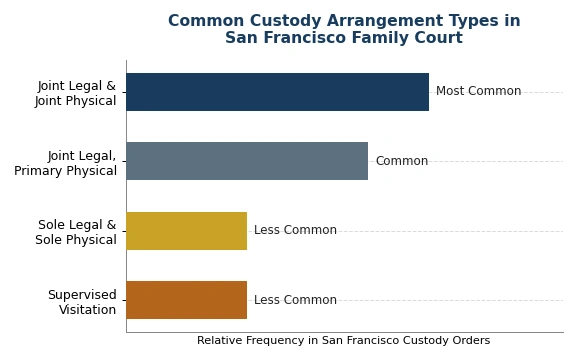
Legal custody and physical custody are evaluated separately. Legal custody covers the authority to make decisions about a child’s health, education, and general welfare. Physical custody determines where the child primarily lives day to day. Courts can award either type jointly or solely to one parent, and the two designations do not have to match, meaning a parent can share legal custody while having a smaller share of physical custody time.
Custody Evaluations in San Francisco
When parents cannot agree and the dispute is significant, the court may order a custody evaluation. A neutral evaluator, either a Family Court Services counselor or a private evaluator appointed under Evidence Code Section 730, interviews both parents, observes interactions with the child where appropriate, and may speak with teachers, therapists, or other relevant parties before submitting a written recommendation to the court.
Evaluations add time and cost to a case, but they also give the court a more complete picture than either parent’s testimony alone can provide. Preparing for an evaluation matters: how a parent communicates about the other parent, documentation of caregiving involvement, and consistency in the child’s routine all factor into what an evaluator ultimately reports.
Modifying an Existing Custody Order
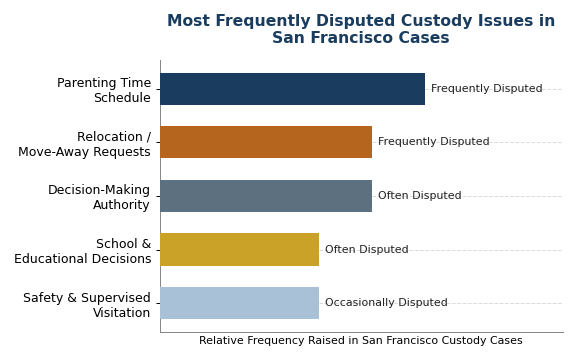
Custody orders are not permanent. A parent seeking to modify an existing order must show a material change in circumstances since the order was issued, such as a significant shift in a parent’s work schedule, a change in the child’s needs, safety concerns that have newly arisen, or a parent’s relocation. The process begins with filing a Request for Order along with supporting documentation, after which the court schedules a hearing to evaluate whether a modification is warranted.
Minor adjustments to a parenting schedule can sometimes be handled by agreement between the parents without returning to court, but any change to legal custody, primary physical custody, or a substantial change in parenting time generally requires a new or amended order to be enforceable.
Relocation and Move-Away Cases
When a parent with primary physical custody wants to move a meaningful distance, whether across the Bay Area or out of state, the other parent can object, triggering what California courts call a move-away case. Courts weigh the reason for the move, the child’s relationship with each parent, the distance involved, and the practical impact on the existing custody schedule. These cases move quickly once filed, since delay affects both the moving parent’s plans and the child’s stability.
Building a Parenting Plan That Actually Works
A parenting plan is the detailed document that translates a custody order into day-to-day practice: which parent has the child on which days, how holidays and school breaks are divided, how decisions get made about school and medical care, and what happens when the regular schedule needs to change for a work trip or a family event. Courts generally prefer that parents reach their own parenting plan rather than have one imposed after a contested hearing, since an agreement both parents helped design tends to hold up better over time.
A workable plan addresses the predictable friction points before they become disputes: how pickup and drop-off logistics work when parents live in different neighborhoods, how school breaks and SFUSD’s academic calendar factor into the schedule, how far in advance a parent must request a schedule change, and how the parents will communicate about the child’s needs without routing every small decision through email disputes or, worse, back through court. The more specific a plan is on these points, the less room there is for later disagreement about what the order actually requires.
Holiday and vacation schedules deserve particular attention. Many San Francisco parenting plans alternate major holidays year to year and set aside blocks of vacation time each parent can claim with advance notice, which avoids the recurring conflict of negotiating the same disputed dates every single year.
San Francisco Custody Mediation: What to Expect
Before a judge will hear a contested custody matter in San Francisco, the parents must attend mediation through Family Court Services. A trained mediator meets with both parents, separately or together depending on the circumstances, to try to develop a workable parenting plan. If the parents reach agreement, that plan typically becomes the basis for the court’s order.
When no agreement results, San Francisco’s recommending mediation model allows the mediator to submit a written recommendation to the assigned judge. That recommendation carries real weight, which makes preparing for mediation, not just the eventual hearing, an important part of building a strong custody case.
Jurisdiction, Interstate Custody, and Relocation Across State Lines
Custody disputes involving a parent who has moved out of California, or a child who has recently moved to California, raise jurisdiction questions governed by the Uniform Child Custody Jurisdiction and Enforcement Act, adopted in California as part of the Family Code. Under the UCCJEA, a child’s home state generally requires six months of residency, and California courts will typically defer to another state’s custody order if that state still has proper jurisdiction under the Act.
These jurisdictional questions can determine whether a state court has the authority to modify an existing order at all, which makes them worth raising early in any custody matter involving out-of-state parents or a recent move.
San Francisco Custody Timelines
How quickly a custody matter resolves depends heavily on whether the parents can agree and whether the court orders an evaluation. An agreed parenting plan can be finalized in a matter of weeks, while a contested case involving a full evaluation or a relocation dispute can take the better part of a year.
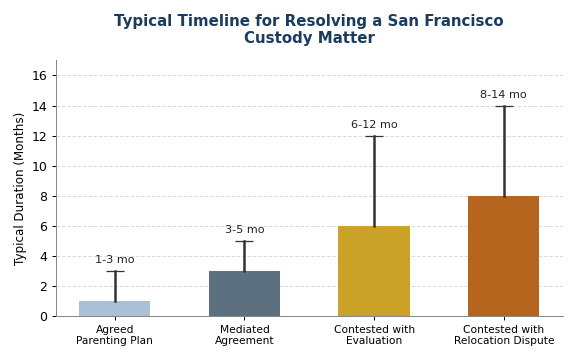
These ranges reflect general patterns rather than a guarantee for any individual case. Court calendar congestion, whether an evaluation is ordered, and how quickly both parents comply with mediation and disclosure requirements all affect how long a specific matter takes.
How Domestic Violence Affects Custody Decisions
When credible evidence of domestic violence exists, San Francisco family courts weigh it heavily in custody decisions, and specific statutory presumptions can apply depending on the timing and nature of the finding. Safety concerns can lead to supervised visitation, restrictions on decision-making authority, or, in some cases, a temporary or permanent restraining order that directly affects the custody schedule. This is a fact-specific area of family law, and the details of how a domestic violence finding interacts with a custody order are covered in depth on our San Francisco family law attorney page.
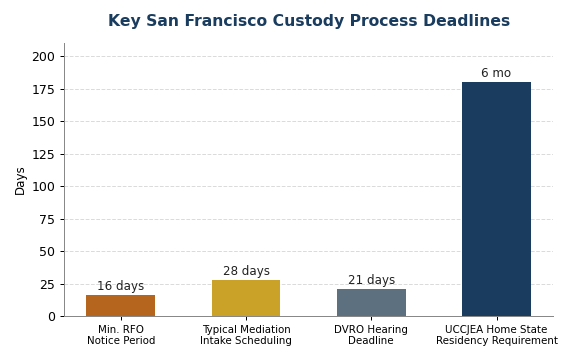
These figures reflect general statutory and procedural minimums under California law and San Francisco Superior Court practice. Specific deadlines can shift based on how a case is served, whether good cause is shown, or local court scheduling.
Local Considerations for San Francisco Co-Parents
Custody arrangements that look reasonable on paper sometimes fail in practice because they don’t account for how families actually live in San Francisco. Parents working in the city’s tech and finance sectors often have unpredictable travel schedules, and co-parents living in different neighborhoods, or commuting via Muni, BART, or across the Bay, need parenting schedules that realistically account for pickup and drop-off logistics. SFUSD’s school calendar and enrollment deadlines also shape how holiday and school-year schedules should be structured, particularly when parents are weighing a request to change a child’s school assignment.
We build parenting plans around these practical realities rather than defaulting to a generic template, because a schedule that looks fair on paper but breaks down every time work travel or a Muni delay gets in the way tends to generate exactly the kind of conflict that leads families back into court. If a custody matter is part of a broader San Francisco civil litigation dispute, that process is covered in more depth on our related page.
Local Resources for San Francisco Custody Matters
- SF Superior Court – Unified Family Court: Filing, hearings, and case management for custody matters. Civic Center Courthouse, 400 McAllister St, San Francisco, CA 94102
- SF Family Court Services: Mandatory mediation for contested custody and visitation disputes. Civic Center Courthouse
- SF Superior Court Self-Help Center: Form assistance for self-represented litigants (no legal advice or advocacy). Civic Center Courthouse
- Superior Court of California – Child Custody & Visitation Self-Help: State-level guidance on custody and visitation procedures. sf.courts.ca.gov/self-help/child-custody-visitation
- San Francisco Bar Association LRIS: Attorney referral service for residents seeking custody counsel. sfbar.org
- San Francisco Unified School District (SFUSD): School calendar and enrollment information relevant to custody scheduling. sfusd.edu
Why Choose Wade Litigation as Your San Francisco Child Custody Attorney
Custody cases require a different kind of judgment than a straightforward financial dispute. Wade Litigation’s founder, Amiel Wade, has been recognized as a Top Ten California Family Law Attorney by the National Academy of Family Law Attorneys, and our approach to custody matters reflects that same combination of thorough preparation and courtroom readiness.
Each client works with a dedicated liaison who provides case updates and answers procedural questions, while our attorneys handle every strategic decision, mediation session, and courtroom appearance personally. For San Francisco parents facing an initial custody determination, a modification request, or a relocation dispute, that structure gives clients a clear plan and a steady advocate throughout a process that can otherwise feel unpredictable.
FAQs About San Francisco Child Custody
Key Takeaways
- Wade Litigation represents San Francisco parents in custody disputes ranging from agreed parenting plans to contested cases involving evaluations and relocation requests.
- California courts decide custody based on the child’s best interests under Family Code §3011, not on either parent’s preference alone.
- San Francisco requires parents in a contested custody dispute to attend mediation through Family Court Services before a judge will hear the matter.
- Modifying an existing custody order requires showing a material change in circumstances since the order was issued.
- Relocation and out-of-state jurisdiction disputes are governed by California’s version of the UCCJEA, which generally requires six months of residency to establish a child’s home state.
Few legal disputes carry more weight than a custody case. The outcome shapes where a child lives, who makes decisions about their schooling and health care, and how much time each parent gets on a day-to-day basis. In San Francisco, where co-parents often navigate different neighborhoods, school districts, and demanding work schedules across the tech and finance sectors, a custody arrangement has to work in practice, not just on paper.
Wade Litigation represents San Francisco parents through every stage of a custody matter, from drafting an initial parenting plan to litigating a contested case involving a custody evaluation or a relocation request. For a broader look at how California courts approach custody generally, our statewide child custody resource covers the standards courts apply in more depth. We approach every case with the same goal: protecting a client’s relationship with their child while building an arrangement that holds up over time.
How California Courts Decide Custody in San Francisco
Family Code Section 3011 requires San Francisco family court judges to base every custody decision on the best interests of the child, not on either parent’s personal preference. Judges weigh a range of factors before issuing an order, and no single factor automatically controls the outcome.
- The health, safety, and welfare of the child above all other considerations
- The nature and quality of the child’s existing relationship with each parent
- Each parent’s ability to provide a stable home environment, including housing and caregiving capacity
- Any history of abuse by either parent against the child, the other parent, or other family members
- The child’s own wishes, when the child is mature enough for the court to consider them
Legal custody and physical custody are evaluated separately. Legal custody covers the authority to make decisions about a child’s health, education, and general welfare. Physical custody determines where the child primarily lives day to day. Courts can award either type jointly or solely to one parent, and the two designations do not have to match, meaning a parent can share legal custody while having a smaller share of physical custody time.
Custody Evaluations in San Francisco
When parents cannot agree and the dispute is significant, the court may order a custody evaluation. A neutral evaluator, either a Family Court Services counselor or a private evaluator appointed under Evidence Code Section 730, interviews both parents, observes interactions with the child where appropriate, and may speak with teachers, therapists, or other relevant parties before submitting a written recommendation to the court.
Evaluations add time and cost to a case, but they also give the court a more complete picture than either parent’s testimony alone can provide. Preparing for an evaluation matters: how a parent communicates about the other parent, documentation of caregiving involvement, and consistency in the child’s routine all factor into what an evaluator ultimately reports.
Modifying an Existing Custody Order
Custody orders are not permanent. A parent seeking to modify an existing order must show a material change in circumstances since the order was issued, such as a significant shift in a parent’s work schedule, a change in the child’s needs, safety concerns that have newly arisen, or a parent’s relocation. The process begins with filing a Request for Order along with supporting documentation, after which the court schedules a hearing to evaluate whether a modification is warranted.
Minor adjustments to a parenting schedule can sometimes be handled by agreement between the parents without returning to court, but any change to legal custody, primary physical custody, or a substantial change in parenting time generally requires a new or amended order to be enforceable.
Relocation and Move-Away Cases
When a parent with primary physical custody wants to move a meaningful distance, whether across the Bay Area or out of state, the other parent can object, triggering what California courts call a move-away case. Courts weigh the reason for the move, the child’s relationship with each parent, the distance involved, and the practical impact on the existing custody schedule. These cases move quickly once filed, since delay affects both the moving parent’s plans and the child’s stability.
Building a Parenting Plan That Actually Works
A parenting plan is the detailed document that translates a custody order into day-to-day practice: which parent has the child on which days, how holidays and school breaks are divided, how decisions get made about school and medical care, and what happens when the regular schedule needs to change for a work trip or a family event. Courts generally prefer that parents reach their own parenting plan rather than have one imposed after a contested hearing, since an agreement both parents helped design tends to hold up better over time.
A workable plan addresses the predictable friction points before they become disputes: how pickup and drop-off logistics work when parents live in different neighborhoods, how school breaks and SFUSD’s academic calendar factor into the schedule, how far in advance a parent must request a schedule change, and how the parents will communicate about the child’s needs without routing every small decision through email disputes or, worse, back through court. The more specific a plan is on these points, the less room there is for later disagreement about what the order actually requires.
Holiday and vacation schedules deserve particular attention. Many San Francisco parenting plans alternate major holidays year to year and set aside blocks of vacation time each parent can claim with advance notice, which avoids the recurring conflict of negotiating the same disputed dates every single year.
San Francisco Custody Mediation: What to Expect
Before a judge will hear a contested custody matter in San Francisco, the parents must attend mediation through Family Court Services. A trained mediator meets with both parents, separately or together depending on the circumstances, to try to develop a workable parenting plan. If the parents reach agreement, that plan typically becomes the basis for the court’s order.
When no agreement results, San Francisco’s recommending mediation model allows the mediator to submit a written recommendation to the assigned judge. That recommendation carries real weight, which makes preparing for mediation, not just the eventual hearing, an important part of building a strong custody case.
Jurisdiction, Interstate Custody, and Relocation Across State Lines
Custody disputes involving a parent who has moved out of California, or a child who has recently moved to California, raise jurisdiction questions governed by the Uniform Child Custody Jurisdiction and Enforcement Act, adopted in California as part of the Family Code. Under the UCCJEA, a child’s home state generally requires six months of residency, and California courts will typically defer to another state’s custody order if that state still has proper jurisdiction under the Act.
These jurisdictional questions can determine whether a state court has the authority to modify an existing order at all, which makes them worth raising early in any custody matter involving out-of-state parents or a recent move.
San Francisco Custody Timelines
How quickly a custody matter resolves depends heavily on whether the parents can agree and whether the court orders an evaluation. An agreed parenting plan can be finalized in a matter of weeks, while a contested case involving a full evaluation or a relocation dispute can take the better part of a year.
These ranges reflect general patterns rather than a guarantee for any individual case. Court calendar congestion, whether an evaluation is ordered, and how quickly both parents comply with mediation and disclosure requirements all affect how long a specific matter takes.
How Domestic Violence Affects Custody Decisions
When credible evidence of domestic violence exists, San Francisco family courts weigh it heavily in custody decisions, and specific statutory presumptions can apply depending on the timing and nature of the finding. Safety concerns can lead to supervised visitation, restrictions on decision-making authority, or, in some cases, a temporary or permanent restraining order that directly affects the custody schedule. This is a fact-specific area of family law, and the details of how a domestic violence finding interacts with a custody order are covered in depth on our San Francisco family law attorney page.
These figures reflect general statutory and procedural minimums under California law and San Francisco Superior Court practice. Specific deadlines can shift based on how a case is served, whether good cause is shown, or local court scheduling.
Local Considerations for San Francisco Co-Parents
Custody arrangements that look reasonable on paper sometimes fail in practice because they don’t account for how families actually live in San Francisco. Parents working in the city’s tech and finance sectors often have unpredictable travel schedules, and co-parents living in different neighborhoods, or commuting via Muni, BART, or across the Bay, need parenting schedules that realistically account for pickup and drop-off logistics. SFUSD’s school calendar and enrollment deadlines also shape how holiday and school-year schedules should be structured, particularly when parents are weighing a request to change a child’s school assignment.
We build parenting plans around these practical realities rather than defaulting to a generic template, because a schedule that looks fair on paper but breaks down every time work travel or a Muni delay gets in the way tends to generate exactly the kind of conflict that leads families back into court. If a custody matter is part of a broader San Francisco civil litigation dispute, that process is covered in more depth on our related page.


Local Resources for San Francisco Custody Matters
- SF Superior Court – Unified Family Court: Filing, hearings, and case management for custody matters. Civic Center Courthouse, 400 McAllister St, San Francisco, CA 94102
- SF Family Court Services: Mandatory mediation for contested custody and visitation disputes. Civic Center Courthouse
- SF Superior Court Self-Help Center: Form assistance for self-represented litigants (no legal advice or advocacy). Civic Center Courthouse
- Superior Court of California – Child Custody & Visitation Self-Help: State-level guidance on custody and visitation procedures. sf.courts.ca.gov/self-help/child-custody-visitation
- San Francisco Bar Association LRIS: Attorney referral service for residents seeking custody counsel. sfbar.org
- San Francisco Unified School District (SFUSD): School calendar and enrollment information relevant to custody scheduling. sfusd.edu
Why Choose Wade Litigation as Your San Francisco Child Custody Attorney
Custody cases require a different kind of judgment than a straightforward financial dispute. Wade Litigation’s founder, Amiel Wade, has been recognized as a Top Ten California Family Law Attorney by the National Academy of Family Law Attorneys, and our approach to custody matters reflects that same combination of thorough preparation and courtroom readiness.
Each client works with a dedicated liaison who provides case updates and answers procedural questions, while our attorneys handle every strategic decision, mediation session, and courtroom appearance personally. For San Francisco parents facing an initial custody determination, a modification request, or a relocation dispute, that structure gives clients a clear plan and a steady advocate throughout a process that can otherwise feel unpredictable.
FAQs About San Francisco Child Custody
Take Action by Consulting a San Francisco Child Custody Attorney Today
Custody matters rarely improve with delay. Informal arrangements can solidify into a pattern the court expects to continue, and windows to raise safety concerns or request an evaluation can close as a case moves forward. Working with an experienced San Francisco child custody attorney early helps protect a parent’s relationship with their child and their position going into mediation or a hearing.
Wade Litigation represents San Francisco parents through initial custody determinations, modification requests, and relocation disputes. Contact Wade Litigation today for a free case evaluation to discuss your San Francisco custody matter.
This page is for general informational purposes only and does not constitute legal advice. Prior results do not guarantee a similar outcome. Contact Wade Litigation directly to discuss the specific facts of your case.