Wade Litigation represents spouses throughout Los Angeles County in every stage of a divorce, from filing through judgment. This page explains how divorce works in Los Angeles and across California, covering who can file, the legal process from filing through judgment, how long a divorce typically takes, how child custody and support are decided, how property and debt are divided, and what a divorce generally costs, all from the perspective of the California divorce lawyer team at Wade Litigation. Call (888) 705-5059 for a free case evaluation.
When a relationship ends, deciding where children will live and who will make important decisions about their upbringing is often the most emotional part of the process. We know that custody disputes touch every part of a family's life, from daily routines to long-term decisions about school, healthcare, and religion. When a divorce involves children or other family-law issues, our Los Angeles family law attorney team can help clients address the broader legal issues alongside the divorce itself. This guide walks through how child custody works in Los Angeles County, what the courts consider, and how we approach these cases for the families we represent.
What Does It Mean to Get a Divorce in Los Angeles?
In California, the legal word for divorce is dissolution. Dissolution is the court process that ends a marriage or domestic partnership, and it is separate from legal separation and annulment, which we describe below. Once a divorce is final, the parties are no longer married, and a judge will have made decisions about issues such as property, debts, spousal support, and, if there are children involved, custody, visitation, and child support.
One spouse does not need the other spouse's agreement to file for divorce in Los Angeles, and California is a no-fault state, which means the person filing does not need to prove wrongdoing. A spouse can ask for a divorce for any reason, including simply stating that irreconcilable differences have caused the marriage to break down.
We also want to acknowledge that divorce can be especially difficult, and sometimes unsafe, when domestic violence or abuse is present in a relationship. Domestic violence is not limited to physical harm. It can include threats, stalking, controlling shared finances, or attempts to isolate a spouse from family and friends. If you are in immediate danger, please call 911. Free, confidential support is also available 24/7 through the National Domestic Violence Hotline, even if you have not yet filed for divorce. Safety concerns can affect custody, visitation, who remains in the family home, and how papers are served, and the court can issue special orders to help protect you and your children.
Who Can File for Divorce in Los Angeles?
Before a Los Angeles divorce case can begin, California law requires one spouse to meet residency requirements. According to the California Courts Self-Help Center, to start a divorce case in California, one spouse must have:
- Lived in California for the last six months, and
- Lived in their current California county, such as Los Angeles County, for the last three months
There are some additional considerations for same-sex couples and registered domestic partners. If neither spouse meets these residency requirements yet, a spouse can either wait until the requirement is met or begin with a legal separation and later amend the case to ask for a divorce once residency requirements are satisfied.
Your Options for Ending a Marriage in California
Divorce is just one way to end a marriage or domestic partnership. Depending on your situation, one of these related options may fit better:
- Divorce: The most common way to end a marriage in Los Angeles. One spouse starts the case and the other responds, and the spouses do not need to agree on every issue to move forward.
- Divorce by joint petition: A newer process where both spouses file together and agree, or expect to agree, on issues like property and parenting. This option can involve fewer steps, though the mandatory waiting period still applies.
- Summary dissolution: A faster, simpler, and less costly process for couples who have been married less than five years, do not have children together, and do not have significant property or debt.
- Legal separation: Allows a court to divide property and issue orders about money or parenting without ending the marriage. This can be useful for spouses who are not yet eligible to divorce or who do not want to divorce for personal or religious reasons.
- Annulment: A legal finding that a marriage was never valid in the first place, typically due to circumstances like fraud, bigamy, or lack of legal capacity to consent.
The Los Angeles Divorce Process, Step by Step
While every case is different, most Los Angeles divorces move through the same general stages. We walk clients through each of these steps and help them understand what to expect along the way.
- File your petition. The case begins when one spouse (or both, in a joint petition) files the required forms with the Los Angeles Superior Court, including a petition that identifies the issues to be resolved, such as property, support, and custody.
- Serve your spouse. Unless the case is filed as a joint petition, the responding spouse must be formally served with the petition and given an opportunity to respond, typically within 30 days.
- Exchange financial disclosures. Both spouses must exchange a full and accurate list of their income, assets, debts, and expenses. These disclosures are required even in an uncontested case, and incomplete or delayed disclosures are one of the most common reasons cases stall.
- Try to reach an agreement. Many issues can be resolved through negotiation or mediation rather than a trial. Reaching an agreement on property, support, and parenting can significantly shorten the overall timeline.
- Go to court, if needed. If spouses cannot agree on every issue, a judge will decide the disputed issues after reviewing evidence and hearing from both sides, which may involve one or more hearings.
- Finalize your divorce. Once all forms are complete and any agreement or court order is in place, the final paperwork is submitted to the court. A judge reviews the forms, and if everything is in order, signs the judgment that states the exact date the marriage ends.
the Wade Litigation difference
Request Your Free Case Evaluation Now!
How Long Does a Divorce Take in Los Angeles?
Under Family Code section 2339, a judgment of dissolution cannot be entered until at least six months have passed from the date the responding spouse was served with the petition, or the date the respondent formally appeared in the case, whichever happens first. This six-month period is a minimum, not a target, and it applies whether or not the spouses agree on every issue.
In practice, most Los Angeles divorces take considerably longer than six months. The Los Angeles Superior Court's family law division handles an extremely high volume of cases, and hearing dates are often scheduled months in advance. When you add in the time it can take to exchange financial disclosures, negotiate a settlement, or resolve disputes over custody or property, a contested Los Angeles divorce can easily take a year or more from start to finish. Uncontested cases with a full agreement in place can sometimes finalize close to the six-month mark, though local processing times still play a role.
Understanding Divorce and Marriage Trends in California and the U.S.
It can help to see how divorce fits into broader national and state trends. The data below comes from the CDC's National Center for Health Statistics (NCHS), which tracks marriage and divorce rates using state-reported data.
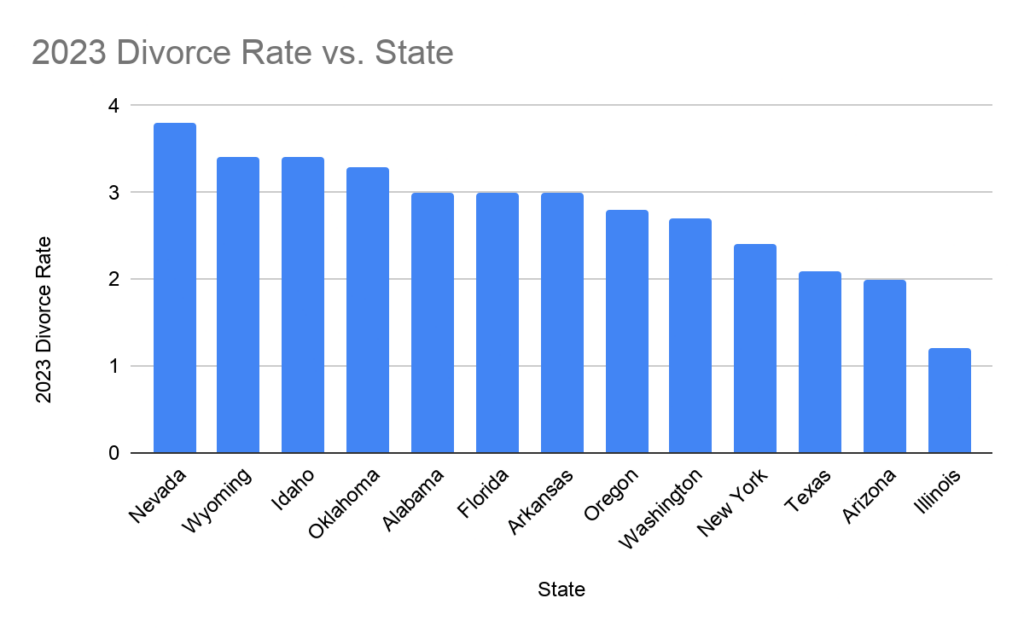
2023 Divorce Rate by State Source: CDC/NCHS, Divorce rates by State: 1990, 1995, and 2000-2023. California is not shown because it does not report divorce statistics to the NCHS.
As the chart above shows, divorce rates vary widely from state to state, with several states reporting rates well above 3 per 1,000 residents in 2023. California does not report detailed divorce statistics to the CDC, so a direct state-level comparison is not available. This is a common source of confusion, since many national "divorce rate" statistics people see online exclude California entirely.
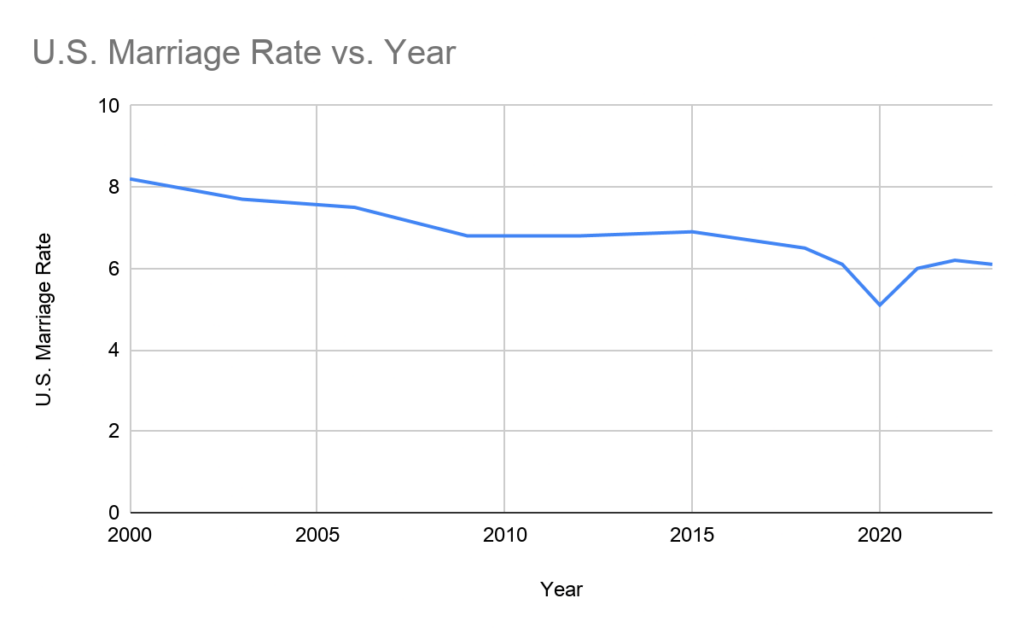
U.S. Marriage Rate Trend, 2000-2023 Source: CDC/NCHS, National marriage and divorce rate trends, 2000-2023.
Nationally, the marriage rate has trended downward since 2000, with a sharp, temporary dip in 2020 during the pandemic before partially recovering. Fewer marriages over time, combined with generational shifts in when and whether people marry, are part of the broader social context behind divorce trends, even though they do not tell us how many marriages end in divorce in any given year.
Common Reasons Los Angeles Divorces Take Longer Than Expected
Beyond the mandatory waiting period, several recurring factors tend to extend how long a Los Angeles divorce actually takes. We see these issues come up again and again in our practice.
- Incomplete or missing financial disclosures. Both spouses must exchange a full and accurate list of income, assets, debts, and expenses. When disclosures are late, incomplete, or appear inaccurate, the case often stalls while the missing information is tracked down, sometimes through formal discovery requests.
- Disagreements over child custody and visitation. Custody disputes often require mediation, a custody evaluation, or input from Family Court Services before a judge is ready to decide. In our experience, custody disagreements are frequently the single largest source of delay in an otherwise straightforward case.
- Disputes over property and debt. Disagreements about how to characterize or value a home, retirement account, or business often require appraisals, forensic accounting, or expert testimony, all of which add time.
- Court backlogs and scheduling delays. Los Angeles County family courts handle an extremely high volume of cases, and hearing dates are often set months in advance, with continuances pushing things back further.
- One spouse refusing to cooperate or respond. If a spouse ignores the petition, avoids discovery requests, or declines to participate, additional filings and hearings are often necessary before the case can move forward.
- Ongoing settlement negotiations. Not every delay is procedural. Reaching a fair resolution on support, custody, and property can simply take time, especially when significant assets or strong disagreements are involved.
- Complex or high-value estates. Cases involving multiple properties, business interests, or stock options typically require more discovery, more expert valuations, and more detailed negotiation than a straightforward divorce.
Child Custody and Visitation in a Los Angeles Divorce
When parents cannot agree on a parenting plan, California courts decide custody and visitation based on the best interests of the child. Judges consider factors such as each parent's ability to care for the child, the child's health and safety, and, depending on the child's age, the child's own wishes.
California law distinguishes between legal custody, which is the right to make decisions about a child's health, education, and welfare, and physical custody, which addresses where the child lives day to day. Either type of custody can be awarded solely to one parent or shared jointly between both parents. Our Los Angeles child custody lawyer team handles these disputes as their own dedicated practice, whether or not they arise alongside a divorce filing.
Los Angeles County offers Family Court Services to help parents work through custody disagreements, and many judges require mediation before a contested custody hearing. We generally encourage parents to try to reach their own parenting agreement whenever it is safe to do so, since parents who work out their own arrangements tend to have more workable, durable plans than those imposed after a contested hearing.
Child Support and Spousal Support Basics
California calculates child support using a statewide guideline formula that accounts for both parents' incomes, the amount of time each parent spends with the child, and certain deductions and expenses, such as health insurance and childcare. Because the formula is set by statute, child support amounts are generally more predictable than other issues in a divorce. Our Los Angeles child support attorney team can walk you through how the guideline calculation applies to your income and timeshare specifically.
Spousal support works differently. Temporary support during the case is often based on a formula, but long-term spousal support after judgment is decided using a broader set of factors, including the length of the marriage, each spouse's earning capacity, the standard of living established during the marriage, and each spouse's age and health. As a general guideline, judges often look to roughly half the length of the marriage as a starting point for support duration in shorter marriages, while marriages of 10 years or longer can result in the court retaining jurisdiction over support indefinitely.
Dividing Property and Debt: California's Community Property Rules
California is a community property state. Under Family Code section 2550, the court must generally divide the community estate equally between the spouses unless they agree otherwise in writing. Community property generally includes income earned and assets acquired during the marriage, while separate property generally includes assets owned before the marriage, inheritances, and gifts to one spouse.
In practice, dividing property is rarely as simple as splitting everything down the middle. Common issues we help clients work through include:
- Determining whether the family home, or the equity in it, is community property, separate property, or a mix of both
- Dividing retirement accounts and pensions earned during the marriage, which often requires a specialized court order
- Valuing a business or professional practice that one or both spouses own or operate
- Allocating credit card, mortgage, and other debts accumulated during the marriage
What Does a Los Angeles Divorce Cost?
The cost of a Los Angeles divorce varies widely depending on how the case is handled. Every California Superior Court charges an initial filing fee to open a family law case, and this fee is typically several hundred dollars, though it can vary somewhat and is subject to change, so we always recommend confirming the current fee with the court clerk. Spouses who cannot afford the fee may qualify for a fee waiver.
Filing fees are usually a small part of the overall cost. Attorney's fees tend to be the largest expense in a contested case, and they are directly tied to how much time a case requires. Several factors tend to drive costs up, including:
- Contested custody or visitation disputes that require hearings, evaluations, or extensive negotiation
- Business valuations, real estate appraisals, or forensic accounting for complex estates
- Extensive discovery required because a spouse is uncooperative or disclosures are incomplete
- Multiple court appearances caused by continuances or unresolved disputes
Couples who can agree on the major issues, or who are willing to work through mediation, generally spend significantly less than those who litigate every disputed issue in court.
Domestic Violence and Safety During a Divorce
Safety has to come first. If domestic violence is part of your situation, California courts can issue a domestic violence restraining order, which can address custody, visitation, who stays in the family home, and contact between spouses. A spouse does not need to have already filed for divorce to request a restraining order. Our Los Angeles restraining order attorneys handle these requests as a standalone matter or alongside a pending divorce case.
If you are in immediate danger, please call 911. Free, confidential support is also available 24/7 through the National Domestic Violence Hotline, whether or not you have filed for divorce yet. We work closely with clients to help them understand their options and to request appropriate protective orders as part of a divorce case when needed.
Practical Tips for Navigating Your Los Angeles Divorce
Based on what we see work well for clients, we suggest keeping the following in mind as you move through the process:
- Start gathering financial documents, such as tax returns, pay stubs, and account statements, as early as possible
- Consider mediation for issues where you and your spouse are likely to reach common ground
- Keep your children's routines and wellbeing at the center of custody discussions whenever possible
- Respond to requests for information promptly to avoid unnecessary delays
- Work with an experienced family law attorney who can help you understand your rights and avoid common pitfalls
How Wade Litigation Can Help
We understand that divorce affects nearly every part of a client's life, from finances and housing to parenting and long-term security. From the beginning of our representation, we focus on identifying the issues most likely to slow a case down and addressing them early, rather than waiting for problems to surface later.
- We help clients gather and organize financial disclosures promptly and accurately
- We pursue mediation or settlement discussions when appropriate to resolve disputes efficiently
- We monitor court deadlines and filings closely to help avoid unnecessary continuances
- We advocate for custody and support arrangements that reflect our clients' families and circumstances
- We keep clients informed at every stage so they understand what is happening and why
Every client working with our firm is also assigned a client liaison who is available to answer questions and help resolve issues as they arise, so our clients are never left wondering about the status of their case. If your Los Angeles divorce has been delayed, or you are just getting started and want to understand your options, we invite you to reach out to Wade Litigation for a free case evaluation.
Uncontested vs. Contested Divorce in Los Angeles
Whether a Los Angeles divorce is contested or uncontested has more impact on cost and timeline than almost any other factor. An uncontested divorce means the spouses agree on every issue, including property division, support, and custody, and the case moves through the court largely as a formality once the paperwork and waiting period are satisfied. A contested divorce means one or more issues remain unresolved and may require exchanges of formal discovery, settlement conferences, or a trial before a judge decides the outstanding issues.
Many Los Angeles divorces start out contested and become uncontested as the case progresses and spouses narrow their disagreements through negotiation. We often see couples resolve the majority of their issues, leaving only one or two disputed points, such as a specific custody schedule or the value of a particular asset, for the court to decide. Narrowing the issues in dispute, even if a full agreement is not possible, can meaningfully reduce the time and expense of a case.
Mediation vs. Litigation: Choosing the Right Approach
Not every disputed issue in a Los Angeles divorce needs to be decided by a judge. Mediation allows spouses to work with a neutral third party to negotiate their own resolution on issues like custody, support, and property division. Because the spouses control the outcome, mediated agreements often better reflect each family's specific needs, and the process is typically faster and less expensive than litigating the same issues in court.
Litigation becomes necessary when spouses cannot reach an agreement, when there is a significant power imbalance between the spouses, or when one spouse is unwilling to negotiate in good faith. In these situations, a judge reviews the evidence presented by both sides and issues a ruling on the disputed issues. Litigation provides important protections when negotiation is not realistic, but it generally takes longer and costs more than a negotiated resolution.
In many cases, we recommend a hybrid approach: attempting mediation on issues where agreement seems achievable, while preserving the right to litigate any issue that cannot be resolved through negotiation. This approach lets our clients avoid unnecessary court involvement without giving up their right to a fair hearing on the issues that matter most.
Dividing Retirement Accounts and Other Complex Assets
Retirement accounts earned during the marriage, including 401(k) plans, pensions, and certain government retirement benefits, are generally considered community property and must be divided as part of a Los Angeles divorce. Dividing most employer-sponsored retirement plans requires a separate court order, often called a Qualified Domestic Relations Order, which instructs the plan administrator on how to split the account without triggering early withdrawal penalties or unnecessary tax consequences.
Other complex assets require their own specialized handling. Stock options and restricted stock units that vest over time may be partly community property and partly separate property, depending on when they were granted and when they vest. Business interests often require a formal valuation to determine what the community's share is worth, particularly when one spouse will keep operating the business after the divorce. When a divorce involves ownership disputes or other litigation concerning a closely held company, a Los Angeles business litigation attorney may also be needed to address issues outside the divorce proceeding. Real property, including rental properties or vacation homes, may require an appraisal to determine current value before it can be divided or bought out.
Because mistakes in dividing these assets can be costly and difficult to fix later, we work closely with financial professionals when a case involves retirement accounts, stock compensation, or business interests, to make sure our clients understand the true value of what is being divided.
Modifying Custody, Support, or Property Orders After Divorce
A finalized divorce judgment does not necessarily mean every issue is settled forever. Child custody, visitation, and child support orders can generally be modified later if there has been a significant change in circumstances, such as a parent relocating, a substantial change in either parent's income, or a change in the child's needs as they get older. Courts will only modify custody or support if the requested change is consistent with the child's best interests.
Spousal support orders can also sometimes be modified, particularly if the original order did not waive the right to seek a modification. Common reasons to request a change include a significant change in either spouse's income, retirement, or remarriage of the spouse receiving support. Property division, by contrast, is generally final once the judgment is entered, except in limited circumstances such as fraud, mistake, or an asset that was not disclosed during the divorce.
If your circumstances have changed since your Los Angeles divorce was finalized, we can help you evaluate whether a modification is likely to succeed and, if so, guide you through the process of requesting one.
Choosing the Right Los Angeles Divorce Attorney
Los Angeles has no shortage of family law attorneys, which can make choosing the right one feel overwhelming. We believe a few factors matter most when selecting representation for a divorce.
- Experience with cases similar to yours, whether that involves complex property, business interests, or contested custody
- Clear communication about your case status, timeline, and likely costs, rather than vague reassurances
- A team that is comfortable both negotiating a settlement and, when necessary, litigating in front of a judge
- A genuine focus on your goals and your family's wellbeing, rather than an incentive to prolong the case
At Wade Litigation, we measure our success by the satisfaction of our clients and the strength of our results, and we work to make sure every client understands what to expect at each stage of their Los Angeles divorce.
Special Considerations: Military and Same-Sex Divorce in Los Angeles
Military divorce cases in Los Angeles can involve additional considerations, including how military retirement benefits are divided, compliance with servicemember protections that may pause certain proceedings while a spouse is deployed, and jurisdictional questions when one spouse is stationed outside California. These cases often require coordination with federal rules that do not apply in a typical civilian divorce.
California recognizes marriage equality, and same-sex spouses generally go through the same divorce process as any other married couple. That said, couples who registered a domestic partnership before marrying, or whose relationship began before marriage was legally available to them, may face unique questions about when the relationship legally began for purposes of property division and support. We help same-sex couples navigate these issues based on the specific history of their relationship.
Preparing for Your First Meeting with a Divorce Attorney
Coming prepared to an initial consultation can help you get more value from the conversation and give your attorney a clearer picture of your situation from the start. It can help to bring recent tax returns, pay stubs, and account statements, a list of significant assets and debts, and a summary of any custody or parenting concerns. It is also helpful to write down your goals and questions in advance, since consultations can feel overwhelming, and having them in writing makes it easier to make sure everything gets addressed.
You do not need to have every document organized perfectly before reaching out. Part of our role is to help you identify what is missing and to guide you through gathering the rest as your case moves forward. The most important step is simply starting the conversation so we can understand your situation and help you evaluate your options.
How Divorce Can Affect Your Taxes and Estate Plan
Divorce affects more than custody and property. It also has consequences for your taxes and long-term financial planning that are easy to overlook in the middle of an emotional and stressful process. For example, filing status changes once a divorce is final, spousal support treatment under current federal tax law depends on when the divorce agreement was signed, and dividing certain assets, such as investment accounts or a family home, can carry capital gains implications depending on how the division is structured.
Divorce is also a good time to review your estate plan. Most people name their spouse as a beneficiary on life insurance policies, retirement accounts, and wills, and as an agent under powers of attorney or healthcare directives. These designations do not automatically update when a divorce is filed, and in some cases they do not automatically update even after the divorce is final. Our Los Angeles probate lawyer team routinely advises divorce clients to update beneficiary designations, powers of attorney, and estate planning documents as soon as it is appropriate to do so, so that outdated designations do not create problems for their families later.
We are not tax or estate planning professionals, and we work alongside accountants and estate planning attorneys when a case calls for it, but we make sure our clients understand these issues exist so that nothing important falls through the cracks during the divorce process.
Frequently Asked Questions
How long does it take to get a divorce in Los Angeles?
California law requires a minimum of six months from the date the other spouse is served before a divorce can be finalized. In practice, most Los Angeles cases take longer than six months, and contested cases involving custody or property disputes can take a year or more.
Do I need my spouse's agreement to file for divorce?
No. California is a no-fault state, and one spouse can file for divorce without the other spouse's agreement or without proving wrongdoing.
What are the residency requirements to file in Los Angeles?
At least one spouse must have lived in California for the last six months and in Los Angeles County, or their current county, for the last three months before filing.
How is property divided in a California divorce?
California is a community property state, which generally means assets and debts acquired during the marriage are divided equally, while separate property owned before the marriage, or received as a gift or inheritance, typically stays with the spouse who owns it.
How is child custody decided in Los Angeles?
Courts decide custody based on the best interests of the child. Parents are encouraged to reach their own agreement, and Los Angeles County offers Family Court Services and mediation to help parents work through disputes before a contested hearing.
Can I get divorced if my spouse won't respond to the paperwork?
Yes. If a properly served spouse does not respond within the required time, the filing spouse can generally request a default judgment, which allows the case to move forward without the other spouse's participation.
Should I hire a divorce attorney, or can I handle it myself?
Simple, uncontested cases with little property or no children are sometimes handled without an attorney, but most people benefit from experienced representation, particularly when custody, support, property, or a business interest is involved. An attorney can also help you avoid procedural mistakes that add delay.
Will I have to go to court for my Los Angeles divorce?
Not necessarily. Many issues can be resolved through negotiation or mediation without a court appearance. However, if you and your spouse cannot agree on custody, support, or property division, you will likely need to attend one or more hearings so a judge can decide the disputed issues.
Can I change my divorce agreement after it becomes final?
Custody, visitation, and child support orders can generally be modified if circumstances have significantly changed. Spousal support may also be modifiable depending on the terms of your judgment. Property division, however, is typically final once the judgment is entered, except in limited circumstances such as fraud or an undisclosed asset.
What is the difference between legal separation and divorce?
A legal separation allows a court to divide property, debts, and custody, and to issue support orders, but it does not end the marriage. This means neither spouse is free to remarry. A divorce accomplishes the same financial and parenting outcomes while also legally ending the marriage. Some spouses choose legal separation first, for personal, religious, or insurance-related reasons, and later convert the case to a divorce.
What happens if my spouse and I own a business together?
A business started or grown during the marriage is typically treated as community property, even if only one spouse's name is on the paperwork. Dividing a business usually requires a professional valuation, and spouses can choose to sell the business and split the proceeds, have one spouse buy out the other's interest, or, in some cases, continue co-owning the business after the divorce, though that arrangement can be difficult in practice.
Talk to a Los Angeles Divorce Lawyer Today
Every case is different, and general information can only take you so far when your family's future is on the line. Whether you are just starting to consider filing, have already been served, or are looking to modify an existing order, we encourage you to reach out to our team for a free case evaluation. Call (888) 705-5059 today.
We will listen to your situation, explain your realistic options under California law, and help you build a clear plan for protecting your finances, your children, and your future throughout the process. This page will be updated periodically to reflect changes in California family law, court procedure, and the data referenced above.
the Wade Litigation difference
Request Your Free Case Evaluation Now!
Sources & References
This page references publicly available legal and statistical information, including:
- California Courts Self-Help Center, "Divorce in California" and related divorce process pages, selfhelp.courts.ca.gov
- California Family Code, sections 2339 and 2550, leginfo.legislature.ca.gov
- Centers for Disease Control and Prevention, National Center for Health Statistics, "Divorce rates by State: 1990, 1995, and 2000-2023," cdc.gov/nchs
- Centers for Disease Control and Prevention, National Center for Health Statistics, "National marriage and divorce rate trends for 2000-2023," cdc.gov/nchs
This page provides general information about California divorce law and does not constitute legal advice. Laws, fees, and procedures referenced here are subject to change. For guidance on your specific situation, please contact a licensed attorney.