Our Los Angeles family law attorneys represent clients in divorce, child custody, child support, spousal support, domestic violence, and prenuptial agreement matters governed by the California Family Code. We work alongside our California family law attorney team statewide, with local knowledge of Los Angeles County’s courts built in.
California is a no-fault divorce state, which means neither spouse has to prove wrongdoing to end a marriage. Community property is generally divided equally, child custody is decided based on the best interest of the child standard, and child support follows a statewide guideline formula.
Los Angeles County operates one of the largest family court systems in the country, so working with an attorney who knows local judges, courthouses, and procedures can significantly affect the outcome of a case. Wade Litigation provides confidential consultations for residents throughout Los Angeles County at (866) 784-2624.
Why Los Angeles Families Need Experienced Legal Representation
Family law cases touch every part of a person’s life at once: finances, parenting time, housing, and emotional well-being. When a marriage ends, or a custody dispute arises in Los Angeles, the outcome often shapes the next decade of a family’s life, not just the next few months.
Because California family law is detailed and procedural, small missteps in paperwork, deadlines, or financial disclosures can carry consequences that last for years.
A Los Angeles family law attorney does more than file documents. A skilled attorney evaluates the facts of a case, anticipates how a judge is likely to view the evidence, and builds a strategy designed around a client’s specific goals, whether that means protecting a business, securing more parenting time, or reaching a fast and fair settlement.
Because Los Angeles County includes dozens of courthouses and hundreds of judicial officers, local experience often matters as much as legal knowledge. Attorneys who regularly appear before the same judges and court commissioners understand what evidence carries weight, how long a given department typically takes to rule, and which negotiation tactics tend to succeed.
Los Angeles County recorded tens of thousands of divorce filings last year alone, and thousands more parents modified custody or support orders during the same period. Understanding how the system works, and what the data shows about outcomes, can help families make more informed decisions from the very first consultation.

How the Los Angeles County Family Law Court System Works
The Los Angeles County Superior Court is one of the largest unified trial court systems in the world, with family law matters handled across multiple courthouses, including the Central District, San Fernando Valley, Long Beach, Pasadena, Pomona, and other regional locations. Each courthouse has its own family law departments, local procedures, and filing requirements, and each judicial officer may run their courtroom slightly differently.
Because the volume of cases is so high, self-represented parties often face long waits for hearing dates and can struggle to navigate local rules that are not always obvious from the Judicial Council’s statewide forms. An attorney who practices regularly in a specific courthouse knows which judges prefer detailed written declarations, which departments move faster through discovery disputes, and how local family court services and mediation programs operate.
California’s Family Code governs the substantive rules that apply in every county, including the no-fault principle for divorce and the community property framework for dividing marital assets.
The Judicial Council of California also publishes statewide caseload data every year showing how many divorce, custody, and support cases move through the system. Family law matters consistently rank among the highest volume case types filed in California courts each year, and Los Angeles County accounts for a large share of that volume simply because of its population size.
Most family law departments also require parties to attend Family Court Services for a child custody recommending counseling session before a judge will rule on contested custody issues. Understanding these procedural steps in advance, and preparing the right documentation before a hearing, often makes the difference between a quick resolution and months of delay.
Divorce and Legal Separation Under California Law
California is a no-fault divorce state, which means a spouse does not need to prove misconduct such as adultery or cruelty to end a marriage. Either spouse may file for dissolution simply by stating that the marriage has suffered an irreconcilable breakdown.
To file for divorce in Los Angeles County, at least one spouse must have lived in California for the six months immediately before filing and in the county where the case is filed for at least three months.
California also imposes a mandatory six-month waiting period from the date the divorce petition is served before a court can finalize the judgment, even in a fully uncontested case. Because of this rule, no divorce in California can be completed in less than about six months, and cases involving disputes over property, custody, or support routinely take considerably longer.
A divorce is considered contested when the spouses disagree on one or more major issues, such as how to divide property, how much child support or spousal support should be paid, or how custody and visitation should be structured. An uncontested divorce, resolved through a marital settlement agreement, can move through the court system much faster because the parties present the judge with an agreement rather than asking the court to decide disputed issues.
Legal separation follows a similar process to divorce, resolving property division, support, and custody, but it does not end the marriage itself, which means neither spouse is free to remarry. Some couples choose legal separation instead of divorce for religious, insurance, immigration, or personal reasons even though the legal process looks nearly identical. Our Los Angeles divorce attorneys handle both paths and can walk you through which one fits your situation.
National data helps put the scale of divorce in context. According to the Centers for Disease Control and Prevention, the national divorce rate has fallen substantially over the past two decades, from about 4.0 divorces per 1,000 people in 2000 to 2.4 divorces per 1,000 people in 2023, as shown in the chart below.
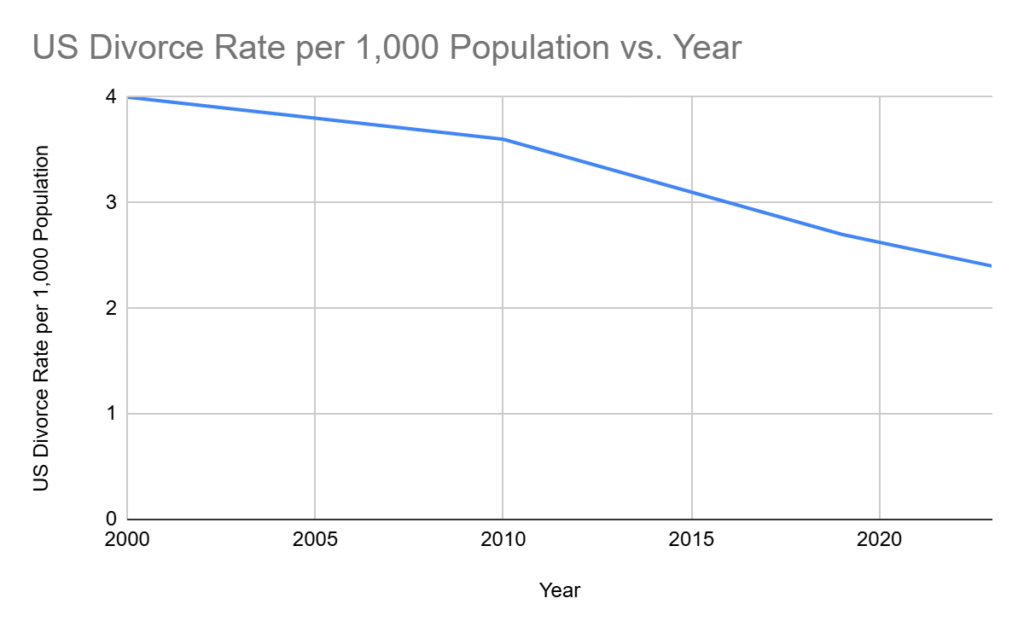
Source: Centers for Disease Control and Prevention, National Center for Health Statistics, FastStats and National Marriage and Divorce Rate Trends, 2000 to 2023.
Despite the declining national rate, Los Angeles County remains the busiest single family court jurisdiction in California simply due to population. Industry analysis of California court filing data indicates Los Angeles County accounted for roughly one quarter of all divorce filings statewide in a recent year, more than any other county in California, as illustrated below.
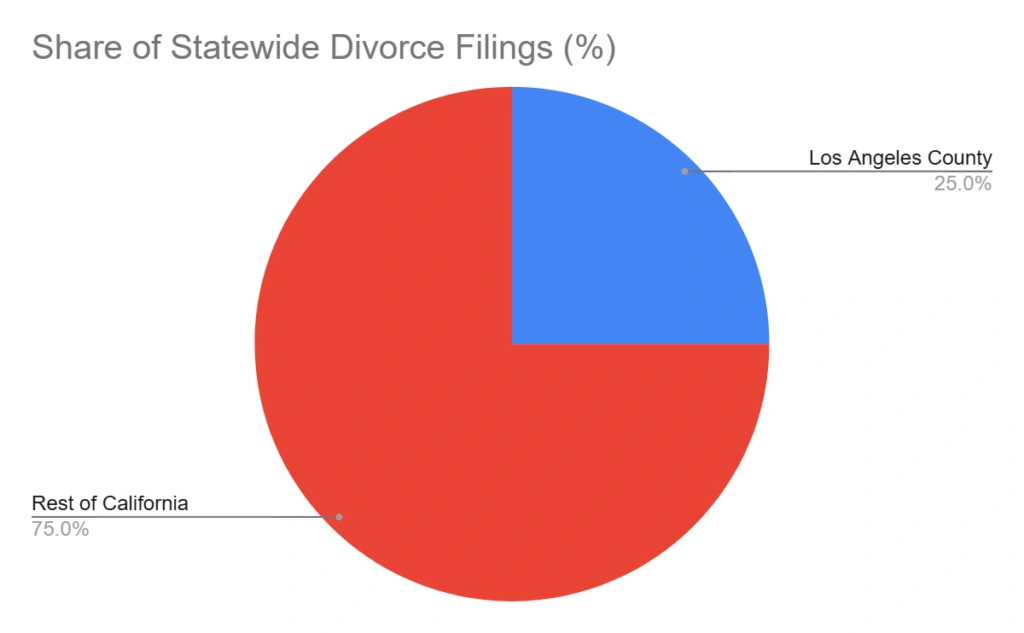
Source: Analysis of Judicial Council of California filing data reported by California family law industry publications, 2024 figures.
Dividing Property in a Los Angeles Divorce
California is a community property state, which generally means that most assets and debts acquired during the marriage belong equally to both spouses, regardless of whose name is on the title or whose income paid for them.
Community property is typically divided equally in a divorce, while property owned before the marriage, gifts, and inheritances usually remain the separate property of the spouse who received them, as long as that property was not commingled with community funds.
Los Angeles is home to a large number of high-net-worth marital estates, including business owners, entertainment industry professionals, real estate investors, and executives with complex compensation packages. Dividing these estates fairly often requires forensic accountants, business valuation experts, and appraisers to determine what an asset is actually worth and whether it should be classified as community or separate property.
Common high-value assets in Los Angeles divorces include closely held businesses and professional practices, commercial and residential real estate portfolios, stock options and restricted stock units, entertainment industry royalties and residuals, and retirement accounts, pensions, and investment portfolios. Dividing a retirement account often requires a Qualified Domestic Relations Order, a specialized court order that allows funds to move between spouses without triggering early withdrawal penalties or unnecessary tax consequences.
One of the more difficult issues in property division is tracing, which involves proving that separate property funds were kept apart from community funds, or showing how commingled funds should be divided. Without careful documentation, a spouse can lose a claim to what would otherwise be separate property. An experienced attorney works with financial professionals early in the case to build a clear record before assets are divided.
Courts also consider whether one spouse’s separate property increased in value because of community labor or funds, a concept known as reimbursement. Business owners in particular should expect the other spouse’s attorney to request detailed financial records going back several years, since a professional practice or company is often the single most valuable, and most contested, asset in a Los Angeles divorce.
Child Custody and Visitation in Los Angeles
California family law separates custody into two categories: legal custody, which is the right to make major decisions about a child’s health, education, and welfare, and physical custody, which determines where the child lives and how time is divided between parents. Either type of custody can be awarded solely to one parent or jointly to both parents. Custody disputes are common enough on their own that we maintain a dedicated Los Angeles child custody lawyer practice for parents who need this as their primary focus, whether or not it’s part of a divorce.
Judges in Los Angeles County decide all custody and visitation questions using the best interest of the child standard set out in the California Family Code. Courts consider factors such as the health, safety, and welfare of the child, any history of abuse by either parent, the nature and quality of each parent’s relationship with the child, and each parent’s ability to cooperate and communicate about the child’s needs. The court does not automatically favor either parent based on gender.
Most contested custody cases in Los Angeles County are first referred to Family Court Services for child custody recommendations, where a court-connected counselor meets with both parents and sometimes the children before making a recommendation to the judge. Many parents settle custody and visitation issues at this stage rather than proceeding to a contested hearing.
Parenting plans typically address a regular timeshare schedule, holiday and vacation schedules, transportation and exchange logistics, and decision making authority for schooling, medical care, and travel. Parents who wish to relocate with a child after a custody order is in place generally must give notice to the other parent and, if the move is contested, ask the court for permission, since relocation can significantly affect the other parent’s ability to maintain a relationship with the child.
Because custody orders can be modified later if circumstances change significantly, keeping thorough records of parenting time, communication, and any safety concerns is valuable well beyond the initial court order.
Child Support Guidelines in California
California uses a statewide guideline formula to calculate child support, primarily based on each parent’s net disposable income and the percentage of time each parent spends with the children. Courts use this formula, sometimes called the income shares model, to produce a presumptively correct support amount, although judges retain some discretion to deviate from the guideline in unusual circumstances, such as a child’s extraordinary medical or educational needs. Our Los Angeles child support attorney team handles both setting and modifying these orders.
Because the calculation depends heavily on accurate income information, disputes often arise over self-employment income, bonuses, stock compensation, or income that a parent may be underreporting. An attorney can request financial records, tax returns, and sometimes a forensic accountant’s review to make sure the court has accurate numbers before setting a support order.
Child support orders can be modified later if a parent’s income changes substantially, if the amount of parenting time changes, or if a child’s needs change. Either parent can request a modification, but the requesting parent must show the court that circumstances have changed enough to justify a new order.
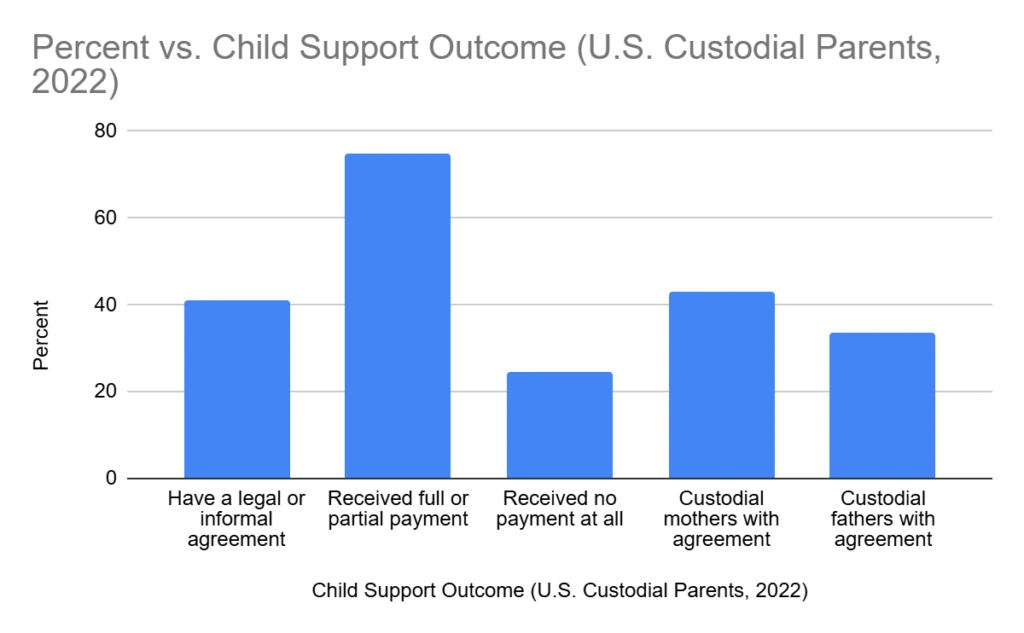
National data from the U.S. Census Bureau illustrates how important a properly calculated and enforced support order can be for families. In the Census Bureau’s most recent Custodial Parents and Their Child Support report, only 41.0 percent of the nation’s 13.9 million custodial parents had a legal or informal child support agreement in place, and about 24.5 percent of parents who were owed support received no payment at all during the year. The chart above breaks down these figures further.
Spousal Support (Alimony) in California
Spousal support, sometimes called alimony, is designed to help a lower-earning spouse maintain a standard of living reasonably comparable to the one enjoyed during the marriage while they become self-supporting after a divorce. Unlike child support, spousal support in California does not follow a rigid mathematical formula for long-term orders, although many Los Angeles courts use a temporary support calculation, often referred to informally as a guideline number, while a case is pending.
For a final spousal support order, judges consider the factors listed in California Family Code section 4320, including the length of the marriage, each spouse’s earning capacity and ability to maintain the marital standard of living, the age and health of both parties, contributions made by one spouse to the other’s education or career, and any history of domestic violence between the parties. Because these factors involve significant judgment, spousal support is one of the most heavily litigated issues in Los Angeles family law cases.
As a general guideline, marriages under ten years often result in support that lasts roughly half the length of the marriage, while longer marriages may result in support that continues indefinitely, subject to later modification or termination. Support can typically be modified or ended if the receiving spouse remarries, if either party’s income changes substantially, or if the receiving spouse fails to make reasonable efforts to become self supporting.
Because spousal support payments can significantly affect both parties’ finances for years, presenting the court with clear and well documented evidence of income, expenses, and earning capacity is one of the most important things a Los Angeles family law attorney can do for a client on either side of a support dispute.
Domestic Violence Restraining Orders
Safety is the first priority in any family law case involving abuse. California law allows a person who has experienced domestic violence to request a Domestic Violence Restraining Order, which can order an abusive partner to stay away from the victim and any children, move out of a shared home, stop contact of any kind, and turn over firearms. A judge can grant a temporary restraining order the same day a request is filed, often before the other party is even notified, followed by a full court hearing within about three weeks where both sides can present evidence. Our Los Angeles restraining order attorneys handle both sides of these petitions.
A restraining order can also affect custody and visitation, since a documented history of domestic violence is one of the factors judges must consider under the best interest of the child standard. Because these orders carry serious legal consequences, including firearm restrictions and a public record, they are sometimes contested by a party who denies the allegations. An experienced attorney can help a person seeking protection present clear evidence, and can also help a falsely accused person defend against unsupported claims.
Anyone in immediate danger should contact law enforcement first. Family law representation becomes important once the immediate safety issue is addressed and the case moves into the court system for a full hearing. Restraining orders in Los Angeles County are handled at dedicated family law courthouses, and violating an active order can result in criminal charges in addition to any family court consequences.


Prenuptial and Postnuptial Agreements
A prenuptial agreement is a contract signed before marriage that defines how property, debt, and sometimes spousal support will be handled if the marriage ends. A postnuptial agreement covers the same topics but is signed after the wedding. Both types of agreements are commonly used in Los Angeles by business owners, entertainment industry professionals, and couples entering a second marriage who want to protect children from a previous relationship.
For a prenuptial or postnuptial agreement to hold up in court, California law requires both parties to fully disclose their finances, sign the agreement voluntarily without pressure or fraud, and have at least seven calendar days between receiving the final agreement and signing it if either party is unrepresented. Courts frequently reject agreements that were signed under pressure, without proper financial disclosure, or without each party having the opportunity to consult independent legal counsel.
A well-drafted agreement can protect a family business, clarify how property acquired during the marriage will be characterized, and reduce the likelihood of a lengthy court battle if the marriage later ends. Because these agreements are frequently challenged years after they are signed, working with an attorney who understands how Los Angeles courts evaluate enforceability is essential.
The Family Law Case Process: Step by Step
Most Los Angeles family law cases move through a similar sequence of stages, although the timeline varies significantly depending on how many issues are contested.
| Stage | What Happens | Typical Timeframe |
|---|---|---|
| Initial Consultation | Attorney reviews the facts, discusses goals, and outlines a strategy | Before filing |
| Filing and Response | One party files a petition, and the other party generally has 30 days to respond | Weeks 1 to 4 |
| Temporary Orders | Either party can request temporary orders for custody, support, or use of property while the case is pending | Weeks 2 to 8 |
| Discovery | Both sides exchange financial disclosures, documents, and sometimes depositions | Months 2 to 8 |
| Negotiation and Mediation | Attorneys, and sometimes a mediator, work toward a settlement agreement | Ongoing throughout the case |
| Trial | If no settlement is reached, the case proceeds to a contested hearing before a judge | Often 12 months or more after filing |
| Judgment | The court enters a final judgment resolving all remaining issues | After settlement or trial |
California’s mandatory six-month waiting period means the fastest possible Los Angeles divorce still takes about half a year, but the vast majority of cases take considerably longer once property division, custody, or support are contested.
Statewide caseload data published by the Judicial Council of California shows that family law cases are among the categories most likely to require more than a year to reach a final resolution in busy counties such as Los Angeles.
How Much Does a Family Law Attorney Cost in Los Angeles?
Family law attorney fees in Los Angeles vary widely depending on experience, case complexity, and whether the matter is contested. Most attorneys bill by the hour, with rates in Los Angeles County commonly ranging from around 350 dollars to 700 dollars per hour depending on the attorney’s experience and the complexity of the case, although rates for highly experienced trial attorneys handling high net worth cases can run higher.
Attorneys typically require an upfront retainer, which is a deposit held in trust and billed against as work is performed.
| Case Type | Typical Fee Structure | General Cost Range |
|---|---|---|
| Simple uncontested divorce | Flat fee or limited scope representation | $1,500 to $5,000 |
| Standard contested divorce | Hourly billing with a retainer | $10,000 to $30,000 |
| High asset or high conflict divorce | Hourly billing, often including outside experts | $30,000 and up |
| Custody modification | Hourly billing or flat fee | $2,000 to $8,000 |
| Restraining order petition or defense | Hourly billing or flat fee | $2,000 to $10,000 |
These figures are general ranges, not quotes, since every case is different. The best way to understand what a specific case is likely to cost is a consultation where an attorney can review the facts and give an honest estimate of the work involved.
Why Choose Wade Litigation
The attorney a person chooses directly affects how a family law case unfolds. Wade Litigation combines courtroom experience, strategic case management, and direct communication to help clients throughout Los Angeles County move through some of the most difficult moments of their lives with confidence.
In-depth knowledge of the Los Angeles County court system. The Los Angeles Superior Court operates dozens of courthouses across the county, each with its own local practices. Wade Litigation’s attorneys appear in these courts regularly and understand the judges, procedures, and unwritten expectations that can shape how a case moves forward.
A strategy built around each client’s goals. Rather than applying a one-size-fits-all approach, Wade Litigation starts by listening to a client’s priorities and concerns, then builds a plan suited to those goals, whether that means a negotiated settlement, mediation, or assertive courtroom advocacy.
Direct and consistent communication. Clients deserve to know the status of their case and have their questions answered promptly. At Wade Litigation, clients work directly with their attorney and receive clear explanations at every stage of the process.
Trial-ready preparation from day one. Wade Litigation always seeks to resolve matters efficiently, but every case is prepared as if it will go to trial. This preparation strengthens a client’s position during settlement negotiations and ensures the firm is ready to fight for a client’s interests in court when a fair agreement cannot be reached.
How to Choose the Right Los Angeles Family Law Attorney
Choosing the right attorney is one of the most important decisions a person makes during a divorce or custody dispute. Because the relationship often lasts many months and involves sensitive personal and financial information, fit and trust matter as much as legal credentials.
Experience in Los Angeles County courts. Ask how often the attorney appears in the specific courthouse where the case will be filed, and whether they have handled cases in front of the judges likely to be assigned. Local familiarity often translates into more realistic advice about timelines and likely outcomes.
Clear fee structure. A reputable attorney explains hourly rates, retainer requirements, and billing practices in writing before representation begins. Clients should understand roughly what a case is likely to cost and how often they will receive invoices.
Communication style. Some clients want frequent updates and direct access to their attorney, while others prefer a more hands-off approach. Discussing communication expectations during the initial consultation helps avoid frustration later in the case.
Trial experience, even for cases likely to settle. Attorneys who are comfortable in a courtroom tend to negotiate from a position of strength, because the other side knows the case can proceed to trial if a fair settlement is not offered.
Most attorneys offer an initial consultation, which is a valuable opportunity to ask direct questions about experience, strategy, and cost before committing to representation.
Modifying Existing Custody, Support, and Divorce Orders
A family law judgment is not always the end of the story. Custody, visitation, child support, and spousal support orders can all be modified later if circumstances change enough to justify a new order. Property division, by contrast, is generally final once a divorce judgment is entered, except in cases involving fraud, duress, or assets that were not disclosed at the time of the original judgment.
Common reasons parents and former spouses return to court include a significant change in either party’s income, a parent’s relocation, a child’s changing school or medical needs, remarriage of the spouse receiving support, or a breakdown in co parenting that requires a clearer custody schedule. Courts generally require the requesting party to show a material change in circumstances since the last order, not simply a preference for different terms.
Modification requests follow a similar process to the original case: a party files a request for order, serves the other party, exchanges updated financial or custody information if relevant, and attends a hearing if the parties cannot agree. Because modification standards can be difficult to meet, particularly for custody orders tied to a full evaluation, working with an attorney to document the changed circumstances clearly often makes a significant difference in the outcome.
Enforcement is a related but separate issue. When one party has simply failed to comply with an existing order, whether that means missed support payments or denied parenting time, the other party does not need to prove changed circumstances. Instead, the case focuses on enforcing the existing order, which can include wage garnishment for support, makeup parenting time, or, in serious cases, contempt of court proceedings.