At Wade Litigation, we help parents throughout Los Angeles navigate legal custody, physical custody, and visitation disputes under California family law. This page covers how courts apply the best interest of the child standard, the difference between joint and sole custody, mediation through Family Court Services, custody evaluations, modifying existing orders, move-away cases, domestic violence considerations, and what to expect from the legal process. We also break down real data on custodial parents and child support enforcement, and explain how our team can advocate for your parental rights from filing through resolution. Call (888) 705-5059 for a free consultation.
When a relationship ends, deciding where children will live and who will make important decisions about their upbringing is often the most emotional part of the process. As a Los Angeles family law firm, we know that custody disputes touch every part of a family's life, from daily routines to long-term decisions about school, healthcare, and religion. This page walks through how child custody works in Los Angeles County, what the courts consider, and how we approach these cases for the families we represent.
Understanding Child Custody in California
Under California law, child custody refers to the rights and responsibilities parents hold for caring for their children. Until a court issues an order, both parents share equal rights to make decisions for their children and to have them in their care. Once we separate or begin a family law case, it becomes important to establish a parenting plan that spells out where the children will live, how decisions will be made, and how time will be shared between both parents.
A parenting plan must reflect what is in the best interest of the children involved. Courts do not automatically favor either parent, and outdated assumptions about mothers or fathers have no place in a modern custody determination. Instead, judges look closely at the specific circumstances of each family.
Legal Custody vs. Physical Custody
California recognizes two distinct types of custody, and understanding the difference is essential before walking into any negotiation or hearing.
Legal custody refers to who has the right and responsibility to make important decisions for the children, including choices about school or childcare, religious upbringing, mental health counseling, medical and dental care, and extracurricular activities.
Physical custody refers to where the children live on a day-to-day basis and who is responsible for their daily care and supervision.
Both legal and physical custody can be shared jointly between parents or awarded solely to one parent, and the two types of custody do not have to match. For example, we regularly help clients reach arrangements where parents share joint legal custody but one parent has primary physical custody with the other receiving a defined visitation schedule.
Joint Custody vs. Sole Custody
With joint legal custody, both parents share the right and responsibility to make important decisions about their children, even if the children primarily live with one parent. With sole legal custody, only one parent holds that decision-making authority. The same joint versus sole distinction applies to physical custody: joint physical custody means the children spend significant time living with both parents, while sole physical custody means the children live primarily with one parent, subject to visitation by the other.
California courts generally favor arrangements that allow children to maintain frequent and continuing contact with both parents whenever it is safe and appropriate to do so. That said, joint physical custody does not have to mean an exact fifty-fifty time split. We often help clients negotiate parenting schedules that reflect work commitments, school schedules, and the practical realities of coordinating two households.
How California Courts Decide Custody: The Best Interest Standard
When parents cannot agree on a parenting plan, a judge will decide based on what is in the best interest of the child. This is the central legal standard in every California custody case, and it gives judges broad discretion to weigh the specific facts in front of them. Factors a judge typically considers include:
- The age and health of the child
- The emotional bond between each parent and the child
- The child's ties to their school, home, and community
- Each parent's ability to care for and provide a stable home for the child
- Any history of family violence between the parents or toward the child
- Any history of ongoing substance abuse by either parent
- The child's own wishes, depending on their age and maturity
No single factor controls the outcome. Judges weigh the full picture, which is why presenting clear, well-organized evidence about your relationship with your child matters so much in these cases.
Types of Visitation and Parenting Time Orders
Visitation, also called parenting time, describes when a child spends time with each parent. There are several types of visitation orders we commonly see in Los Angeles family courts:
- Scheduled visitation: a set schedule with specific dates and times, including holidays and vacations.
- Reasonable visitation: an open-ended order that lets parents work out the details themselves, which can work well when parents communicate effectively.
- Supervised visitation: visits monitored by another adult or professional agency, often used when there are safety concerns or when a parent and child need to reconnect.
- No visitation: used only when visitation, even supervised, would be harmful to the child.
Courts are increasingly incorporating virtual visits, such as video calls, into parenting plans when one parent lives far away or in-person visits are not practical. Virtual visitation can supplement, but rarely fully replaces, in-person parenting time.
The Child Custody Process in Los Angeles County
While every case is different, most custody matters in Los Angeles County move through a similar sequence of steps. Here is what we typically walk our clients through:
- Filing the initial request. Depending on whether you are already married, divorcing, or were never married, you may file a petition for custody as part of a divorce case with a Los Angeles divorce lawyer, a parentage case, or a standalone custody request.
- Serving the other parent. The other parent must be formally served with the request and generally has 30 days to file a response.
- Temporary orders. If immediate arrangements are needed, either parent can request temporary custody and visitation orders while the case is pending.
- Mediation through Family Court Services. In most contested Los Angeles custody cases, parents are required to attend mediation before their court date to try to reach an agreement.
- Hearing or trial. If mediation does not resolve every issue, the judge will hear evidence and arguments before issuing a custody order.
- Final judgment. Once signed, the custody order becomes legally binding on both parents until it is modified by agreement or further court order.
the Wade Litigation difference
Request Your Free Case Evaluation Now!
Mediation and Family Court Services
Los Angeles County Family Court Services provides mediators who help parents try to reach a voluntary custody and visitation agreement before a judge gets involved. Mediation sessions are confidential, and the mediator does not represent either parent. Instead, their role is to help both sides focus on the children's needs and identify workable solutions.
We often encourage clients to approach mediation seriously, even in high-conflict situations, because agreements reached through mediation tend to be more durable than orders imposed after a contested hearing. That said, mediation is not appropriate in every case, particularly where domestic violence is present, and we help our clients understand their rights and options at every stage of this process.
Child Custody Evaluations
In more contested cases, a judge may order a custody evaluation, sometimes called a 730 evaluation after the Evidence Code section that authorizes it. A licensed psychologist or other qualified evaluator interviews both parents, observes interactions with the children, and may speak with teachers, therapists, or other relevant witnesses before submitting a written report and recommendation to the court.
While judges are not required to follow an evaluator's recommendation, these reports carry significant weight. We help our clients prepare for evaluations by making sure they understand what to expect and how to present themselves and their relationship with their children honestly and effectively.
Domestic Violence and Its Impact on Custody
California law includes a rebuttable presumption against awarding sole or joint custody to a parent who has committed domestic violence against the other parent, the children, or certain other family members within the previous five years. This means the abusive parent must present significant evidence to overcome that presumption before receiving custody.
If you or your children have experienced abuse, special protections apply to your case, including the ability to request a domestic violence restraining order alongside your custody request. If you need to seek or defend against a protective order, a Los Angeles restraining order lawyer can help you understand your options. Mediation may also be handled differently, including separate sessions for each parent, and supervised visitation is often used to protect children while still preserving a relationship with the non-custodial parent when appropriate. If safety is a concern, we encourage clients to reach out to us or to a local domestic violence resource immediately.
Custodial Parents in America: What the Data Shows
National data from the U.S. Census Bureau offers useful context for understanding custody arrangements, even though it reflects nationwide trends rather than Los Angeles specifically. As of 2018, mothers made up the large majority of custodial parents nationwide, though the share of custodial fathers has grown over recent decades as courts have moved away from outdated assumptions about parenting roles.
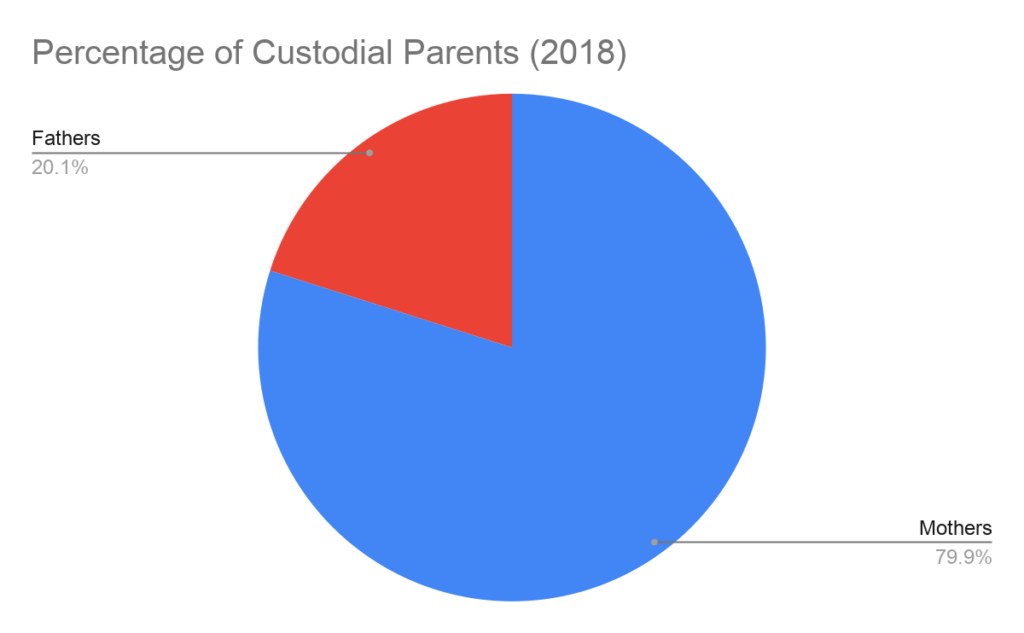
Source: U.S. Census Bureau, Custodial Mothers and Fathers and Their Child Support: 2017 (Report P60-269, issued May 2020).
Child Support and Custody: Why Enforcement Matters
Custody and child support are closely connected, since the non-custodial parent's financial support helps make joint or sole custody arrangements workable for the custodial household. Census Bureau data tracking child support receipt from 1993 through 2017 shows that the share of custodial parents receiving full payment has hovered in the mid-40 percent range for most of the past two decades, with dips during economic downturns.
This data underscores why clear, enforceable custody and support orders matter. When we draft parenting plans and support agreements with our Los Angeles child support attorneys, we build in specific terms designed to reduce the chances of future disputes over missed payments or unclear obligations.
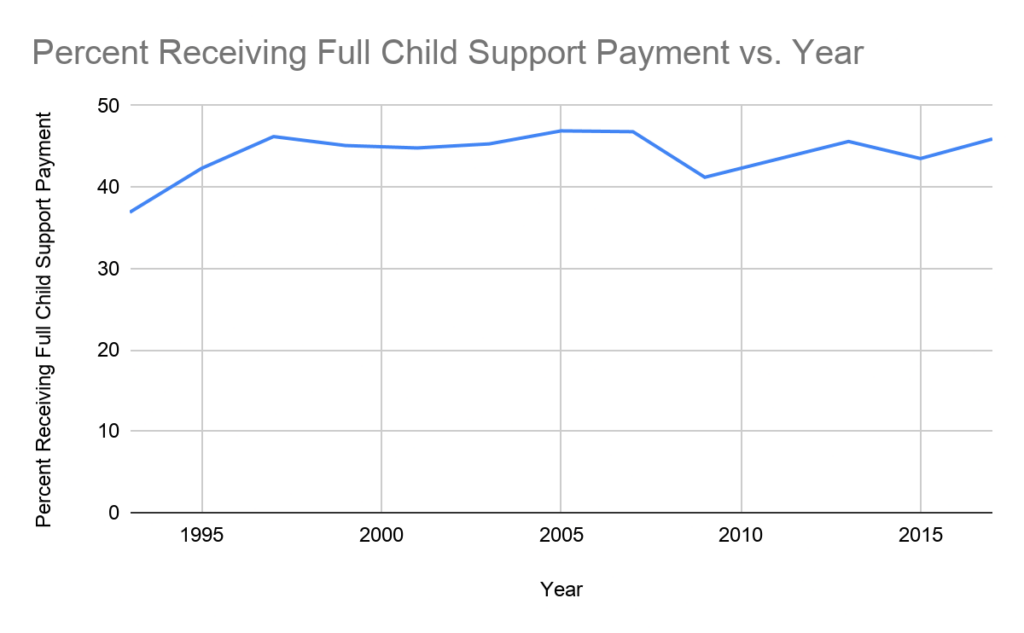
Source: U.S. Census Bureau, Current Population Survey Child Support Supplement, April 1994 to 2018.
Modifying a Custody or Visitation Order
Custody orders are not necessarily permanent. Either parent can request a modification, but the court will generally require a showing of changed circumstances since the last order, such as a parent relocating, a change in the child's needs, concerns about safety, or a significant change in either parent's work schedule or living situation.
Courts are generally reluctant to disrupt a working custody arrangement without good reason, since stability is considered important for children. We help clients evaluate whether their situation truly rises to the level of a substantial change and, if so, build the strongest possible case for modification.
Relocation and "Move-Away" Cases
Move-away cases arise when a custodial parent wants to relocate with the children in a way that would affect the other parent's ability to maintain their existing visitation schedule. California courts generally allow a custodial parent to move unless the relocation would be detrimental to the child, but the analysis is highly fact-specific and depends on factors such as the distance of the move, the reasons for it, the children's ages, and the existing custody arrangement.
If you are considering a move, or if your co-parent has informed you of a planned relocation, it is important to speak with an attorney before taking action. Move-away disputes are among the most contested issues we handle, and early legal guidance can make a significant difference in the outcome.
Custody Rights for Unmarried Parents
When parents were never married, custody is typically established through a parentage, or paternity, case rather than a divorce. If a father's name is on the birth certificate or paternity has otherwise been legally established, he holds the same custody rights as a married father. If paternity has not been established, that is usually the first step before custody or visitation can be ordered.
Unmarried mothers generally have sole legal and physical custody by default until a court order says otherwise, which sometimes surprises unmarried fathers who assume they automatically share equal rights. We regularly help unmarried parents establish parentage and pursue a fair custody and visitation arrangement.
Same-Sex Parents and Custody
California law treats same-sex parents the same as opposite-sex parents when it comes to custody and visitation. The best interest standard applies equally, without regard to the sexual orientation or gender of either parent. That said, same-sex couples sometimes face unique legal questions, particularly around establishing legal parentage for a non-biological or non-adoptive parent, especially if the couple was not married or did not complete a second-parent adoption before separating.
We help same-sex parents document their parental relationship clearly and advocate for custody arrangements that reflect the real bonds within their family, regardless of biological or legal technicalities.
Military Families and Child Custody
Los Angeles is home to a significant number of military families, and deployment adds an extra layer of complexity to custody cases. California law prevents a parent's deployment, or the possibility of future deployment, from being used as the sole factor in a custody decision. Courts can put temporary custody arrangements in place during deployment that revert once the service member returns, and deployed parents may delegate their parenting time to a close relative in some circumstances.
We work with military families to build custody plans that account for training schedules, deployments, and permanent change of station moves, while protecting the service member parent's relationship with their children.
Grandparent and Third-Party Custody Rights
California law allows grandparents and, in some circumstances, other third parties to request visitation or even custody under specific conditions, such as when it would be detrimental to the child to remain solely with the parents, or when a grandparent has an existing bond with the grandchild and the parents are separated, divorced, or one parent has passed away.
These cases involve a higher legal bar than a typical parent-versus-parent dispute, since parents have a constitutionally protected right to make decisions about their children. We help grandparents and other relatives understand whether they have a viable claim and, if so, how to pursue it effectively.
Supervised Visitation: What to Expect
Supervised visitation allows a parent to maintain a relationship with their child while a neutral third party monitors the visit. Supervision can be provided by a professional monitor, a supervised visitation center, or in some cases a trusted family member agreed to by both parents. Sessions are typically held in a neutral location and may be limited in length and frequency depending on the court's order.
Supervised visitation is not necessarily permanent. Parents can often petition to move to unsupervised visitation over time by demonstrating consistent, positive visits and addressing whatever concern led to supervision in the first place, such as completing a substance abuse program or parenting class.
The Cost of a Child Custody Case in Los Angeles
The cost of a custody case varies widely depending on how contested it is. An uncontested case where both parents agree on a parenting plan may involve relatively modest legal fees and court costs, while a highly contested case involving a custody evaluation, expert witnesses, and multiple hearings can become significantly more expensive.
Costs to plan for typically include court filing fees, mediator or evaluator fees if ordered, and attorney's fees, which are often billed hourly and depend on the complexity of the case and how cooperative the other parent is. We talk openly with clients about the likely costs upfront and work to resolve cases as efficiently as possible without sacrificing the outcome that matters most: your relationship with your children.
Common Mistakes That Can Hurt Your Custody Case
Over the years, we have seen the same avoidable mistakes undermine otherwise strong custody cases. Some of the most common include:
- Speaking negatively about the other parent in front of the children
- Posting about the case or the other parent on social media
- Denying or interfering with the other parent's court-ordered visitation
- Failing to keep records of communications, expenses, and parenting time
- Missing mediation sessions, court dates, or deadlines to respond to filings
- Waiting too long to involve an attorney once a dispute becomes serious
Avoiding these pitfalls will not guarantee a favorable outcome, but it puts you in a much stronger position when a judge or evaluator is assessing your credibility and commitment to co-parenting.
Preparing for Your Custody Hearing
Whether you are heading to mediation or a contested hearing, preparation makes a real difference. We typically advise clients to:
- Gather school records, medical records, and any documentation relevant to the children's routine and needs
- Keep a factual, dated log of parenting time, missed visits, or concerning incidents
- Think through a realistic, workable parenting schedule rather than an all-or-nothing position
- Dress and conduct themselves professionally at every court appearance and mediation session
- Review all filings carefully with their attorney before submitting them to the court
How Our Los Angeles Child Custody Lawyers Can Help
At Wade Litigation, we represent parents throughout Los Angeles County in every stage of a custody dispute, from an initial filing through mediation, evaluation, hearing, and if necessary, appeal. We take time to understand your family's specific circumstances, your children's needs, and your goals before recommending a strategy.
Our approach combines thorough legal preparation with practical, clear communication. We help clients understand what to realistically expect, prepare strong, well-organized cases, and negotiate firmly but constructively whenever a fair agreement is possible, while being fully prepared to litigate when it is not.
Choosing the Right Los Angeles Child Custody Attorney
Custody cases affect your children for years to come, so choosing the right attorney matters. When evaluating a Los Angeles child custody lawyer, consider their experience handling cases similar to yours, their familiarity with the specific family court where your case will be heard, and how clearly they communicate about strategy, costs, and likely outcomes.
We encourage prospective clients to ask direct questions during a consultation, including how the attorney typically approaches high-conflict co-parents, how they staff cases, and what their fee structure looks like. You should feel confident that your attorney understands not just the law, but what actually matters most to you: your ongoing relationship with your children.
Frequently Asked Questions
How is child custody decided in Los Angeles?
Judges decide custody based on the best interest of the child, considering factors such as each parent's ability to provide a stable home, the child's relationship with each parent, and any history of violence or substance abuse. Parents can also reach their own agreement, which the court will generally approve if it serves the child's best interest.
What is the difference between legal and physical custody?
Legal custody is the right to make important decisions about a child's education, health care, and welfare. Physical custody determines where the child primarily lives on a day-to-day basis. Parents can share one type jointly while one parent holds the other solely.
Can I get sole custody of my child?
Sole custody is possible but is not automatically favored by California courts, which generally prefer arrangements that keep both parents involved unless there is a compelling reason not to, such as abuse, neglect, or substance abuse concerns. We can help you evaluate whether the facts of your case support a request for sole custody.
How long does a child custody case take in Los Angeles?
An uncontested case resolved through agreement can be finalized in a matter of weeks to a few months, while a contested case involving mediation, evaluations, or a trial can take a year or longer, depending on court schedules and the complexity of the issues involved.
Do I need a lawyer for a child custody case?
You are not required to have a lawyer, but custody cases can have long-lasting consequences for your relationship with your children, and the legal and procedural requirements can be difficult to navigate alone, especially in a contested case. Having experienced representation can help protect your rights and present your case effectively.
Can a child decide which parent to live with?
A child's preference can be considered, particularly as they get older, but it is only one of several factors a judge weighs and is not determinative on its own. Younger children's preferences typically carry less weight than those of teenagers.
What happens if my co-parent violates our custody order?
Custody orders are legally binding, and a parent who repeatedly violates them, for example by withholding visitation or making unilateral decisions, can face consequences including modification of the order or, in serious cases, contempt of court. We can help you document violations and take appropriate action.
Can I move out of California with my child?
Relocating out of state with your child generally requires either the other parent's agreement or court approval, particularly if there is an existing custody order. Courts evaluate move-away requests based on whether the relocation would be detrimental to the child, so it is important to address this properly rather than moving without approval.
Interstate and International Custody Issues
When parents live in different states, California generally has jurisdiction over custody matters under the Uniform Child Custody Jurisdiction and Enforcement Act if California is the child's home state, typically meaning the child has lived here for at least six months. Once a California court establishes jurisdiction, other states are generally required to honor and enforce that state's custody orders.
International custody disputes add another layer of complexity, particularly when one parent wishes to relocate abroad with the children or when a child has been wrongfully removed from the United States. The Hague Convention on the Civil Aspects of International Child Abduction provides a legal framework for returning children wrongfully taken to or retained in certain member countries, though enforcement can be slow and complicated.
If your case involves another state or country, it is especially important to work with an attorney who understands jurisdictional rules, since acting too quickly or in the wrong forum can create serious complications for your case.
Co-Parenting Successfully After a Custody Order
A custody order sets the legal framework, but successful co-parenting depends on how parents behave day to day. Clients who navigate co-parenting well after a difficult custody dispute often follow a few consistent practices:
- Communicating about the children directly and respectfully, ideally in writing when the relationship is strained
- Sticking closely to the agreed parenting schedule and giving reasonable notice for any requested changes
- Keeping the other parent informed about school events, medical appointments, and other important updates
- Avoiding using the children as messengers between households
- Revisiting the parenting plan through mediation or an attorney when circumstances genuinely change, rather than informally ignoring the order
Co-parenting rarely feels easy right after a contested case, but most families do settle into a workable rhythm over time. If ongoing conflict makes that difficult, additional tools such as co-parenting counseling or a formal communication app can help reduce friction.
New Relationships, Stepparents, and Custody
Introducing a new partner or stepparent into your children's lives can raise sensitive questions after a custody case. While a new relationship alone is rarely grounds for modifying custody, courts may become involved if introducing a new partner disrupts an existing custody arrangement, exposes children to inappropriate situations, or if a co-parent has genuine safety concerns about someone new in the household.
We generally advise clients to introduce new partners to their children gradually and thoughtfully, and to communicate appropriately with their co-parent about significant changes to the household, even when it is not strictly required by their custody order. Being proactive can prevent unnecessary conflict and protect your credibility if a dispute does arise later.
Substance Abuse and Mental Health Concerns in Custody Cases
When one parent raises concerns about the other's substance use or mental health, courts take these allegations seriously but require evidence rather than accusations alone. A judge may order drug testing, request records from treatment providers, or order a custody evaluation to better understand how a parent's condition affects their ability to safely care for the children.
A diagnosis or history of substance use does not automatically disqualify a parent from custody or visitation. Courts generally focus on current, demonstrated ability to parent safely, and a parent who is in stable recovery or effectively managing a mental health condition can often maintain a meaningful custody role, sometimes with safeguards such as supervised visitation or regular check-ins built into the order.
If you are raising these concerns, or defending against them, documentation and credible evidence are critical. We help clients gather appropriate records and present these sensitive issues to the court in a factual, non-inflammatory way that keeps the focus on the children's safety and well-being.
Emergency Custody Orders
In urgent situations, such as when a child is in immediate danger, a parent may request an emergency, or ex parte, custody order without waiting for a regular hearing date. Courts reserve this option for genuine emergencies, such as credible threats of abuse, abduction, or abandonment, rather than ordinary disagreements between parents.
An emergency order is typically temporary and followed by a full hearing where the other parent has an opportunity to respond. Misusing the emergency process for tactical advantage can backfire and damage your credibility with the court, so it is important to have a genuine, well-documented basis before pursuing this route. We help clients evaluate whether their situation truly warrants emergency intervention and, if so, move quickly and effectively.
Holiday and Vacation Parenting Schedules
Holidays and special occasions are often the most contested part of a parenting plan, since both parents naturally want meaningful time with their children during Thanksgiving, winter break, and other significant dates. Most parenting plans address holidays separately from the regular weekly schedule, often alternating major holidays year to year or splitting winter and summer breaks into defined blocks.
We encourage clients to think through these details early rather than leaving them to be resolved in the moment each year, since a clear, specific holiday schedule dramatically reduces last-minute conflict. Details worth addressing include exchange times and locations, how school breaks are divided, provisions for extended family gatherings, and how make-up time is handled if a holiday period overlaps with a parent's regular time.
What if my co-parent and I cannot agree on a holiday schedule? If you cannot agree, mediation is typically the first step, and if that fails, a judge will set a holiday schedule as part of your custody order. Once in place, a court-ordered holiday schedule is binding, and either parent can seek enforcement if the other does not follow it.
How much does child support relate to custody time? California calculates child support using a statewide guideline formula that factors in each parent's income and the percentage of time each parent has with the children. Because of this, changes to a custody or timeshare arrangement often trigger a corresponding change in the support calculation, which is one reason custody and support are frequently addressed together.
What if I believe my child is unsafe with the other parent right now? If you believe your child is in immediate danger, contact local law enforcement or emergency services right away. Once the immediate safety concern is addressed, an attorney can help you pursue an emergency custody order and any necessary protective orders through the family court.
Talk to a Los Angeles Child Custody Lawyer Today
Every custody case is different, and general information can only take you so far when your children's future is on the line. Whether you are just starting to consider filing, responding to a request from your co-parent, or looking to modify an existing order, we encourage you to reach out to Wade Litigation for a consultation.
We will listen to your situation, explain your realistic options under California law, and help you build a clear plan for protecting your relationship with your children throughout the process. This page will be updated periodically to reflect changes in California family law, court procedure, and the data referenced above.
Our team has guided many Los Angeles families through the custody process, from straightforward, amicable agreements to complex, high-conflict litigation involving evaluations and multiple hearings. We approach every case with the same commitment: protecting your parental rights while keeping your children's well-being at the center of every decision. Call (888) 705-5059 today to schedule a consultation and take the first step toward a resolution that works for your family.
We offer consultations to review the specifics of your situation, answer your questions about the process ahead, and give you an honest, realistic sense of what to expect so you can make informed decisions for your family. Reach out to Wade Litigation whenever you are ready to discuss your case. Our goal in every case is the same: a clear, workable plan that protects your children and respects your role as their parent.
the Wade Litigation difference
Request Your Free Case Evaluation Now!
Sources & References
- California Courts Self-Help Center, "Child Custody and Parenting Time" (selfhelp.courts.ca.gov)
- U.S. Census Bureau, "Custodial Mothers and Fathers and Their Child Support: 2017," Current Population Reports P60-269, issued May 2020
- California Family Code sections including 3011 (best interest factors), 3044 (domestic violence presumption), and 3170 (mandatory mediation)
- Uniform Child Custody Jurisdiction and Enforcement Act (UCCJEA), as adopted in California
- Hague Convention on the Civil Aspects of International Child Abduction
This page is provided for general informational purposes and does not constitute legal advice. Laws and court procedures change over time, and the outcome of any custody case depends on its specific facts. Contact Wade Litigation directly to discuss your individual situation.