


In California, a defendant usually has 30 days after service to file either a demurrer or an answer. An answer responds to the facts by admitting or denying the allegations and asserting defenses. A demurrer challenges the complaint’s legal sufficiency without disputing the facts. Choosing between them affects cost, timing, and whether you can eliminate weak claims early.
Once you have been served, the clock starts quickly. Most people focus on the deadline itself, but an equally important decision is what kind of response to file. California gives defendants two primary options for the first formal response to a complaint: a demurrer or an answer. The choice can determine whether some claims disappear before discovery begins, how much the case costs, and what defenses remain available later. If you have just received papers and are still sorting out the basics, start with the steps for responding to a civil lawsuit in California, then come back here to understand which response fits your situation.
What an Answer Does
An answer is the defendant’s response to the facts alleged in the complaint. It admits or denies each allegation and sets out affirmative defenses, which are legal reasons the plaintiff should not recover even if some allegations are true. Common affirmative defenses include the statute of limitations, failure to mitigate damages, comparative fault, waiver, estoppel, and unclean hands.
An answer moves the case forward into discovery and toward trial or settlement. Affirmative defenses that are not raised in the answer can be waived, so the answer must be drafted with the whole case in mind. A defense based on timing, for example, often depends on the rules governing statutes of limitations in civil litigation, and contract cases frequently turn on common defenses in breach of contract cases.
The form of the answer also depends on the complaint. If the complaint is not verified, or if the case is a limited civil case, the defendant can generally file a general denial. If the plaintiff verified the complaint in an unlimited civil case, the answer must respond to the allegations specifically, and it must be verified as well.
What a Demurrer Does
A demurrer is a pleading that tests whether the complaint is legally adequate on its face. For purposes of a demurrer, the court assumes the alleged facts are true and asks whether those facts add up to a valid claim. The court generally does not consider outside evidence, declarations, or documents, aside from matters it can take judicial notice of.
California Code of Civil Procedure Section 430.10 lists the grounds for a demurrer. The most common include:
- Failure to state facts sufficient to constitute a cause of action. The complaint is missing a required element of the claim, such as damages or an owed duty.
- Uncertainty. The complaint is so vague or confusing that the defendant cannot reasonably respond to it.
- Contract ambiguity. In a contract case, the complaint does not make clear whether the contract was written, oral, or implied by conduct.
- Defect or misjoinder of parties. The wrong parties are named, or a necessary party is missing.
- Another action pending. The same parties are already litigating the same claims in another case.
- Lack of subject matter jurisdiction or legal capacity. The court cannot hear the claim, or the plaintiff lacks capacity to sue.
A demurrer is often filed together with a motion to strike under Code of Civil Procedure Sections 435 and 436, which asks the court to remove improper or irrelevant portions of the complaint, such as an unsupported request for punitive damages or attorney fees.
Comparing Your Options
|
Factor |
Demurrer |
Answer |
|---|---|---|
|
What it challenges |
Legal sufficiency of the complaint |
The facts alleged in the complaint |
|
Does it dispute the facts? |
No, facts are assumed true |
Yes, admits or denies allegations |
|
Evidence considered |
Generally limited to the complaint and judicially noticeable matters |
Facts are tested later through discovery and trial |
|
Meet and confer required? |
Yes, under CCP 430.41 |
No |
|
Possible outcome |
Claims dismissed or narrowed; plaintiff may be allowed to amend |
Case proceeds to discovery |
|
Effect on timing |
Adds a hearing and potential amendment cycles |
Moves the case forward immediately |
|
Best suited for |
Complaints with legal gaps, vague claims, or defective causes of action |
Complaints that are legally sound but factually disputed |
The Timeline and Meet-and-Confer Requirement
For a defendant who is personally served, the response is generally due 30 days after service. Other forms of service, such as substituted service, can push back when service is considered complete, so the deadline should be calculated carefully. If you are unsure whether service was even valid, it helps to understand what proper service looks like when being served with a lawsuit.
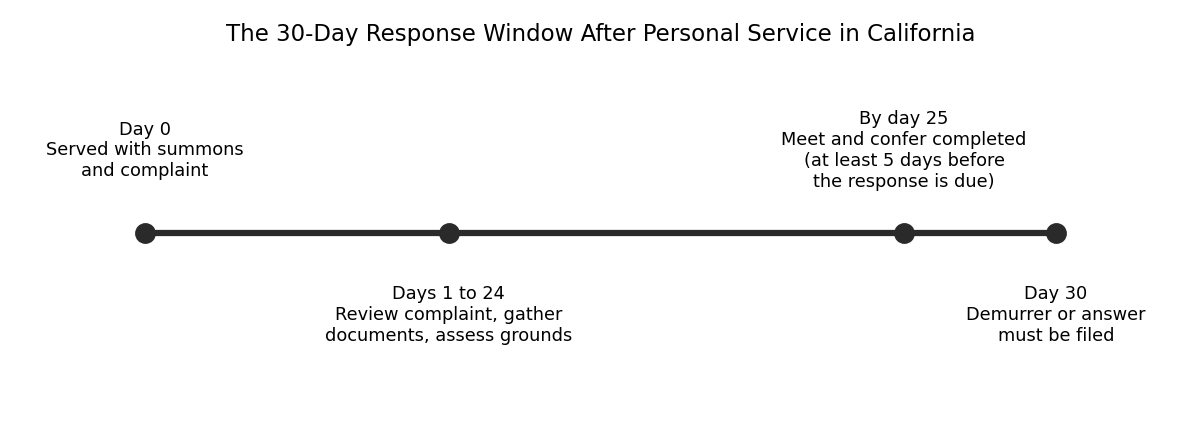
Before filing a demurrer, California requires the defendant to meet and confer with the plaintiff in person, by telephone, or by video. Under Code of Civil Procedure Section 430.41, that conversation must take place at least five days before the responsive pleading is due. The purpose is to identify the defects and see whether the plaintiff will fix them voluntarily. If the parties cannot meet in time, the defendant can obtain an automatic 30-day extension by filing a declaration describing the good faith attempt to meet and confer. That extension can be valuable, but it is only available if the request is filed before the original deadline passes.
What Happens After a Demurrer Is Heard
The court will either overrule or sustain the demurrer. If it is overruled, the defendant files an answer, usually within 10 days after notice of the ruling. If it is sustained, the court decides whether to give the plaintiff leave to amend. Courts frequently allow at least one amendment, particularly early in a case. If no amendment could fix the problem, the court sustains the demurrer without leave to amend, and that claim is dismissed.
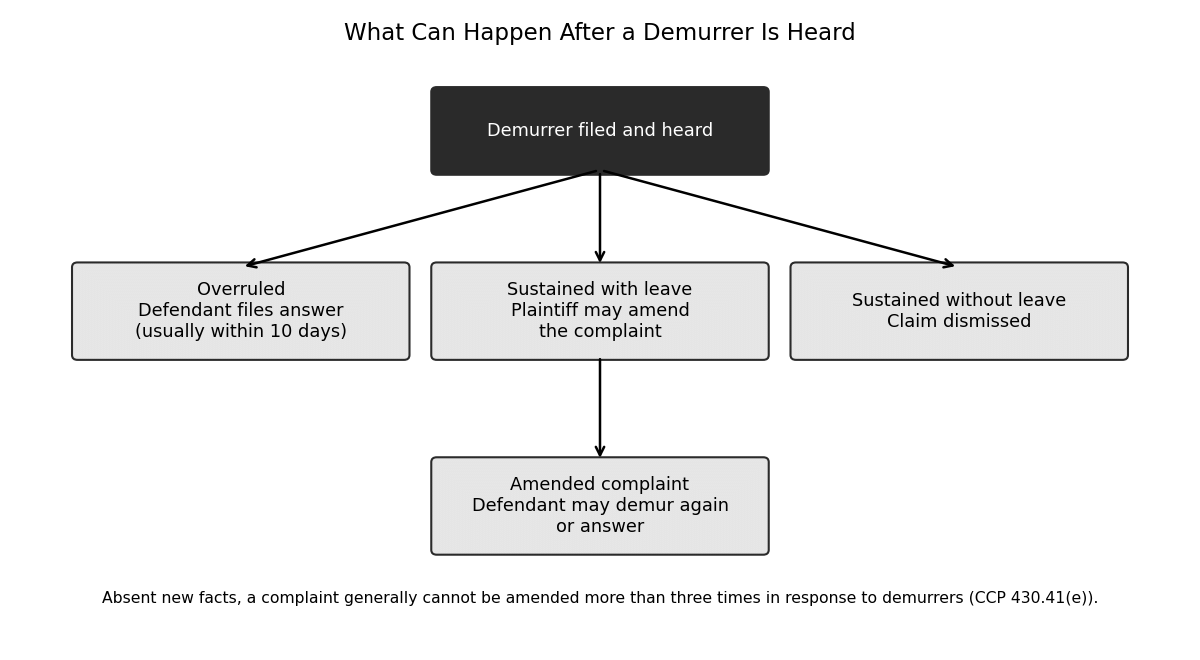
Each amendment gives the defendant another opportunity to demur, but the process has limits. Absent new facts, a plaintiff generally cannot amend more than three times in response to demurrers. Courts weigh amendment requests carefully, a subject explored further in how courts handle requests to amend pleadings. Later in a case, a similar challenge can be raised through a motion for judgment on the pleadings.
When a Demurrer Makes Strategic Sense
A demurrer is a strong choice when the complaint has a genuine legal flaw. That might mean a claim the law does not recognize, a fraud claim pleaded without the required specificity, a contract claim that never identifies the contract, or a cause of action that is clearly time-barred on the face of the complaint. Eliminating or narrowing those claims early can reduce the scope of discovery and change the case’s settlement value.
Even when a demurrer is unlikely to end the case, it can force the plaintiff to commit to specific facts. That clarity helps shape discovery strategy and can expose weaknesses that matter later at summary judgment or trial.
When Filing an Answer Is the Better Move
A demurrer is not always worth the cost and delay. If the complaint is legally sound and the dispute is really about what happened, a demurrer may simply result in a better-pleaded complaint. In that situation, filing an answer and moving into discovery can be the more efficient path. An answer also makes sense when the defendant wants to file a cross-complaint promptly, since related claims against the plaintiff generally must be filed with the answer.
Speed can matter too. Some defendants want the case to move quickly toward mediation or trial, and a demurrer adds a hearing and possible amendment cycles. Understanding how long a civil lawsuit takes in California helps put that tradeoff in perspective, and the discovery process in a California lawsuit is what comes next after an answer.
Other Early Motions That Can Affect Your Choice
A demurrer and an answer are not the only early responses. If service was defective or the court lacks personal jurisdiction over you, a motion to quash should be filed before or with any demurrer or answer, because appearing in the case without it can waive the objection. Wade Litigation attorney Yuri Voronin has used this tool successfully, as shown by his motion-to-quash victory. In cases involving protected speech or petitioning activity, an anti-SLAPP motion under Code of Civil Procedure Section 425.16 may also be available and has its own deadline, generally 60 days after service of the complaint.
Common Mistakes Defendants Make
|
Mistake |
Why It Matters |
|---|---|
|
Missing the 30-day deadline |
The plaintiff can request entry of default and seek a default judgment |
|
Skipping the meet-and-confer |
The court may decline to consider the demurrer or delay the hearing |
|
Demurring to a sound complaint |
Adds cost and delay while giving the plaintiff a roadmap to improve the pleading |
|
Leaving out affirmative defenses |
Defenses not raised in the answer can be waived |
|
Filing a general denial to a verified complaint |
An unlimited civil case with a verified complaint requires specific, verified denials |
|
Answering before challenging service |
Can waive objections to personal jurisdiction |
|
Ignoring compulsory cross-claims |
Related claims against the plaintiff may be lost if not filed with the answer |
Served with a lawsuit and unsure which response to file? You must decide between a demurrer and an answer under a tight deadline, and it shapes everything that follows. Wade Litigation’s civil litigation attorneys have secured dismissals, defense verdicts, and favorable resolutions for clients across California, including a dismissal with prejudice in a civil dispute. Call 408-214-5225 to schedule a case evaluation.
Frequently Asked Questions
What is the difference between a demurrer and an answer in California?
An answer responds to the complaint’s facts by admitting or denying the allegations and raising affirmative defenses. A demurrer does not dispute the facts. It argues that even if everything in the complaint is true, the complaint is legally defective, for example because it fails to state a valid cause of action or is too uncertain to respond to.
How long do I have to file a demurrer or answer in California?
Generally, 30 days after you are personally served with the summons and complaint. Other methods of service, such as substituted service or service by mail with acknowledgment, can change when service is considered complete, so calculate the exact deadline carefully.
Do I have to meet and confer before filing a demurrer?
Yes. California Code of Civil Procedure Section 430.41 requires the demurring party to meet and confer with the plaintiff in person, by telephone, or by video at least five days before the responsive pleading is due. If that cannot happen in time, the defendant can obtain an automatic 30-day extension by filing a declaration explaining the good faith attempt to meet and confer.
Can a demurrer get my lawsuit dismissed?
It can. If the court sustains a demurrer without leave to amend, it dismisses the claim. More often, courts give the plaintiff a chance to amend, but a demurrer can still narrow the case, eliminate weak claims, and force the plaintiff to commit to specific facts.
What happens if my demurrer is overruled?
You will need to file an answer, usually within 10 days after notice of the ruling unless the court sets a different deadline. An overruled demurrer does not mean you lose the case. It only means the complaint was sufficient to move forward.
Can I file a general denial in California?
Sometimes. If the complaint is not verified, or if the case is a limited civil case, a defendant can generally file an answer that denies the allegations in general terms. If the complaint is verified in an unlimited civil case, the answer must respond specifically to the allegations.
What if I was not properly served?
A challenge to personal jurisdiction, including improper service, should be raised with a motion to quash before or at the same time as any demurrer or answer. Filing a demurrer or answer first without that motion can waive the service objection.
Questions Defendants Often Ask About This Decision
“Is a demurrer just a delay tactic?” It should not be. A demurrer filed without real legal grounds wastes time and money, and courts notice. Used properly, it tests whether the plaintiff has a legally viable case before both sides spend heavily on discovery.
“Will filing a demurrer make the plaintiff angry and harder to settle with?” Not usually. Experienced plaintiffs’ attorneys expect legal challenges to defective pleadings. In many cases, a well-supported demurrer improves the defendant’s negotiating position by exposing weaknesses early.
“Can I handle this myself?” Defendants can represent themselves, but demurrers in particular involve technical pleading rules, case law, and strict procedural requirements. A misstep can waive defenses or leave weak claims in the case. If you are weighing the risks, it helps to see how early decisions carry through the six phases of a lawsuit.
What Happens When You Contact Wade Litigation
When you reach out, our intake team will ask when and how you were served, what court the case is in, and what the complaint alleges. Have the summons and complaint available if you can. An attorney will then review whether the complaint has legal defects worth challenging, whether to contest service and jurisdiction, what defenses to preserve, and how to meet the response deadline. You will leave the evaluation knowing which response fits your case and what the next steps look like.
Protect Your Defense From the First Filing
The first response you file in a California lawsuit sets the direction for everything that follows. Whether the right move is a demurrer that narrows or eliminates claims or an answer that preserves every defense and moves the case forward, you should make the decision deliberately and on time. Learn more about our California civil litigation practice, including business litigation and real estate litigation matters; review our case results; call 408-214-5225, or contact Wade Litigation to schedule a case evaluation.