

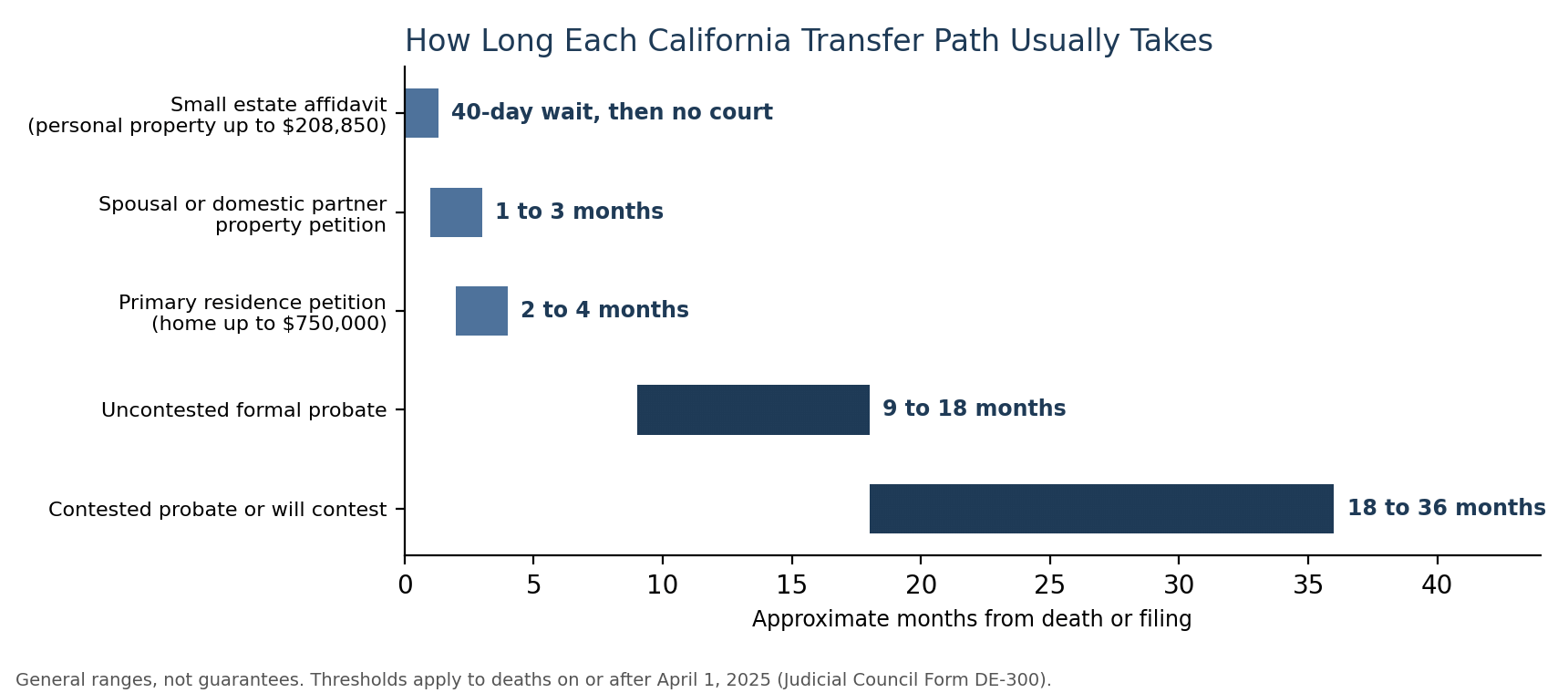
Most uncontested probate cases in California take about 9 to 18 months from filing to final distribution. Several waiting periods are built into the law, including a four-month creditor claim period, so even simple estates rarely close in less than six to eight months. Contested estates and will disputes can take two years or more, while smaller estates may qualify for faster procedures that avoid formal probate entirely.
Families are often surprised by how long the process lasts, especially when the estate seems straightforward. Understanding where the time goes, and which delays are legally required versus avoidable, helps executors plan and helps beneficiaries set realistic expectations.
Why California Probate Takes So Long
California probate is court-supervised. A judge must approve the appointment of the personal representative and, in most cases, the final accounting and distribution as well. Between those two hearings, the law requires specific notice periods that cannot be shortened, even when every family member agrees.
Court calendars add another layer. The probate department in the county where the decedent lived sets hearing dates, and busy courts such as those in Los Angeles, San Francisco, and Orange County can schedule initial hearings weeks or months out. Our overview of how probate court works explains the court’s role in more detail.
The California Probate Timeline, Stage by Stage
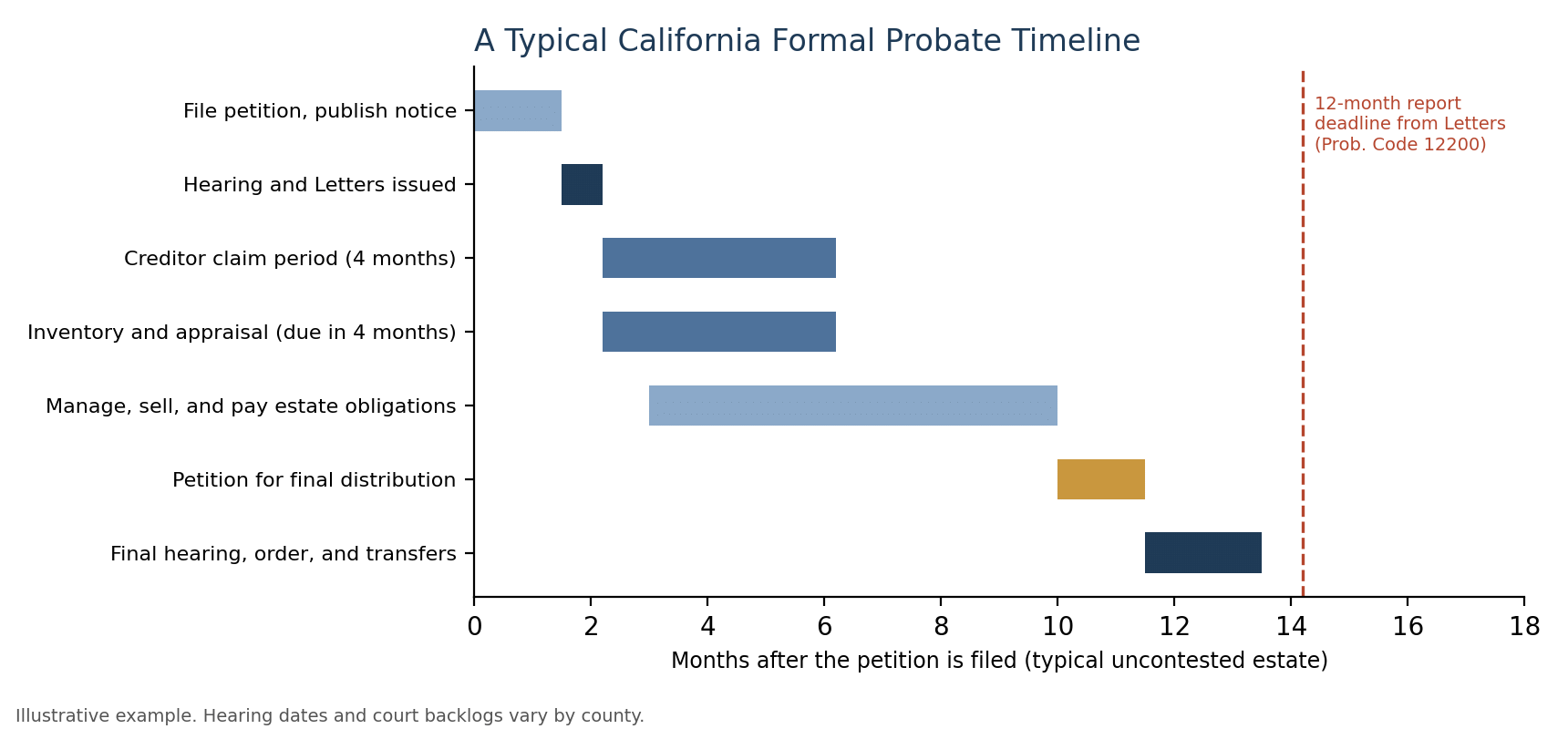
The chart below shows a typical uncontested formal probate. Every county and every estate is different, but the sequence and the statutory deadlines are the same statewide.
Stage One: Filing the Petition and Publishing Notice
The process begins when someone files a Petition for Probate in the superior court of the county where the decedent lived. The court sets a hearing date when it files the petition. Before that hearing, the petitioner must publish a Notice of Petition to Administer Estate in a local newspaper and mail it to heirs and beneficiaries.
Stage Two: The First Hearing and Letters
If no one objects, the court appoints the executor named in the will, or an administrator if there is no will, and orders the issuance of Letters. Letters are the document that gives the personal representative legal authority to act for the estate. Most of the statutory clocks start running from this date.
Stage Three: Creditor Claims and the Inventory
Two four-month windows typically run at the same time once Letters are issued:
- Creditor claims. Under Probate Code Section 9100, creditors generally have until the later of four months after Letters are issued or 60 days after notice is mailed to them to file a claim.
- Inventory and appraisal. Probate Code Section 8800 requires the personal representative to file an inventory and appraisal within four months after the court issues Letters. Most non-cash assets are valued by a court-appointed probate referee.
Stage Four: Administering the Estate
During this stage, the personal representative pays valid debts and expenses, manages or sells property, files final income tax returns, and resolves any rejected creditor claims. Selling a house is often the single longest task. A personal representative granted full authority under the Independent Administration of Estates Act can usually sell without a separate court confirmation hearing, saving significant time.
Stage Five: Final Accounting and Distribution
Under Probate Code Section 12200, the personal representative must petition for final distribution, or file a report explaining why the estate cannot yet close, within one year after the court issues Letters. That deadline extends to 18 months when a federal estate tax return is required. After the court approves the final petition, the personal representative transfers assets and files receipts to be discharged.
Faster Options for Smaller Estates
Not every estate needs to go through formal probate. California offers several shortcuts, and the thresholds increased for deaths on or after April 1, 2025.
Procedure | Who Can Use It | Typical Timing |
|---|---|---|
Small estate affidavit (Prob. Code 13100) | Personal property in California worth $208,850 or less | After a 40-day waiting period, with no court hearing |
Primary residence petition (Prob. Code 13151) | Decedent’s primary residence worth $750,000 or less | Court petition after 40 days, usually a few months |
Spousal or domestic partner property petition | Surviving spouse or registered domestic partner | Often one to three months |
Formal probate | Estates that do not qualify for a shortcut | About 9 to 18 months if uncontested |
Thresholds from Judicial Council Form DE-300, effective for deaths on or after April 1, 2025. Values are scheduled for the next adjustment on April 1, 2028.
Assets that pass outside probate, such as accounts with named beneficiaries, jointly held property, and assets titled in a living trust, generally do not count toward these limits. Many estates that look large on paper qualify for a simplified procedure once those assets are set aside.
What Causes Probate Delays in California
Some delays are built into the law. Others come from the estate itself or from the people involved. The most common causes include:
- Will contests and objections. A contest filed before or after the will is admitted can add a year or more and may require discovery, mediation, or trial.
- Disputes among heirs. Disagreements over who should serve as personal representative, how to value property, or whether to sell a family home often stall progress.
- Real estate. Preparing, listing, and selling property takes time, especially when it requires a court confirmation hearing.
- Missing heirs or incomplete records. Locating beneficiaries or reconstructing financial records can delay notices and the inventory.
- Creditor claim litigation. A rejected claim that the creditor sues on must be resolved before the estate can close.
- Tax issues. Estates that require a federal estate tax return face a longer deadline and may wait for clearance before final distribution.
When a delay comes from a dispute rather than paperwork, the matter has usually become a probate litigation case. Our California probate litigation practice handles will contests, removal of personal representatives, and fiduciary disputes that extend the timeline.
How Personal Representatives Can Keep Probate Moving
Executors and administrators cannot skip the statutory waiting periods, but they can avoid adding unnecessary time. Practical steps include requesting full authority under the Independent Administration of Estates Act, gathering account statements and deeds early, mailing creditor notices promptly, and responding to probate examiner notes before each hearing. Missing a correction requested by the examiner is one of the most common reasons a hearing gets continued.
Local practice also matters. Each superior court has its own probate examiners, hearing calendars, and filing preferences. Families settling an estate in Southern California can learn more from our Los Angeles probate attorney page, and those in the Bay Area can visit our San Francisco probate attorney page.
Is a California probate taking longer than it should? Wade Litigation represents personal representatives and beneficiaries in probate administration and disputes across California. Call 866-925-4552 to schedule a case evaluation.
Frequently Asked Questions About the California Probate Timeline
How long does probate take in California with a will?
An uncontested California probate with a valid will usually takes about 9 to 18 months from the date the petition is filed. The will does not shorten statutory waiting periods, such as the four-month creditor claim period, but it often makes appointing the executor simpler.
How long does probate take in California without a will?
Probate without a will generally follows the same timeline, but it can take longer at the start. The court must appoint an administrator based on California’s priority rules, heirs must be identified under intestate succession law, and a bond may be required unless the heirs waive it.
What is the shortest possible probate in California?
The fastest formal probate cannot close until the four-month creditor claim period has run, so most estates take at least six to eight months. Estates that qualify for a small estate affidavit, a spousal property petition, or a primary residence petition can often avoid formal probate entirely.
Is there a deadline to finish probate in California?
Yes. Under Probate Code Section 12200, the personal representative must petition for final distribution or file a status report within one year after the court issues Letters, or within 18 months if a federal estate tax return is required. The court can extend these deadlines for good cause.
Can beneficiaries receive anything before probate closes?
In some cases. The court can approve a preliminary distribution once the creditor claim period has expired, as long as the distribution will not prejudice creditors or other beneficiaries. This is often helpful when an estate must stay open to sell real property or resolve a tax issue.
Does a living trust avoid the probate timeline?
Assets properly titled in a living trust generally pass outside probate, so a trustee can often settle them without court supervision. Trust administration still involves notices and waiting periods, but it rarely requires court hearings unless a dispute arises.
What Happens When You Call Wade Litigation
When you call 866-925-4552, our team will ask when your loved one passed away, which county they lived in, whether there is a will or trust, and whether a probate case has already been opened. We will schedule a case evaluation with an attorney, who will explain which procedure fits the estate, where the case stands in the timeline, and how to address any delays or disputes.
Speak With a California Probate Attorney
Probate in California follows a predictable structure, but small mistakes and family disagreements can add months to the process. Whether you are serving as executor or waiting as a beneficiary, knowing the timeline and deadlines puts you in a stronger position.
Call Wade Litigation at 866-925-4552 to schedule a case evaluation.