AI Summary: Key Takeaways
- Wade Litigation represents San Francisco clients through every stage of divorce, from uncontested filings to high-asset, contested litigation.
- California is a no-fault, community property state; divorces filed in San Francisco County require a mandatory six-month waiting period before finalization.
- Divorce timelines and cost scale directly with complexity: uncontested cases with no property often resolve in 6 to 7 months, while contested high-asset cases can take well over a year.
- Real estate, retirement accounts, and equity compensation (stock options and RSUs) are the assets most frequently contested in San Francisco divorce cases.
- San Francisco divorce filings are handled through the Unified Family Court at the Civic Center Courthouse.
Divorce reshapes nearly every part of a person’s life at once: where they live, how their finances work, and what their relationship with their children looks like going forward. In San Francisco, where dual-income households, equity compensation, and real estate holdings complicate even amicable separations, the difference between a well-handled divorce and a mishandled one often comes down to preparation and strategy from the very first filing.
Wade Litigation represents San Francisco clients across the full spectrum of divorce cases, from straightforward uncontested filings to complex, contested litigation involving significant assets. We build every case with the same foundation: thorough fact-gathering, clear communication, and the readiness to litigate when negotiation does not produce a fair result. For an overview of California’s divorce laws and procedures, our California divorce lawyer resource provides additional guidance on the statewide process.

How Wade Litigation Approaches San Francisco Divorce Cases
No two divorces move through the San Francisco court system the same way. A case with no children, no real property, and mutual agreement on terms looks nothing like a contested case involving a family business, stock compensation, or a custody dispute. We start every matter by identifying which category a case falls into, then build a strategy around that reality rather than a one-size-fits-all approach.
A Structured, Client-Centered Process
Our process begins with a detailed review of the marital estate: assets, debts, income sources, and any existing agreements between the spouses. From there, we pursue a negotiated resolution where it serves the client’s interests, while preparing the case as though it may proceed to a contested hearing. Each client works with a dedicated liaison who provides case updates and answers procedural questions, while our attorneys handle every strategic and courtroom decision personally.
Wade Litigation’s our-team/amiel-wade, Amiel Wade, has been recognized as a Top Ten California Family Law Attorney by the National Academy of Family Law Attorneys, reflecting a firm-wide commitment to attentive, ethical representation throughout the divorce process.
The Divorce Process in San Francisco
Grounds for Divorce and Residency Requirements
California operates as a no-fault divorce state. Neither spouse has to prove wrongdoing to end the marriage; the only legal ground required is irreconcilable differences. To file in San Francisco County, at least one spouse must have lived in California for the six months immediately before filing and in San Francisco County for the three months before filing.
Filing, Service, and Financial Disclosure
A divorce case begins when one spouse, the petitioner, files a Petition for Dissolution of Marriage with the San Francisco Superior Court and formally serves the other spouse, the respondent. The respondent generally has 30 days to file a Response. Both spouses must then exchange Preliminary Declarations of Disclosure, covering all assets, debts, income, and expenses, generally within 60 days of filing the petition or response.
These disclosures are not optional paperwork. California law treats full financial transparency as a legal duty, and a spouse who conceals assets can face significant penalties once discovered, including an unequal award of the hidden asset to the other spouse.
Contested vs. Uncontested Divorce
An uncontested divorce means both spouses agree on every material issue: property division, support, and custody if children are involved. These cases typically move through the court on a predictable timeline, limited mainly by California’s mandatory six-month waiting period. A contested divorce, by contrast, involves at least one disputed issue that the parties cannot resolve on their own, which extends the timeline through discovery, negotiation, and potentially trial.
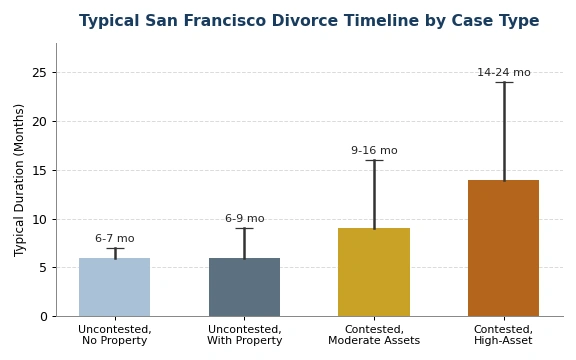
These ranges reflect general patterns rather than a guarantee for any individual case. Court calendar congestion, how quickly both sides complete disclosures, and the number of disputed issues all affect how long a specific divorce actually takes.
What Does a Divorce Cost in San Francisco?
Cost tracks complexity closely. An uncontested divorce with no real property and straightforward finances generally costs a small fraction of what a contested, high-asset case involving business valuation or equity compensation tracing will run. Attorney fees, filing costs, and any expert fees (appraisers, forensic accountants, or business valuators) all scale with how many issues remain unresolved and how much discovery each side requires.
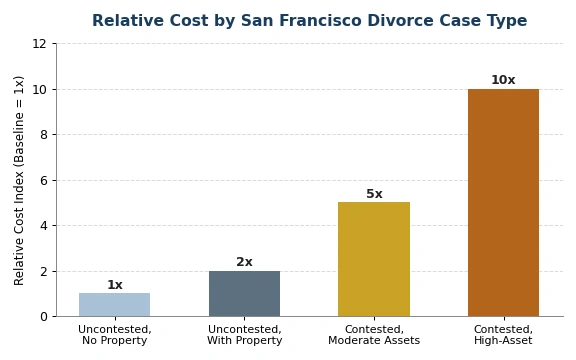
Wade Litigation provides transparent billing throughout representation, with invoices reviewed internally before being sent to clients. Discussing fee structure during an initial consultation helps clients plan for the financial commitment a case may require before it begins.
Property Division in San Francisco Divorces
Community Property and Separate Property
California follows community property principles: assets and debts acquired during the marriage generally belong equally to both spouses, regardless of whose name appears on the title or account. Property acquired before marriage, after the date of separation, or through gift or inheritance typically remains separate property belonging to one spouse alone.
The line between the two categories often blurs in practice. Commingling occurs when separate and community funds mix, which can convert what began as separate property into a community asset or create a reimbursement claim. A home purchased before marriage but paid down using income earned during the marriage is a common example that requires careful tracing.
High-Asset and Complex Divorce Issues
San Francisco’s concentration of technology, finance, and professional-services employment means that divorces here frequently involve compensation structures that do not divide as cleanly as a bank account balance. Equity compensation in particular requires attention to vesting schedules and grant dates to determine what portion counts as community property.
- Real estate, including the family residence and any rental or investment holdings
- Retirement accounts, pensions, and deferred compensation earned during the marriage
- Stock options, RSUs, and other equity compensation with multi-year vesting schedules
- Family-owned or closely held businesses requiring formal valuation
- Allocation of marital debt, including credit cards, loans, and mortgage obligations
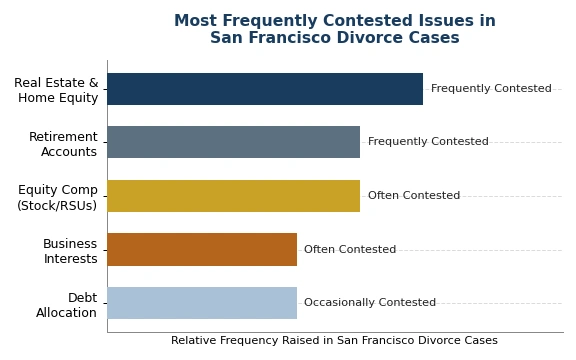
When a business valuation dispute becomes severe enough that it threatens to derail the underlying business itself rather than just the divorce settlement, a San Francisco business litigation attorney may need to get involved separately from the divorce proceeding.
Spousal Support in San Francisco Divorces
Spousal support, sometimes called alimony, follows a separate analysis from property division. Family Code Section 4320 lists more than a dozen factors courts must weigh when setting the amount and duration of support, including the length of the marriage, each spouse’s earning capacity, contributions made to the other spouse’s education or career, and the standard of living established during the marriage.
For marriages under ten years, San Francisco courts often consider a support duration of roughly half the length of the marriage, though outcomes vary significantly based on the specific facts of the case. In longer marriages, courts may retain jurisdiction over spousal support indefinitely, without setting a fixed termination date at the time of judgment.
Child support, by contrast, follows a statewide guideline formula based on each parent’s income and the percentage of time each parent spends with the children. When a divorce involves minor children, custody and support are typically negotiated or litigated alongside the divorce itself rather than as an afterthought.
San Francisco Divorce Court: What to Expect
Divorce filings in San Francisco move through the Unified Family Court at the Civic Center Courthouse. Understanding the procedural deadlines that apply, separate from the substantive law governing property and support, helps clients anticipate what a case will actually require week to week.
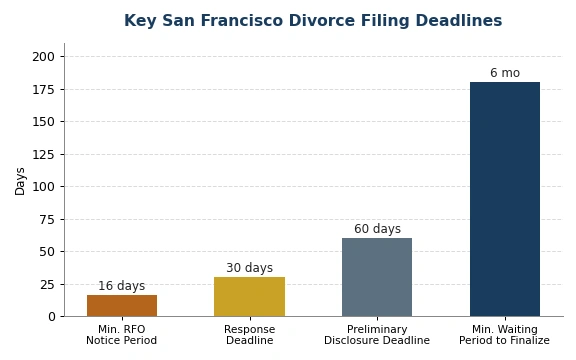
These figures reflect general statutory and procedural minimums under California law. Specific deadlines can shift based on how a case is served, whether good cause is shown, or local court scheduling.
Divorce Resolution Options: Litigation, Mediation, and Collaborative Divorce
Not every divorce needs to be resolved the same way, and choosing the right path early can affect both the cost and the outcome of a case. San Francisco spouses generally have three routes available, and the right one depends on how much the parties agree on and how willing each side is to negotiate in good faith.
Traditional Negotiation and Litigation
Most divorces resolve through a mix of attorney-led negotiation and, when necessary, formal litigation. Each spouse retains their own attorney, exchanges required disclosures, and works toward a settlement. When negotiation breaks down on one or more issues, the unresolved questions go before a judge, who issues binding orders after hearing evidence from both sides.
Mediation
Mediation involves a neutral third party who helps both spouses work through disputed issues outside of court. It tends to work best when both spouses are willing to communicate and compromise, and it often costs less and moves faster than contested litigation. Mediation does not replace legal advice, and many San Francisco spouses still consult an attorney to review any agreement before signing it.
Collaborative Divorce
Collaborative divorce is a structured, team-based approach in which each spouse retains their own attorney and both sides commit in writing to resolving every issue without going to court. Financial professionals and child specialists sometimes join the process to address specific concerns, such as valuing a business or developing a parenting plan. If the collaborative process breaks down, both spouses generally must retain new attorneys before pursuing litigation, which gives everyone a strong incentive to stay at the table.
Litigation becomes the appropriate path when one spouse refuses to cooperate, conceals assets, or when a child’s safety is at risk. In those situations, court oversight provides the structure, enforceable orders, and accountability that voluntary processes cannot guarantee.


Divorce, Custody, and Support for San Francisco Families with Children
When a San Francisco divorce involves minor children, custody and support are typically negotiated or litigated alongside the divorce itself as part of broader family law matters in San Francisco.Legal custody covers decision-making authority over a child’s health, education, and welfare, while physical custody determines where the child primarily lives. California law expresses a preference for arrangements that give children frequent and continuing contact with both parents, provided no safety concerns exist.
Child support follows a statewide guideline formula based on each parent’s income and parenting time, applied through standardized software that produces a presumptively correct support figure. When custody is contested, San Francisco requires parents to attend mediation through Family Court Services before a judge will hear the dispute. Because custody and divorce proceedings move on the same timeline, resolving custody early often clears the way for the rest of the divorce to move forward.
Local Resources for San Francisco Divorce Cases
| Resource | Purpose | Contact / Location |
| SF Superior Court – Unified Family Court | Filing, hearings, and case management for divorce cases | Civic Center Courthouse, 400 McAllister St, San Francisco, CA 94102 |
| SF Superior Court Self-Help Center | Form assistance for self-represented litigants (no legal advice or advocacy) | Civic Center Courthouse |
| San Francisco Bar Association LRIS | Attorney referral service for residents seeking divorce counsel | sfbar.org |
| SF County Clerk – Vital Records | Certified copies of divorce judgments and related court records | San Francisco Superior Court Clerk’s Office |
Why Choose Wade Litigation as Your San Francisco Divorce Attorney
A divorce in a city as competitive and high-stakes as San Francisco calls for a firm that can negotiate effectively and litigate credibly the moment negotiation stops working. Wade Litigation combines recognized family law experience with practical structure: dedicated client liaisons who keep communication consistent, attorneys who handle every strategic decision personally, and a preparation-first approach that treats every filing as though it may eventually be tested in front of a judge.
For San Francisco clients navigating an uncontested filing, a contested property dispute, or a high-asset divorce involving equity compensation or a family business, that combination of responsiveness and litigation readiness often makes the difference in how a case resolves.
FAQs About San Francisco Divorce
Take Action by Consulting a San Francisco Divorce Attorney Today
Divorce cases in San Francisco rarely improve with delay. Financial records become harder to reconstruct, informal custody arrangements can solidify by default, and equity compensation can vest or expire while a case sits unresolved. Working with an experienced San Francisco divorce attorney early helps protect financial position and the ability to negotiate from strength rather than urgency.
Wade Litigation represents San Francisco residents through every stage of divorce, from uncontested filings to complex, high-asset litigation. Contact Wade Litigation today for a free case evaluation to discuss your San Francisco divorce.
This page is for general informational purposes only and does not constitute legal advice. Prior results do not guarantee a similar outcome. Contact Wade Litigation directly to discuss the specific facts of your case.