Real estate disputes in Irvine are shaped by two facts about the city: nearly every neighborhood is governed by a homeowners association under the Irvine Company’s master plan, and home values are high enough that even a modest defect or boundary dispute carries real money. Wade Litigation represents Irvine homeowners, buyers, and co-owners in HOA disputes, nondisclosure claims, partitions, and title disputes, preparing every case as if it is going to trial. Call 866-925-4552 to schedule a case evaluation and discuss where your dispute stands.
Choosing the right Irvine real estate litigation lawyer matters because property disputes rarely resolve themselves, and the amount at stake in this market is rarely small. Wade Litigation represents homeowners, buyers, sellers, and co-owners in disputes over title, disclosure, association rules, and shared property, preparing every file as if it is going to trial. Call 866-925-4552 to talk through your situation.
What Counts As Real Estate Litigation In Irvine?
Real estate litigation covers a wide range of disputes that arise once a property transaction or ownership relationship breaks down. For Irvine residents, that most often includes:
- Homeowners association disputes over rule enforcement, fines, or architectural approval
- Nondisclosure claims against a seller who failed to disclose a known defect
- Partition actions between co-owners who can no longer agree on a shared property
- Quiet title and boundary disputes over who actually owns what
- Landlord-tenant disputes, including unlawful detainer actions
Why Do So Many Irvine Real Estate Disputes Involve An HOA?
Irvine was built almost entirely as a master-planned community under the Irvine Company, which means the overwhelming majority of homes here, from Woodbridge to the newer Great Park neighborhoods, sit inside a common interest development governed by a homeowners association and a set of covenants, conditions, and restrictions. California regulates these associations through the Davis-Stirling Common Interest Development Act, codified at Civil Code section 4000 and following, which sets rules for board elections, assessment increases, fine procedures, and a homeowner’s right to internal dispute resolution before litigation.
Common HOA disputes we handle include architectural approval denials, selective or inconsistent rule enforcement, disputes over special assessments, and board decisions made without following the association’s own governing documents or the Davis-Stirling procedural requirements. Because most Irvine HOAs require an internal dispute resolution process before a lawsuit can be filed, getting that process right often determines how quickly a dispute actually gets resolved.
What If A Seller Did Not Disclose A Problem With The Property?
California law requires sellers of most residential real estate to complete a Transfer Disclosure Statement under Civil Code section 1102, disclosing known material defects, from a leaking roof to a history of water intrusion or unpermitted work. A seller who knowingly conceals a defect, or an agent who should have discovered one through reasonable inspection, can be liable for the buyer’s resulting damages.
Given Irvine’s home values, a nondisclosure claim is rarely a small matter. The median home value in Irvine is 1,115,400 dollars according to the U.S. Census Bureau, well above the statewide median, which means a concealed structural or water intrusion issue can represent a significant fraction of the purchase price.
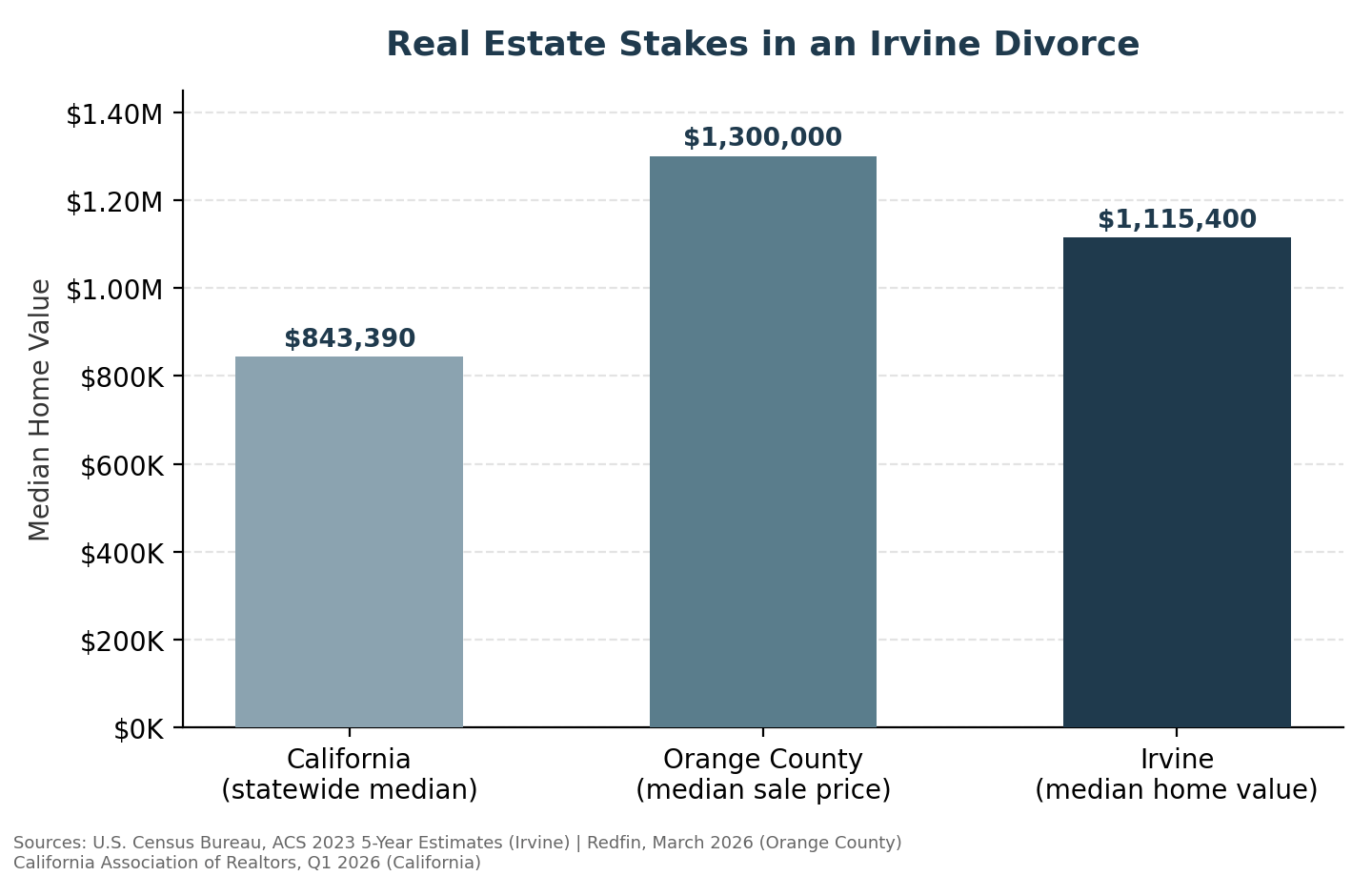
High Irvine and Orange County home values mean a concealed defect or a contested boundary line carries real financial weight. Source: U.S. Census Bureau ACS 2023 5-Year Estimates; Redfin, March 2026; California Association of Realtors, Q1 2026.
What Is A Partition Action?
When two or more people own real property together, whether siblings who inherited a home, former partners who bought a house together, or investors in a rental property, and they can no longer agree on what to do with it, any co-owner can generally file a partition action under Code of Civil Procedure section 872.210 and following. The court can order the property sold and the proceeds divided, or in some cases divide the physical property itself. Partition actions are common in Irvine given how many multi-generational and co-investment purchases the local market has produced.

What Is A Quiet Title Action?
A quiet title action, governed by Code of Civil Procedure sections 760.010 through 764.010, asks the court to resolve a dispute over who actually holds legal title to a property, or to clear a cloud on title such as an old lien, a boundary encroachment, or a competing ownership claim. These actions are often paired with a boundary or easement dispute between neighboring property owners.
What If You Are In A Landlord-Tenant Dispute?
Landlord-tenant disputes range from unpaid rent and lease violations to eviction proceedings, known formally as unlawful detainer actions. California and many local jurisdictions impose strict notice and procedural requirements before an eviction can proceed, and a landlord who skips a required step can see a case dismissed regardless of the merits. We represent both landlords seeking to enforce a lease and tenants defending against improper eviction attempts.
Comparing Common Real Estate Dispute Types
Dispute Type | Common Trigger | Typical Remedy Sought |
HOA Dispute | Rule enforcement, fines, or denied approval | Injunction, damages, or rule compliance |
Nondisclosure Claim | Undisclosed defect discovered after purchase | Damages or rescission of the sale |
Partition Action | Co-owners cannot agree on shared property | Forced sale or physical division |
Quiet Title / Boundary | Competing ownership or encroachment claim | Court determination of title or boundary |
Landlord-Tenant | Unpaid rent, lease violation, or eviction | Possession, back rent, or damages |
Table 1: Common categories of real estate disputes we handle for Irvine clients. Every case turns on its specific facts and governing documents.
Trial-Ready Representation, Backed By Results. Wade Litigation secured a 667,000 dollar arbitration award for homebuyers in a real estate dispute, the kind of result that comes from preparing every case as though it is going to trial. Call 866-925-4552 to schedule a case evaluation.
How Do Courts Interpret The Contracts Behind These Disputes?
Nearly every real estate dispute eventually comes back to a contract, whether it is a purchase agreement, a lease, or a set of CC&Rs. Most Irvine purchase agreements are now signed electronically, which makes our analysis of how courts evaluate electronic contract formation directly relevant when a dispute turns on whether a document was ever validly signed. Purchase agreements and lease indemnity provisions also frequently decide who bears the cost of a third-party claim, which is the subject of our breakdown of how courts interpret contract indemnification clauses.
What Does An Irvine Real Estate Litigation Lawyer Cost, And Is It Worth It?
Real estate litigation is generally billed hourly, and we walk through our rates and a realistic view of likely costs during your case evaluation. Given the values involved in Irvine real estate, litigation costs are often small relative to what is at stake in a nondisclosure, partition, or boundary dispute.
A common mistake is waiting too long to bring in counsel, particularly in an HOA dispute where internal appeal deadlines can run quickly, or in a nondisclosure claim where evidence of the seller’s knowledge can become harder to gather over time.
Why Do Irvine Clients Choose Wade Litigation For Real Estate Disputes?
Many firms treat real estate disputes as simple paperwork matters. We treat them as the lawsuits they are, preparing every contested Irvine real estate case as though it is going to trial from the outset. That approach produced a six-figure arbitration award for homebuyers in a past matter, and we bring the same approach to HOA disputes, partitions, and title fights.
How Should You Prepare For Your First Meeting?
Bring the purchase agreement, lease, or CC&Rs at issue, along with any relevant inspection reports, disclosure documents, or correspondence with the other party or the HOA board. If you are facing a deadline, such as an HOA internal appeal window or an eviction response date, tell us immediately so we can prioritize accordingly.
Common Questions About Real Estate Litigation In Irvine
Contact Wade Litigation Today
Real estate disputes rarely improve with delay, whether it involves an HOA board, a seller who hid a defect, or a co-owner who will not cooperate. Our Irvine real estate litigation attorneys bring courtroom experience and a proven track record to protect your property interests.
Contact us today at 408-214-5225 to schedule your case evaluation. We will listen to your situation, explain your options, and help you build a plan to move forward with confidence.