Quick Answer: Custody cases in Irvine are decided at the Lamoreaux Justice Center under California’s best interest of the child standard, and most contested cases end in some form of joint custody rather than one parent losing all involvement. Wade Litigation represents Irvine parents seeking to establish, defend, or modify child custody and parenting time, preparing every contested matter as if it is going to trial. Call 866-925-4552 to schedule a case evaluation and discuss where your case stands.
Choosing the right Irvine child custody lawyer affects your relationship with your children for years to come. Wade Litigation represents parents on both sides of custody disputes, from first-time parenting plans to contested relocation and modification cases, preparing every disputed matter as though it is headed to trial. Call 866-925-4552 to talk through your situation and the options in front of you.
What Standard Do Irvine Courts Use To Decide Custody?
California courts decide custody under the best-interest-of-the-child standard set out in Family Code section 3011, which weighs the child’s health, safety, and stability; each parent’s ability to care for the child; and the child’s existing relationships with each parent and, where relevant, siblings. Our guide to California child custody laws explains legal and physical custody in more depth than we can cover here.
- Legal Custody: the right to make decisions about a child’s education, healthcare, and religious upbringing
- Physical Custody: where the child lives day to day and how time is divided between parents
Either type of custody can be awarded jointly, where both parents share the right or the time, or solely to one parent. The two do not have to match: a court can award joint legal custody while giving one parent primary physical custody, for example.

Do Most Irvine Custody Cases End In Joint Custody?
Contrary to what many parents expect going into a contested case, sole custody to one parent is the exception, not the rule. Judicial Council of California data on contested custody outcomes shows that a large majority of cases end in some form of joint legal or physical custody arrangement.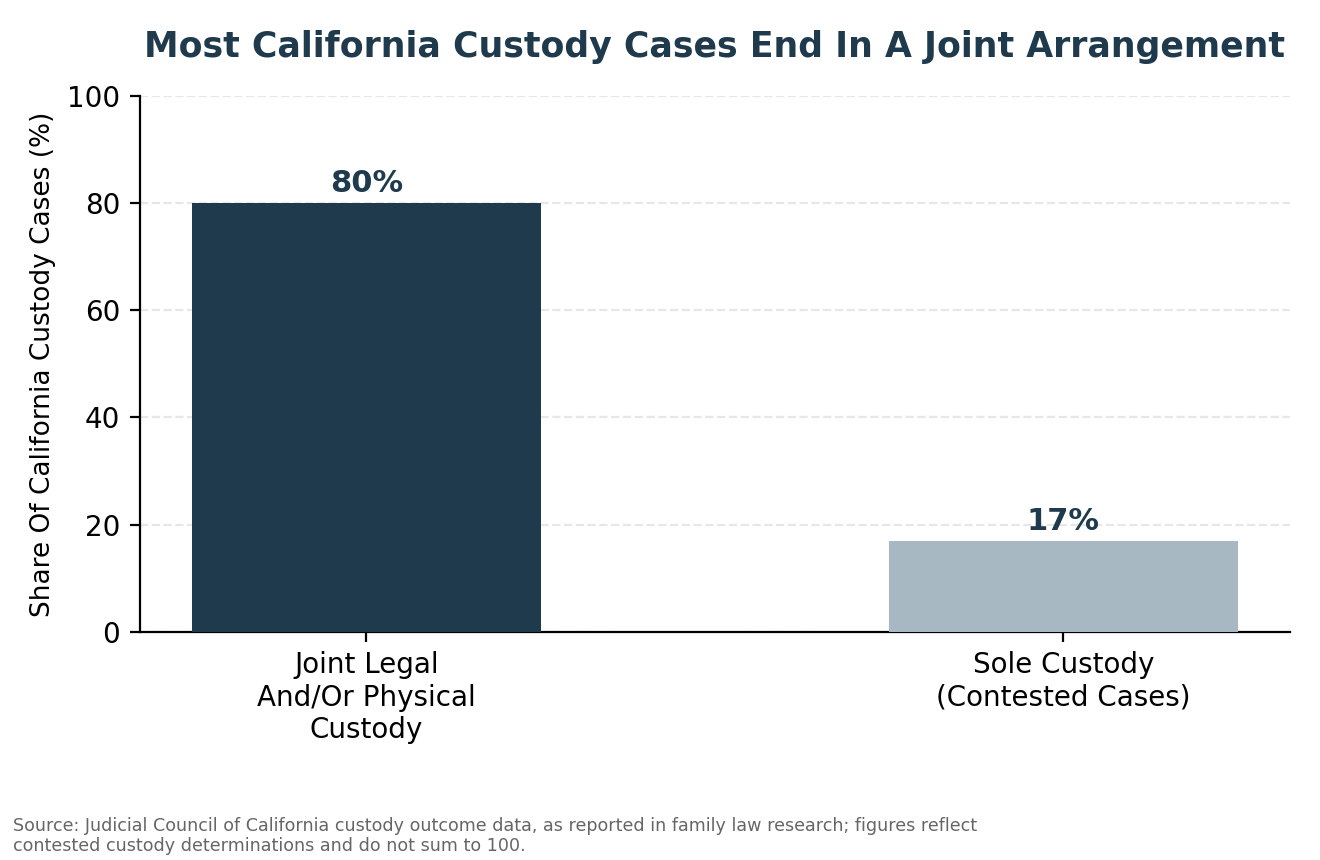 Do Most Irvine Custody Cases End In Joint Custody?[/caption]
Most contested California custody cases result in a joint arrangement rather than sole custody to one parent. Source: Judicial Council of California custody outcome data, as reported in family law research.
That said, sole custody remains appropriate in cases involving abuse, neglect, or a parent who is unable to safely care for the child. Our step-by-step guide to pursuing full custody covers what it actually takes to secure sole custody in a contested case, including the evidence courts look for.
How Does Child Support Interact With Custody?
Custody and support are legally separate questions, but courts calculate them using related inputs. California’s guideline child support formula weighs both parents’ incomes alongside the percentage of time each parent spends with the child, so a change in the parenting schedule can change the support amount even if nothing else in the case changes. Our breakdown of how courts actually calculate child support explains the formula and the common ways it gets miscalculated.
Because the timeshare percentage feeds directly into support, custody negotiations in Irvine cases are rarely just about where the child sleeps. A seemingly small change to a parenting schedule can meaningfully shift a support obligation in either direction, which is why both sides benefit from counsel that understands both halves of the calculation.
What If The Other Parent Wants To Relocate?
Relocation, sometimes called a move-away case, arises when a custodial parent wants to move far enough away that it would disrupt the existing parenting schedule. California courts do not simply ask whether the move is convenient for the relocating parent. The court examines whether the move is being made in good faith and whether it remains in the child’s best interest to allow the existing custody arrangement to change to accommodate the distance.
These cases move quickly once filed, and the outcome often depends on the strength of the evidence on both sides, including the reasons for the move, the child’s ties to the current community and schools, and the feasibility of a revised long-distance parenting schedule. If you are considering a move, or the other parent has informed you of one, timing matters, and you should speak with an attorney before the situation becomes urgent.
Can A Custody Order Be Changed Later?
Yes. As part of an Irvine family law matter, a parent can request a modification of an existing custody order when there has been a significant change in circumstances since the last order was made, such as a relocation, a change in a parent’s work schedule, a child’s changing needs as they get older, or safety concerns that have arisen since the original order. The parent requesting the change generally carries the burden of showing the modification serves the child’s best interest.
What Does An Irvine Child Custody Lawyer Cost, And Is It Worth It?
We are direct about fees and walk through our hourly rates and a realistic view of costs during your case evaluation. A common question is whether it makes sense to handle a custody matter without an attorney, particularly when both parents seem to agree on the general outline of a schedule.
The data suggests that is a closer call than it looks. Research published in the California Law Review found that at least one party is self-represented in roughly 70 percent of California family law cases at filing, a figure that climbs to 80 percent by the time judgment is entered.
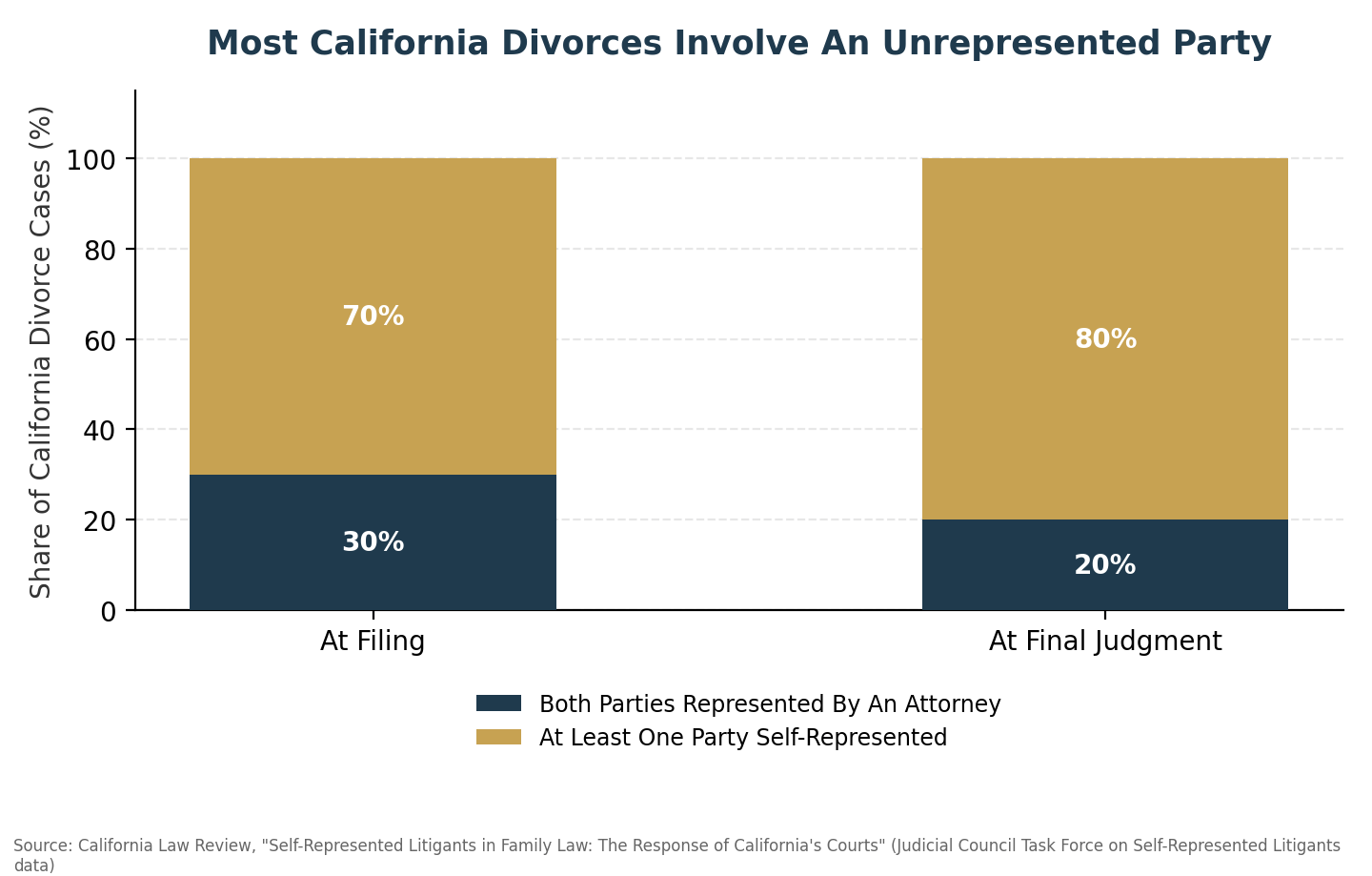
Most California family law cases involve at least one unrepresented party, and that share grows as cases move toward judgment. Source: California Law Review, “Self-Represented Litigants in Family Law: The Response of California’s Courts.”
A custody agreement that looks reasonable on paper can create real problems later if it does not account for how the timeshare percentage affects support, or if it lacks clear terms for holidays, school breaks, and communication. Getting it right from the outset is often less expensive than litigating a modification later.


Why Do Irvine Parents Choose Wade Litigation?
Many firms steer every custody case toward a quick agreement because they are not comfortable in a courtroom. We prepare every contested Irvine custody matter as though it is going to trial from the outset, which changes how the other side approaches negotiation. Whether you are establishing a first parenting plan, defending against a relocation request, or seeking a modification, our attorneys bring the same discovery tools and courtroom preparation to your case that we bring to any other contested litigation matter.
How Should You Prepare For Your First Meeting?
Bring any existing custody order or proposed parenting plan, a summary of the current schedule, and documentation of anything relevant to the child’s best interest, such as school records or communication with the other parent. If there are safety concerns, tell us immediately so we can evaluate whether emergency orders are appropriate.
Common Questions About Child Custody In Irvine
Contact Wade Litigation Today
Your relationship with your children is worth protecting with the right representation from the start. Our Irvine child custody attorneys bring courtroom experience and genuine care to every parenting plan, relocation dispute, and modification request we handle.
Contact us today at 408-214-5225 to schedule your case evaluation. We will listen to your situation, explain your options, and help you build a plan to move forward with confidence.