


Yes. California is one of nine community property states. Property and debts acquired by either spouse from the date of marriage to the date of separation are presumed to belong equally to both spouses, and a court divides them 50/50 in a divorce. Gifts, inheritances, and property owned before marriage are generally separate. If you are unsure which side of the line an asset falls on, an attorney can review it before you sign anything.
California community property law starts with a simple presumption in Family Code section 760: property a married person acquires while living in California is community property unless a statute says otherwise. Section 2550 then tells the court to divide that community estate equally. The hard part is not the rule. It is figuring out which assets fall under it, which are separate, and what happens when the two get mixed. This guide walks through each question with real examples.
What Community Property Means in California
Community property is everything either spouse earns or acquires during the marriage while living in California, along with the debts taken on during that period. It does not matter whose name is on the paycheck, the bank account, or the title. Both spouses own an equal, undivided half.
The window opens on the date of marriage and closes on the date of separation. Family Code section 70 defines the date of separation as the point when one spouse has told the other they intend to end the marriage, and their conduct is consistent with that decision. That date often becomes one of the most contested facts in a divorce, because a single bonus, stock vest, or home purchase can land on either side of it.
Couples who split up without filing for divorce face the same date-of-separation question. If you are weighing your options, our comparison of legal separation versus divorce in California explains how property is handled in each.
California Is One of Nine Community Property States
According to IRS Publication 555, the community property states are Arizona, California, Idaho, Louisiana, Nevada, New Mexico, Texas, Washington, and Wisconsin. California differs from some of the others in one important way. Here, income produced by separate property, such as rent from a building you owned before marriage, stays separate. In Idaho, Louisiana, Texas, and Wisconsin, income from most separate property is community income.
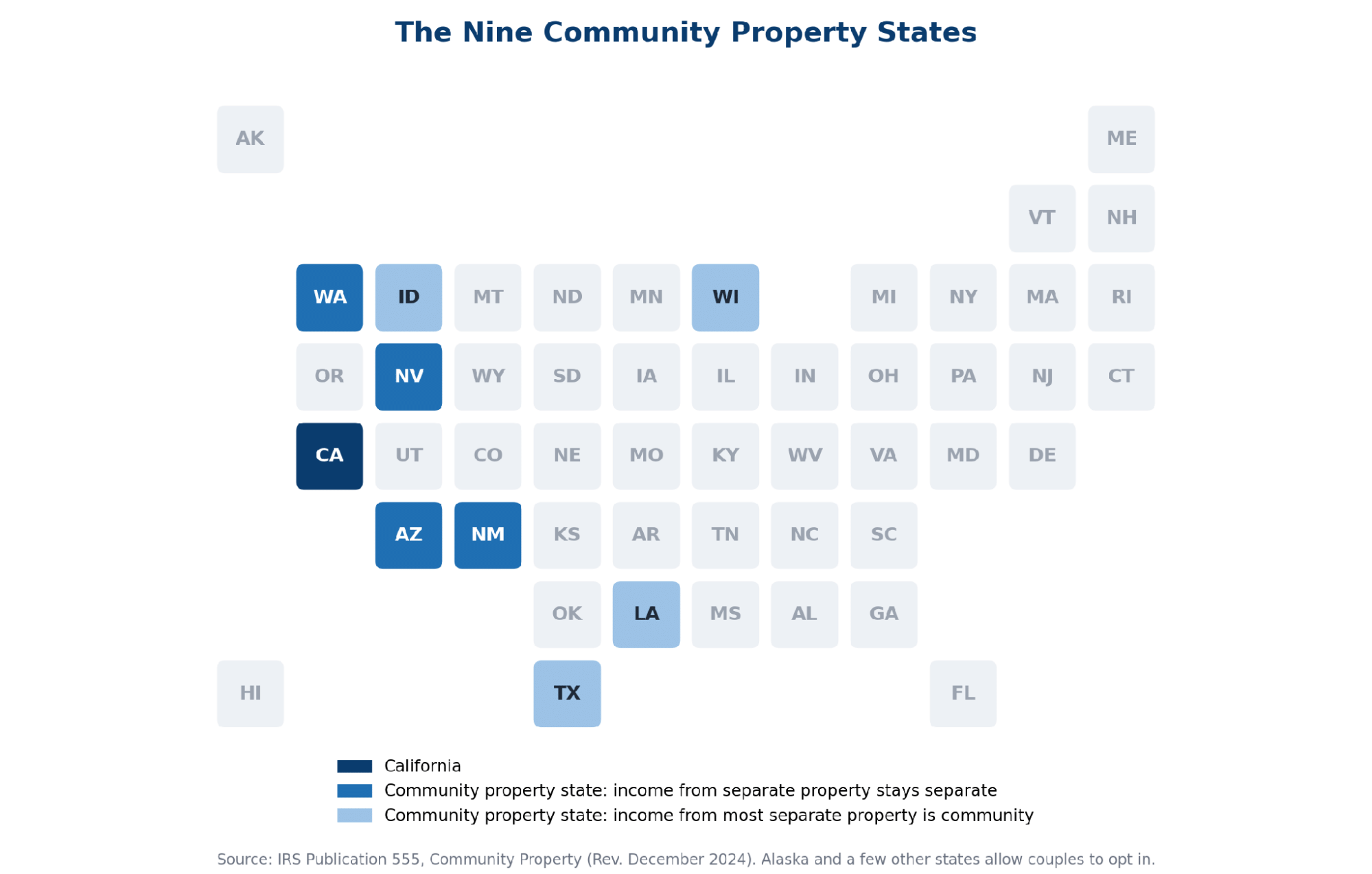
The nine community property states. California keeps income from separate property separate. Source: IRS Publication 555.
What Is Considered Community Property in California
If it was acquired during the marriage and before separation, it is presumed to be community property. Common examples include:
- Wages, salaries, bonuses, and commissions earned during the marriage, including bonuses paid after separation for work performed before it.
- A home or other real estate purchased during the marriage, even if only one spouse is on title.
- Retirement contributions and pension benefits earned during the marriage.
- Stock options and restricted stock units, to the extent they were earned by work performed during the marriage.
- A business started during the marriage, including its goodwill.
- Vehicles, furniture, and other personal property bought with marital earnings.
- Debts taken on during the marriage, such as credit cards, car loans, and mortgages.
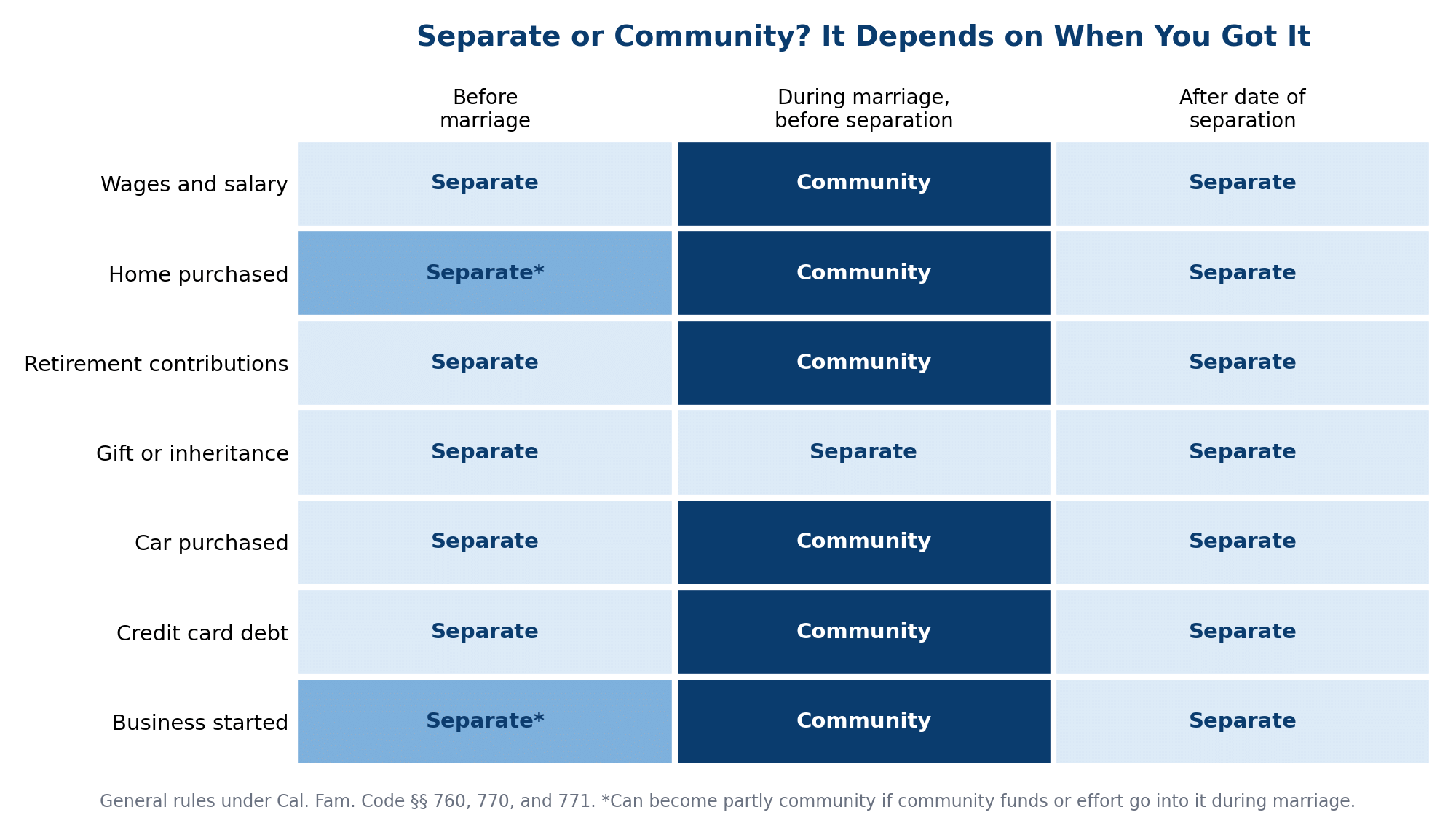
How timing determines character. General rules under Family Code sections 760, 770, and 771.
What Is Not Community Property: The Main Exceptions
Family Code section 770 lists the core exceptions. Separate property includes:
- Everything you owned before the marriage.
- Gifts, bequests, and inheritances you receive during the marriage, even if received the day after the wedding.
- Rents, profits, and income generated by separate property.
- Earnings and accumulations after the date of separation, under Family Code section 771.
- Property that a valid premarital agreement or written transmutation designates as separate.
Two categories surprise people. Personal injury damages received during marriage are community property, but at divorce they are generally assigned to the injured spouse under Family Code section 2603 unless fairness requires otherwise. Education loans are usually treated as the debt of the spouse who received the education, and the community may be entitled to reimbursement if marital funds paid for that education.
Is an Inheritance Community Property in California?
No. An inheritance is separate property no matter when during the marriage you receive it. The risk is not the inheritance itself. The risk is what you do with it.
If you deposit inherited money into a joint checking account, pay household bills from it, and refill it with paychecks, the separate money becomes very hard to trace. When a spouse cannot trace funds back to a separate source, the community property presumption can take over. Keeping an inheritance in its own account, in your name alone, is the simplest way to preserve it.
When Separate Property Becomes Community Property
Separate property can change character in two main ways.
Commingling
Commingling means mixing separate and community property together. Mixing does not automatically convert separate property, but it shifts the burden. The spouse claiming a separate interest has to trace it with records, often bank statements going back years. Courts accept tracing methods such as direct tracing and exhaustion of community funds, but only if the paperwork exists.
Transmutation
Spouses can agree to change separate property into community property, or the reverse. Since 1985, that change has required a writing. Under Family Code section 852, a transmutation is valid only if it is made in a written declaration that is expressly made, consented to, or accepted by the spouse whose interest is adversely affected. The California Supreme Court held in Estate of MacDonald (1990) that the writing must clearly state that ownership is changing. A casual signature on a loan document usually is not enough.
The Court of Appeal reinforced this in In re Marriage of Bonvino (2015). When a home is bought during marriage with a mix of separate and community money, the court must first decide whether a valid section 852 transmutation occurred. Without one, the spouse who contributed separate funds keeps a proportional ownership interest rather than a simple dollar-for-dollar reimbursement.
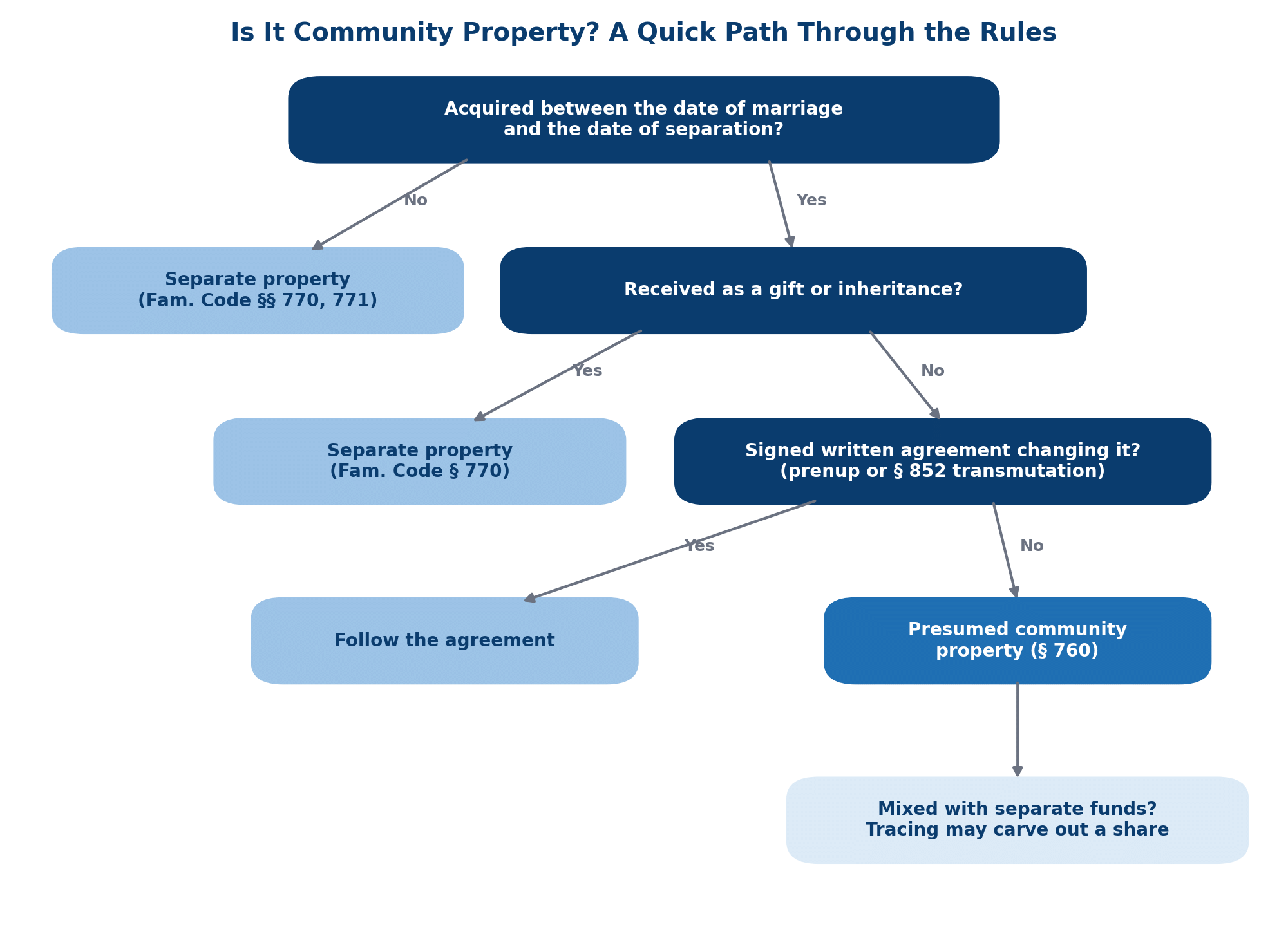
A simplified path through California’s characterization rules. Real cases often turn on tracing and documentation.
The House You Owned Before Marriage
This is the question California couples ask most. If you bought a home before marriage, it remains your separate property. But if mortgage payments during the marriage came from your paychecks, which are community property, the community earns a share of the home’s equity.
Courts usually calculate that share using the formula from In re Marriage of Moore (1980) and In re Marriage of Marsden (1982). The community receives the principal it paid down plus a proportional share of the appreciation that occurred during the marriage. Interest, property taxes, and insurance payments do not count toward the community share.
A Worked Example
Suppose you bought a house for $500,000 two years before the wedding with a $100,000 down payment and paid $20,000 of principal before you married. The house was worth $600,000 on your wedding day. During the marriage, $80,000 of principal was paid with marital earnings. At divorce, the house is worth $900,000, close to California’s statewide median, and the remaining loan balance is $300,000.
Step | Calculation | Result |
Community percentage | $80,000 community principal divided by $500,000 purchase price | 16% |
Separate percentage | 100% minus 16% | 84% |
Appreciation during marriage | $900,000 minus $600,000 | $300,000 |
Community interest | $80,000 principal plus 16% of $300,000 | $128,000 |
Separate interest | $100,000 down plus $20,000 principal plus $100,000 pre-marriage appreciation plus 84% of $300,000 | $472,000 |
Each spouse’s community half | $128,000 divided by 2 | $64,000 |
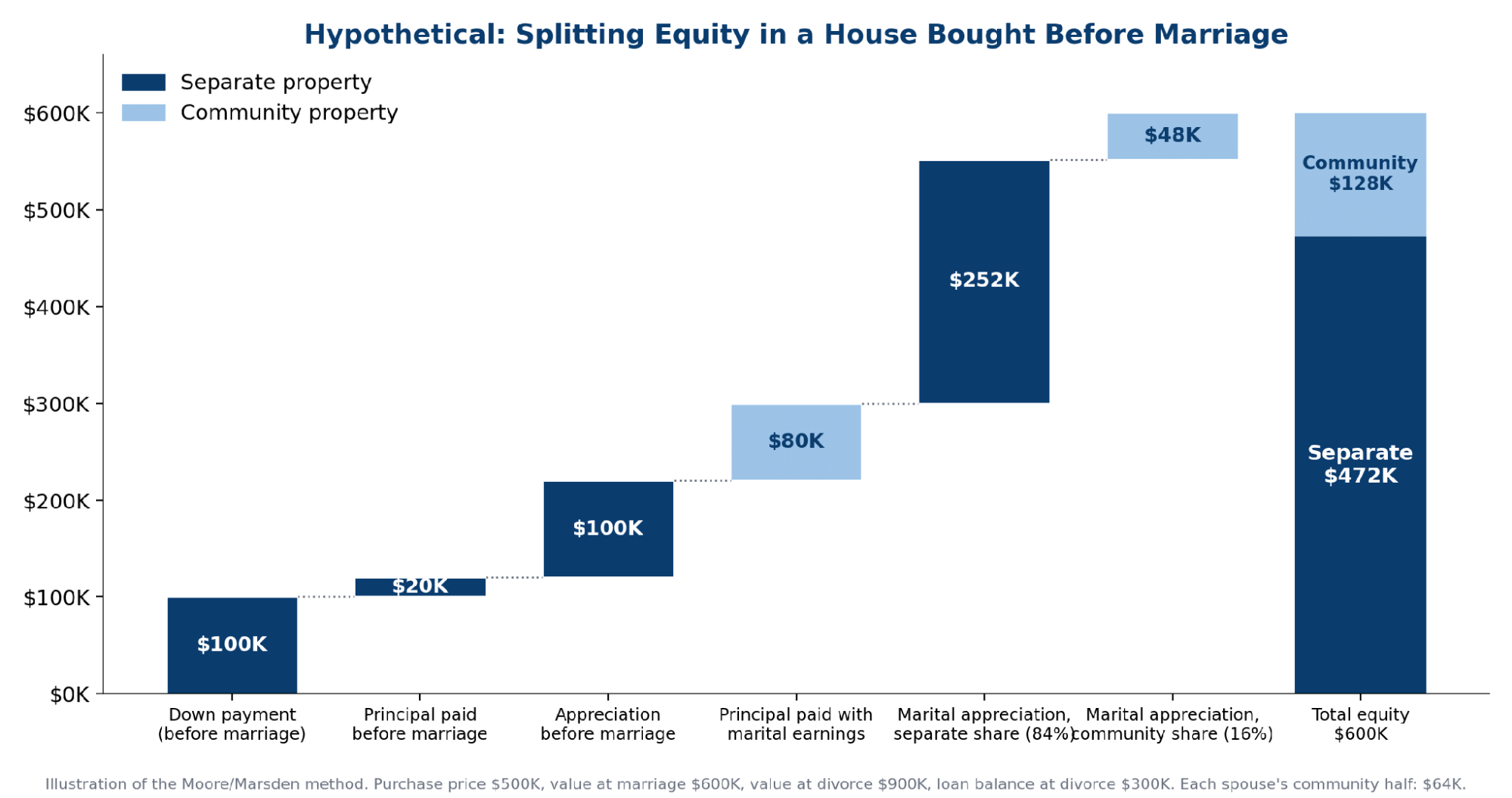
Hypothetical Moore/Marsden calculation. Your actual numbers will depend on your loan history and appraisals.
In this example, the home stays yours, but your spouse is entitled to $64,000 of the equity. If title was later changed to joint tenancy, or you refinanced and added your spouse to the deed, the analysis can shift significantly under Family Code section 2581 and the transmutation rules above.
Retirement Accounts, Businesses, and Debts
Retirement Accounts
A 401(k), IRA, or pension is often part separate and part community. Contributions before marriage are separate, contributions during marriage are community, and contributions after separation are separate again. Pensions are commonly divided with a time rule that compares the years of service during the marriage to total years of service. Dividing a plan without tax penalties usually requires a qualified domestic relations order.
Businesses
A business started during the marriage is presumed to be community property. A business started before marriage stays separate, but the community may claim a share of its growth if a spouse’s work during the marriage increased its value. Courts use two approaches. The Pereira method gives the separate owner a fair return on the original investment and treats the remaining growth as community.
The Van Camp method pays the community a fair salary for the spouse’s work and treats the remaining growth as separate. Which method applies depends on whether the growth came mainly from personal effort or from the business’s own capital and market conditions.
Debts
Under Family Code section 910, the community estate is generally liable for debts either spouse incurs during the marriage. In a divorce, the court divides community debts along with community assets. A spouse’s creditors may still pursue that spouse even after a judgment assigns the debt to the other spouse, so the division order should include protections such as indemnification.
Quasi-Community Property for Couples Who Moved to California
If you married and acquired property in another state, then moved to California, that property is not technically community property. California treats it as quasi-community property under Family Code section 125 and divides it the same way at divorce. Couples who married in states with different rules, or who never formally married, can face extra questions. Our guide on whether California recognizes out-of-state common law marriages covers that situation.
The 7-Year and 10-Year Myths
Many people believe a spouse becomes entitled to half of everything after 7 or 10 years of marriage. That is not how California property law works. Property is characterized by when and how it was acquired, whether the marriage lasted 2 years or 30.
The 10-year figure comes from Family Code section 4336, which treats a marriage of 10 years or longer as a long-duration marriage for spousal support. In those cases, the court may keep jurisdiction over support indefinitely. Our explainer on how California alimony is calculated explains what that means in practice.
What Happens to Community Property When a Spouse Dies
Community property matters outside of divorce too. When a spouse dies, the surviving spouse already owns their half of the community property. The deceased spouse can leave the other half by will or trust. If there is no will, Probate Code section 6401 gives that half to the surviving spouse.
Property held as community property with right of survivorship under Civil Code section 682.1 passes automatically to the survivor. When family members disagree about what was community and what was separate, the dispute often becomes a California probate litigation matter.
How Community Property Is Actually Divided
Equal division means equal in value, not that every item is cut in half. One spouse may keep the house while the other keeps retirement accounts of similar value, or one spouse may buy out the other’s interest. The process typically includes:
- Exchanging financial disclosures, including the Declaration of Disclosure (FL-140) and the Schedule of Assets and Debts (FL-142) or Property Declaration (FL-160).
- Characterizing each asset and debt as community, separate, or mixed.
- Valuing each community asset, often with appraisals or business valuations.
- Allocating assets and debts so each spouse receives an equal net share.
- Putting the division into a written judgment, plus any orders needed to divide retirement plans.
Honesty in disclosure is not optional. Under Family Code section 1101, a court can award a spouse 50% of an asset the other spouse concealed, and up to 100% if the concealment involved fraud, oppression, or malice. Assets discovered after judgment can still be divided under Family Code section 2556.
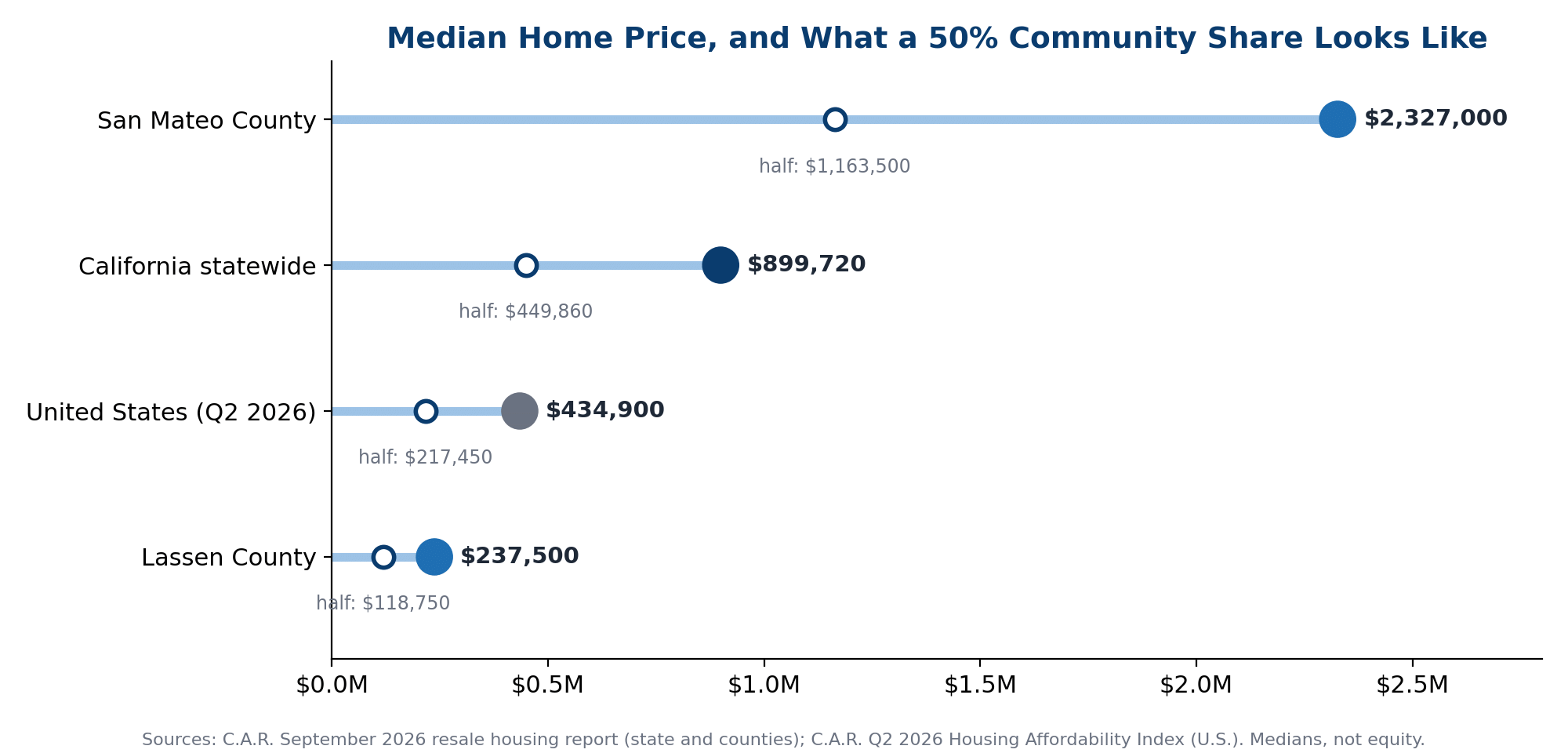
Why characterization disputes get expensive in California. A 50% community share of a median California home is worth more than a typical U.S. home.
With California’s statewide median home price at $899,720 in September 2026, according to the California Association of Realtors, a single characterization mistake on a house can move hundreds of thousands of dollars from one spouse to the other. In counties like San Mateo, where the median reached $2,327,000, the stakes are even higher. If you are in the Bay Area, our San Jose divorce lawyers handle property division cases involving tech compensation, real estate, and closely held businesses every week.
Not sure what is yours and what is shared? Amiel Wade has been named one of California’s Top Ten Family Law Attorneys by the National Academy of Family Law Attorneys and holds a 10.0 Avvo rating. Call (408) 842-1688 for a free case evaluation.
Records That Help Prove Separate Property
Tracing wins or loses many separate property claims. These records make the strongest case.
Record | What It Proves |
Bank and brokerage statements from before marriage | The balance you brought into the marriage |
Closing statements and deeds | Down payment source, purchase price, and how title was taken |
Mortgage statements showing principal paid | The community’s paydown for a Moore/Marsden calculation |
Probate documents or gift letters | That an asset was inherited or gifted to you alone |
Retirement plan statements at marriage and separation | The separate and community portions of each account |
Premarital agreement or signed transmutation | Any agreed change to the default rules |
Business formation documents and valuations | When the business started and what it was worth at marriage |
Frequently Asked Questions About California Community Property
Is California a 50/50 divorce state?
For property, yes. Family Code section 2550 requires the court to divide the community estate equally unless the spouses agree otherwise in writing or on the record in court. Equal means equal in value, so one spouse may keep the house while the other receives assets of the same total worth. Spousal support and child support are decided separately and are not split 50/50.
Is an inheritance community property in California?
No. An inheritance received during marriage is separate property under Family Code section 770, and in California the income it produces stays separate too. It can lose that status if it is deposited into a joint account and mixed with marital funds, or if the inheriting spouse signs a written transmutation.
Can my spouse take my house if I bought it before marriage in California?
The house itself stays your separate property, but the community can earn a share if marital earnings paid down the mortgage principal during the marriage. Courts usually calculate that share with the Moore/Marsden formula. Adding your spouse to the title can also change the analysis, so get advice before refinancing or re-deeding.
Is there a 7-year or 10-year rule for community property in California?
No. Property is characterized by when and how you acquired it, not by how long you were married. The 10-year figure comes from Family Code section 4336, which treats a marriage of 10 years or more as long-duration for spousal support purposes. It has nothing to do with dividing property.
Is debt community property in California?
Generally, yes. Debts incurred by either spouse during the marriage and before separation are usually community obligations, even if only one name is on the account. Debts incurred before marriage or after separation are generally the separate debt of the spouse who incurred them, and education loans are usually assigned to the spouse who received the education.
What happens to community property when a spouse dies in California?
The surviving spouse already owns half of the community property. The other half passes under the deceased spouse’s will or trust. If there is no will, Probate Code section 6401 gives the deceased spouse’s half of the community property to the surviving spouse.
Do retirement accounts count as community property?
Contributions and growth earned during the marriage, up to the date of separation, are community property. Contributions made before marriage or after separation are separate. Splitting a 401(k) or pension usually requires a court order, often a qualified domestic relations order, so the plan can divide it without tax penalties.
Can a prenup override California community property law?
Yes. A valid premarital agreement under the Uniform Premarital Agreement Act can keep earnings, businesses, or appreciation separate. During marriage, spouses can change the character of property only with a written transmutation that meets Family Code section 852.
Common Concerns Before Calling a Divorce Attorney
“We agree on everything. Do we really need a lawyer?”
Agreement helps, but it does not guarantee the division is equal or enforceable. Mistakes in characterizing a house, a 401(k), or stock compensation are common, and a judgment can be hard to change once it is entered. A review before you sign costs far less than fixing it later.
“I do not want this to turn into a fight.”
Most property issues can be resolved through negotiation or mediation. Knowing your rights is what allows you to settle with confidence instead of guessing.
“I cannot afford a long court battle.”
A free evaluation can tell you which issues are worth contesting and which are not, so you can focus your time and money where it matters.
What Happens When You Call
When you call, a member of our team will ask a few basic questions about your marriage, your assets, and where your case is or will be filed. There is no cost for the initial evaluation. If it is a fit, an attorney will review your situation, explain which assets are likely community or separate, and outline your options. You will leave the conversation with a clear picture of what is at stake and what to do next.
Keep Reading
For an overview of the whole process, start with our California divorce attorneys page or our broader California family law overview. If timing is your main concern, our guide to how fast you can finalize a divorce in California explains the six-month waiting period and what can speed things up.
Talk to a California Community Property Attorney
Amiel Wade has practiced law in California since 1996 and has been recognized as one of the state’s Top Ten Family Law Attorneys by the National Academy of Family Law Attorneys. Whether you need to protect separate property, prove a community share, or divide a business, call (408) 842-1688 for a free case evaluation.
Sources
- IRS, Publication 555: Community Property (Rev. December 2024)
- Judicial Branch of California, Property and Debts in a Divorce
- California Family Code section 2640, Reimbursement of Separate Property Contributions
- Justia Opinion Summary, In re Marriage of Bonvino (2015)
- California Association of Realtors, September 2026 Home Sales and Price Report (via PR Newswire)
- 10News, Home Sales Slow Across San Diego County, Statewide (county medians, September 2026)
- California Association of Realtors, Second Quarter 2026 Housing Affordability Index
- State Bar of California, Attorney Profile: Amiel Lee Wade