

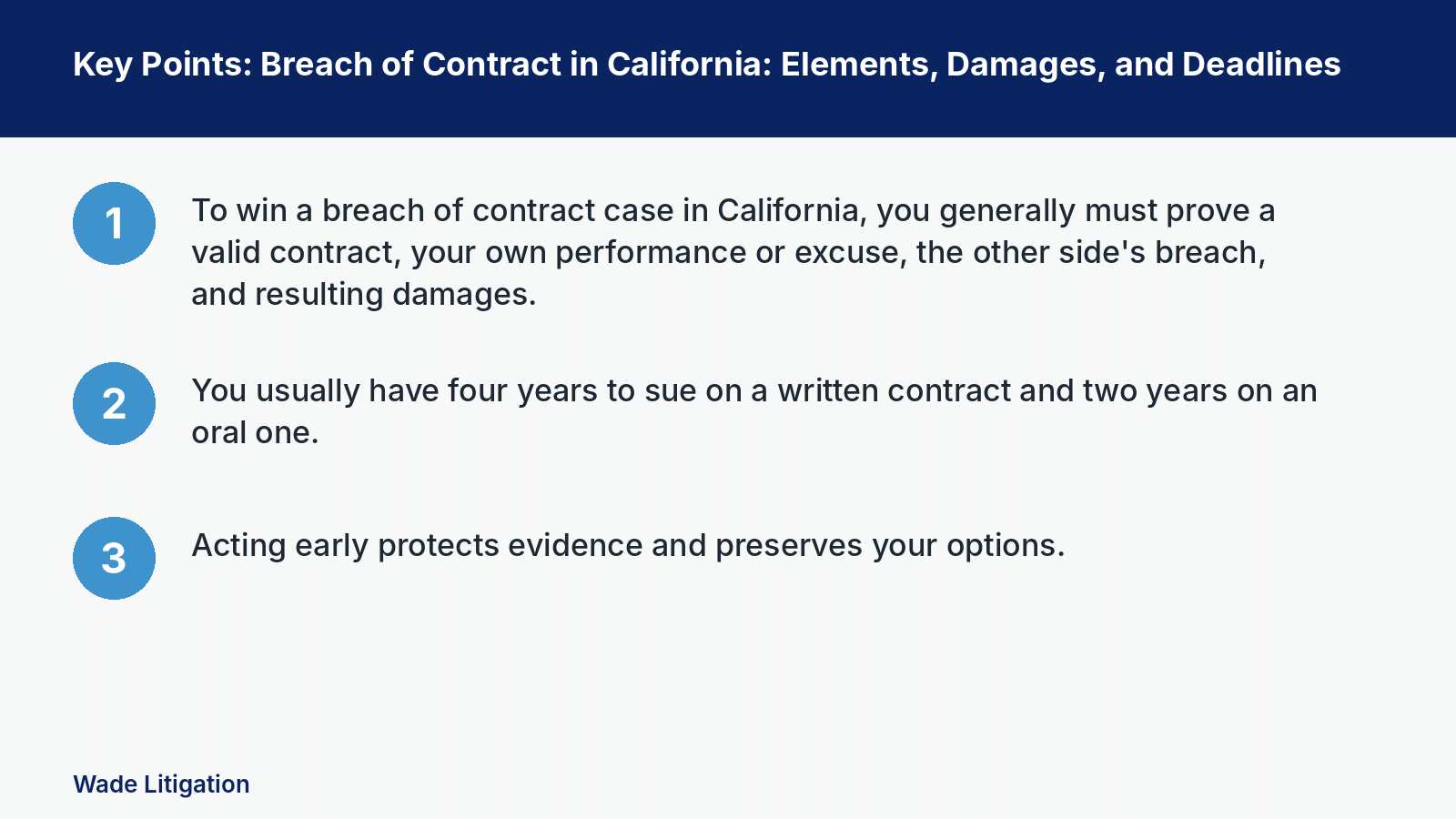
To win a breach of contract case in California, you generally must prove a valid contract, your own performance or excuse, the other side’s breach, and resulting damages. You usually have four years to sue on a written contract and two years on an oral one. Acting early protects evidence and preserves your options.
Contracts hold business relationships together, from vendor agreements and leases to partnership deals and service contracts. When one side fails to hold up its end, the other side may face lost revenue, unpaid invoices, or a project that stalls halfway through. California law gives the injured party ways to recover, but the claim has specific elements and firm deadlines.
This guide explains how breach of contract claims work in California and what businesses and individuals should do when a deal falls apart.
The Four Elements of a Breach of Contract Claim
California courts generally require a plaintiff to prove four things:
- A contract existed between the parties, whether written, oral, or implied by conduct.
- The plaintiff performed its obligations or had a valid excuse for not performing.
- The defendant failed to perform or performed in a way the contract did not allow.
- The plaintiff suffered damages as a result of that breach.
Each element needs evidence. Signed agreements, emails, purchase orders, invoices, and payment records often carry the case. When the contract is oral, witness testimony and the parties’ conduct become especially important.
Written, Oral, and Implied Contracts in California
California recognizes three main kinds of contracts. A written contract is signed by the parties and sets out the terms on paper or electronically. An oral contract is formed by spoken agreement. An implied contract is shown by the parties’ conduct, such as a business that keeps accepting and paying for deliveries under the same terms.
Each type can be enforced, but the proof differs. Written contracts are easiest to prove because the terms are in the document. Oral and implied contracts depend on emails, texts, invoices, payment history, and witness testimony to show what the parties agreed to.
Some agreements must be in writing under California’s statute of frauds, including contracts for the sale of real estate and agreements that cannot be performed within one year. Putting important deals in writing avoids many disputes before they start.
Material and Minor Breaches
Not every breach is equal. A material breach goes to the heart of the deal, such as a supplier that never delivers or a buyer that refuses to pay. A material breach may allow the other party to stop performing and sue for damages. A minor breach, such as a short delay that causes little harm, usually allows a claim for damages but does not excuse the other party from performing.
Damages You May Recover
The goal of contract damages is to put the injured party in the position it would have been in if the contract had been performed.
- Expectation damages, such as lost profits or the cost of hiring someone else to finish the work
- Consequential damages that were reasonably foreseeable when the contract was made
- Incidental costs, such as storage, shipping, or inspection expenses
- Attorney fees, but only when the contract includes a fee provision or a statute allows them
- Interest on amounts owed
Punitive damages are generally not available for a simple breach of contract in California. Courts may also order specific performance in some cases, such as real estate deals, when money alone would not make the injured party whole.
The Duty to Mitigate
California requires the injured party to take reasonable steps to limit its losses. A landlord must try to re-rent, and a business that loses a supplier should look for a replacement. Damages that could have been avoided with reasonable effort may be reduced.
Statute of Limitations for Breach of Contract
Deadlines depend on the type of contract:
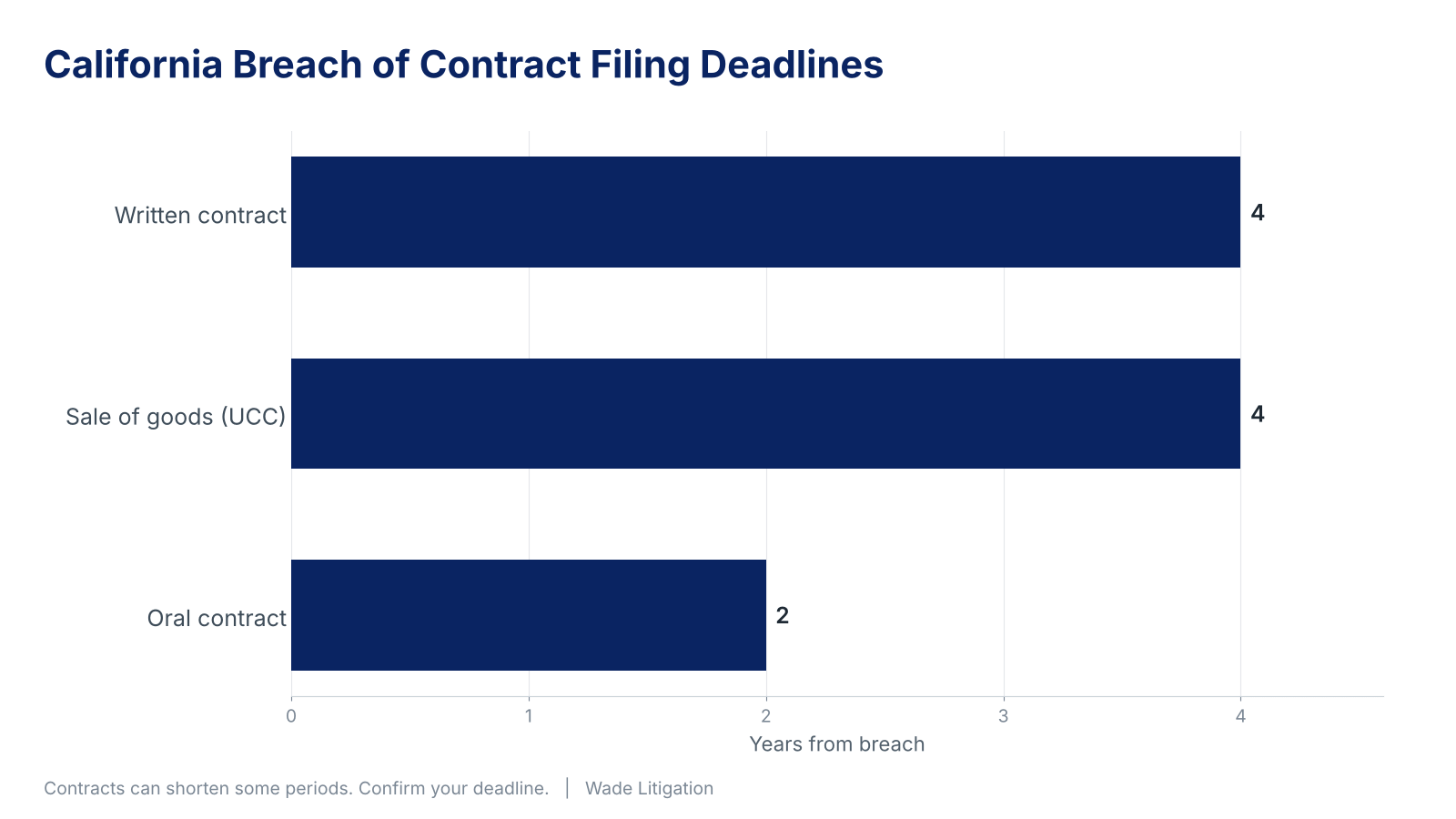
- Written contracts: four years from the breach under Code of Civil Procedure section 337
- Oral contracts: two years from the breach under Code of Civil Procedure section 339
- Contracts for the sale of goods: generally four years under the Commercial Code
Some contracts shorten these periods, and the discovery rule may delay the start of the clock in limited situations. Because missing a deadline can end the claim, it is wise to confirm the exact date early.
The clock usually starts on the date of breach, not the date the contract was signed. For contracts with ongoing payments, each missed payment may start its own limitations period. Parties sometimes sign tolling agreements that pause the deadline while they negotiate, which can be useful but should be put in writing.
California courts generally allow a contract to shorten the time to sue as long as the shorter period is reasonable. Before relying on the default four-year or two-year period, read the contract for a clause that sets a different deadline.
Common Defenses
Defendants often argue that no enforceable contract existed, that the plaintiff breached first, that the contract was modified or waived, that performance was impossible, or that the claim is too late. Fraud, mistake, and duress may also be raised. A careful review of the agreement and related communications helps anticipate these arguments.
Steps to Take When a Contract Is Breached
- Gather the contract, amendments, and all related emails and texts.
- Document every missed deadline, payment, or deliverable.
- Send a written demand that identifies the breach and requests a cure, if appropriate.
- Check the contract for notice, mediation, arbitration, and fee provisions.
- Track your losses and your efforts to reduce them.
Many disputes resolve through negotiation or mediation, but preparing as if the case will be litigated strengthens your position. Wade Litigation handles these disputes as part of its business litigation practice.
Frequently Asked Questions
What is the statute of limitations for breach of contract in California?
Generally, four years for written contracts and two years for oral contracts, measured from the date of breach.
Can I recover attorney fees in a California breach of contract case?
Only if the contract has an attorney fee provision or a statute allows fees.
Is a verbal agreement enforceable in California?
Many oral agreements are enforceable, though some contracts, such as real estate sales, must be in writing.
Can I get punitive damages for breach of contract?
Generally no, unless the conduct also supports a separate claim such as fraud.
What is a material breach?
A breach serious enough to defeat the main purpose of the contract, which may excuse the other party from performing.
How can I prove an oral contract in California?
Use any evidence that shows the agreement and its terms, such as texts, emails, invoices, payments, partial performance, and testimony from people who heard the deal. Writing down your recollection of the terms as soon as possible also helps.
Talk to a California Business Litigation Attorney
Wade Litigation represents businesses and individuals in contract disputes throughout California. When you call (408) 214-5225 for a free evaluation, our team will ask about the agreement, the breach, and your losses, then explain your options and deadlines. Learn more about our civil litigation services.