Wade Litigation is a San Diego divorce law firm handling uncontested, contested, high asset, and military divorces throughout San Diego County. California is a community property state with a six-month residency requirement and a mandatory six-month waiting period before a divorce is final. Divorce costs in San Diego range from under $1,000 for a simple uncontested case to more than $40,000 for a fully litigated dispute. Wade Litigation offers a free case evaluation for San Diego residents considering divorce.
Ending a marriage is one of the most stressful legal events a person can face, and San Diego County sees thousands of new divorce filings every year. Wade Litigation represents spouses across San Diego in uncontested, contested, high-asset, and military divorce matters, guiding clients from the initial filing through final judgment.
Here, you can learn how San Diego, California divorce law works, what a divorce typically costs in San Diego, how long the process takes, and what to expect at each stage, backed by current court data and local statistics.
Why San Diego Families Trust Wade Litigation
Wade Litigation has built its family law practice on direct communication and consistent results for clients throughout San Diego County. The firm handles the full range of divorce matters, from simple uncontested filings to complex, high net worth disputes involving business interests, retirement accounts and real estate.
Every client works with an attorney and a dedicated client liaison who tracks the case and answers questions as it moves through the San Diego Superior Court.
The firm’s work has been recognized with numerous industry honors, including:
- Top Rated Family Law Attorney, National Academy of Family Law Attorneys
- Top Rated Family Law Attorney, American Institute of Family Law Attorneys
- Top Ten California Attorney, National Academy of Family Law Attorneys
- Lawyer of the Year in Civil Litigation, American Institute of Legal Professionals
- Top 100 Attorney in the US, Top 100 Magazine
San Diego Divorce Statistics and Trends (2026)
San Diego County is home to about 3.28 million residents, making it the second most populous county in California (U.S. Census Bureau, 2025 estimate). Divorce remains a common life event locally. Census Bureau and county-level survey data show that roughly 9.9 percent of San Diego County adults are currently divorced, slightly higher than the statewide share of about 8.9 percent.
California’s overall divorce rate, at approximately 5.9 divorces per 1,000 women in 2022, runs below the national rate of 7.1 per 1,000 women reported by the Census Bureau for the same year.
Filing volume tells a different story than the popular narrative of an ever-rising divorce rate. The California Judicial Council’s 2026 Court Statistics Report found that marital filings statewide dropped to a multi-decade low in fiscal year 2024-25, continuing a long-term decline in new divorce cases even as the state’s population has grown.
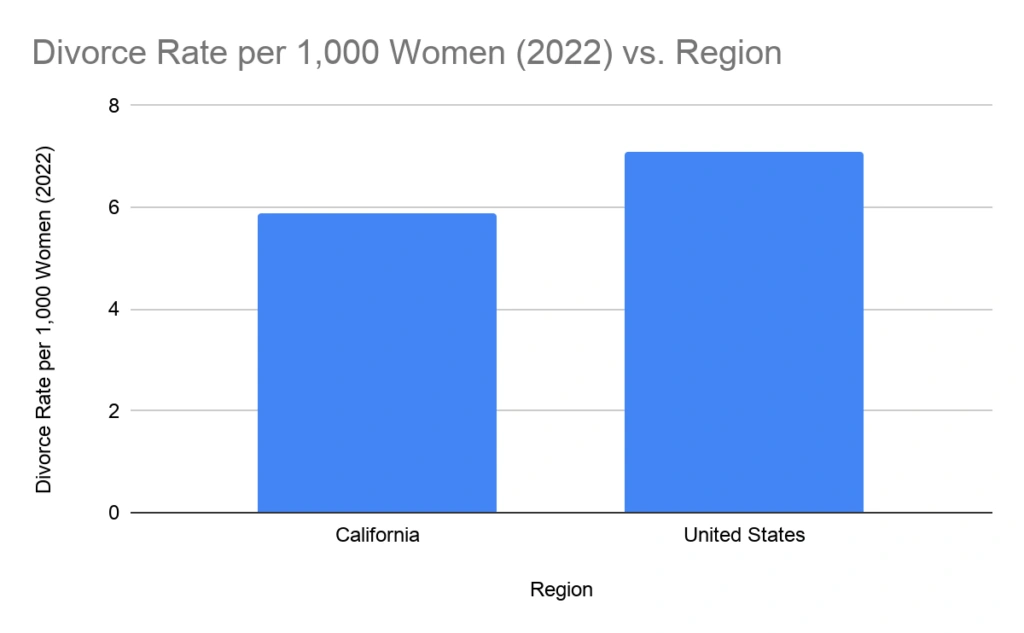
Chart 1: Divorce rate per 1,000 women, California vs. United States, 2022. Source: U.S. Census Bureau.
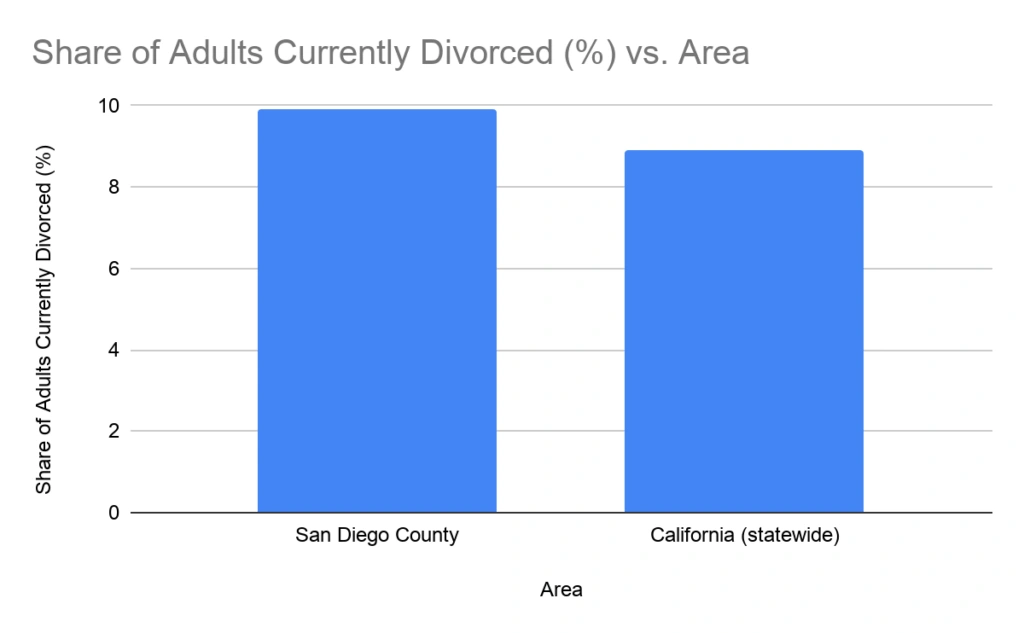
Chart 2: Share of adults currently divorced, San Diego County vs. California statewide. Source: U.S. Census Bureau American Community Survey estimates, county level analysis.
How Much Does a Divorce Cost in San Diego
Cost is one of the first questions most people ask before filing. The price of a San Diego divorce depends almost entirely on how much the spouses agree on before the case begins.
- Uncontested divorce: around $500 to $5,000 total, including the $435 to $450 California filing fee, when both spouses agree on all major terms.
- Mediated or collaborative divorce: typically $5,000 to $15,000, since spouses work with a neutral mediator or collaborative attorneys instead of litigating in court.
- Contested or litigated divorce: $15,000 to $40,000 or more, particularly when custody, business valuation or high value assets are disputed.
Statewide, average total legal fees for a divorce without children run around $17,500, and average around $26,000 when children are involved, according to family law fee surveys cited by California family law firms. Wade Litigation provides a free case evaluation so clients can understand which category their case is likely to fall into before committing to representation.
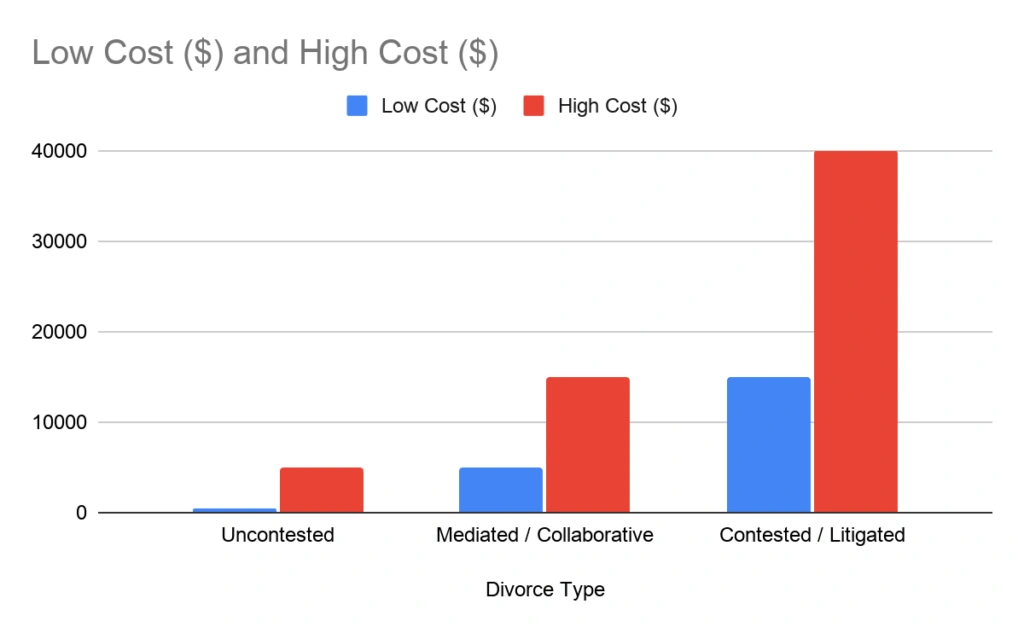
Chart 3: Typical low and high cost range by divorce type in San Diego. Source: aggregated San Diego family law fee data, Hello Divorce, Goldberg Jones, Skaja Daniels and Luu, 2025 to 2026.
The California Divorce Process Step by Step
Every divorce filed in San Diego Superior Court follows the same basic legal sequence, whether the case settles quickly or goes all the way to trial.
- Meet residency requirements. At least one spouse must have lived in California for six months and in San Diego County for three months before filing.
- File the petition. The filing spouse submits a Petition for Dissolution, Form FL-100, with the San Diego Superior Court.
- Serve the other spouse. The responding spouse must be formally served and given 30 days to respond.
- Exchange financial disclosures. Both spouses complete preliminary declarations of disclosure covering income, assets and debts.
- Negotiate or litigate remaining issues. Property division, support and custody are resolved through negotiation, mediation or trial.
- Wait out the mandatory period. California imposes a six month waiting period from the date the respondent is served before any divorce can be finalized.
- Receive final judgment. Once all issues are resolved and the waiting period has passed, the court enters a judgment ending the marriage.
Community Property and Division of Assets
California is a community property state, meaning most assets and debts acquired during the marriage are divided equally between spouses regardless of whose name is on the account or title. Separate property, generally anything owned before marriage or received individually as a gift or inheritance, typically stays with the original owner.
In San Diego, common disputes involve the division of military and retirement benefits, family businesses, real estate purchased during the marriage and stock compensation, all of which can require valuation experts to divide fairly. For a full breakdown of how specific assets are classified and valued, see our dedicated property division guide.
Spousal Support in San Diego Divorces
California divorce law treats spousal support differently depending on the length of the marriage. For marriages under 10 years, support generally lasts about half the length of the marriage. For marriages of 10 years or longer, classified as long duration marriages under Family Code section 4336, the court keeps jurisdiction over support indefinitely, meaning there is no automatic end date.
This is often mischaracterized online as a ten year rule guaranteeing lifetime alimony, but California courts confirm there is no such guarantee. Judges instead weigh factors such as each spouse’s earning capacity, the standard of living during the marriage, and the length of the marriage itself.

Child Custody and Child Support Basics
Many San Diego divorces involve minor children, which adds custody and child support into the case. California courts decide legal custody, meaning who makes major decisions for the child, and physical custody, meaning where the child lives, separately, and either can be sole or joint.
Child support is then calculated using a statewide guideline formula based on both parents’ incomes and the amount of time each parent spends with the child. Because custody and support involve their own detailed rules, we cover them in full in our dedicated San Diego child custody and child support guides, which this page links to for readers who need that level of detail.
Military Divorce in San Diego
San Diego is home to one of the largest concentrations of active duty military in the country, including Naval Base San Diego, Marine Corps Base Camp Pendleton, Marine Corps Recruit Depot San Diego, and Naval Base Point Loma.
Military divorces involve added layers most civilian divorces do not, including division of military retirement benefits under the Uniformed Services Former Spouses Protection Act, the Survivor Benefit Plan, and deployment-related scheduling for custody and service of process. Search data shows steady local demand for this expertise, with terms like military divorce lawyer san diego and san diego military divorce lawyer together drawing hundreds of monthly searches.
Wade Litigation represents both service members and military spouses throughout San Diego County.
Types of Divorce Cases We Handle
Wade Litigation represents San Diego clients across every type of divorce case, including:
- Uncontested divorce
- Contested divorce
- High asset and high net worth divorce
- Collaborative divorce
- Divorce mediation
- Same-sex divorce
- Military divorce
Why Divorce Rates Climb With Each Marriage
National research consistently shows that the likelihood of divorce increases with each subsequent marriage. Roughly 45 percent of first marriages end in divorce, while an estimated 60 percent of second marriages and 73 percent of third marriages end the same way, according to family law research cited by multiple firms.
Blended families, prior support obligations and shorter courtship periods are commonly cited contributing factors, and they often make these later divorces more complex to resolve.

Chart 4: Estimated divorce rate by marriage number. Source: family law research aggregated by The Sands Law Group and related family law publications.


Why Choose Wade Litigation for Your San Diego Divorce
Divorce affects finances, parenting time, and daily life for years after the case closes, so the attorney you choose matters. Wade Litigation combines award-winning trial experience with a client-first process, including a dedicated liaison for every case and clear communication from filing through final judgment. Whether the goal is a fast, low-conflict resolution or aggressive representation in a contested, high-asset dispute, Wade Litigation builds a strategy around each client’s specific goals.
Call 408-214-5225 or complete the intake form for a free, no-obligation case evaluation with a San Diego divorce attorney.
Frequently Asked Questions
Sources
- U.S. Census Bureau, San Diego County QuickFacts, 2025 estimate, and U.S. Marriage and Divorce Rates by State, 2012 and 2022
- California Judicial Council, 2026 Court Statistics Report, Statewide Caseload Trends
- California Courts Self-Help Center, guidance on long term spousal support, and California Family Code section 4336
- San Diego Superior Court, Family Law Self-Help resources
- Aggregated San Diego family law fee data, including Hello Divorce, Goldberg Jones, and Skaja Daniels and Luu
- SEMrush Keyword Overview and Keyword Magic Tool, keyword volume and difficulty data pulled August 2026