When parents in San Diego separate, the question of where a child will live and who will make important decisions on their behalf often becomes the most emotional part of the case. At Wade Litigation, we represent mothers and fathers throughout San Diego County in legal and physical custody disputes, from first filings through Family Court Services counseling and, when necessary, contested hearings in San Diego Superior Court.
This page was built specifically for San Diego parents. It covers the local court procedures, the county’s unique approach to custody counseling, the state laws that shape every decision, and the resources available if you cannot afford private representation. If you need to speak with an attorney today, call us at 866-925-4552 for a free case evaluation.
Why San Diego Parents Choose Wade Litigation for Custody Matters
San Diego is one of the largest and most diverse counties in California, and no two custody cases that come through our office look the same. Some of our clients are active duty service members stationed at Naval Base San Diego or Marine Corps Base Camp Pendleton who need a custody order that can survive a deployment.
Others are parents navigating a first custody filing after a breakup, or a parent trying to modify an order that no longer reflects their child’s needs. We built our family law practice around direct communication and a methodical approach to preparing evidence, because custody cases are often won or lost on the details, including school records, medical history, communication logs, and the day-to-day realities of who is actually caring for the child.
Our attorneys have been recognized by the National Academy of Family Law Attorneys and the American Institute of Family Law Attorneys, and we bring that same level of preparation to every custody matter we accept in San Diego County.

Understanding Legal and Physical Custody Under California Law
Every California custody order is built from two separate components. Legal custody covers the right to make major decisions about a child’s health care, education, and welfare. Physical custody determines where the child actually lives day to day. Under Family Code section 3003, joint legal custody means both parents share the right and responsibility to make these decisions, while sole legal custody gives that authority to one parent alone.
Family Code section 3007 defines sole physical custody as a child residing with and under the supervision of one parent, subject to the other parent’s visitation, while joint physical custody under section 3004 means the child spends significant periods of time living with both parents.
California’s stated policy, found in Family Code section 3020, is that children benefit from frequent and continuing contact with both parents after separation, unless that contact would conflict with the child’s health, safety, or welfare. That policy shapes almost every decision a San Diego family court judge makes, and it is the starting point we use when building a parenting plan for our clients.
A well-drafted parenting plan goes beyond a simple weekend schedule. It should address holidays, school breaks, travel, and how the two of you will communicate about the child going forward, so there is less room for disagreement later. Once a custody order is in place, it is not set in stone.
California courts allow either parent to request a change when circumstances have shifted enough to affect the child’s needs, such as a change in work schedule, a move, or a change in the child’s school situation. Courts generally look for a genuine change since the last order was made, rather than simply relitigating old disagreements, and San Diego judges expect the same level of documentation for a modification request that they expect for an initial custody filing.
San Diego County Families by the Numbers
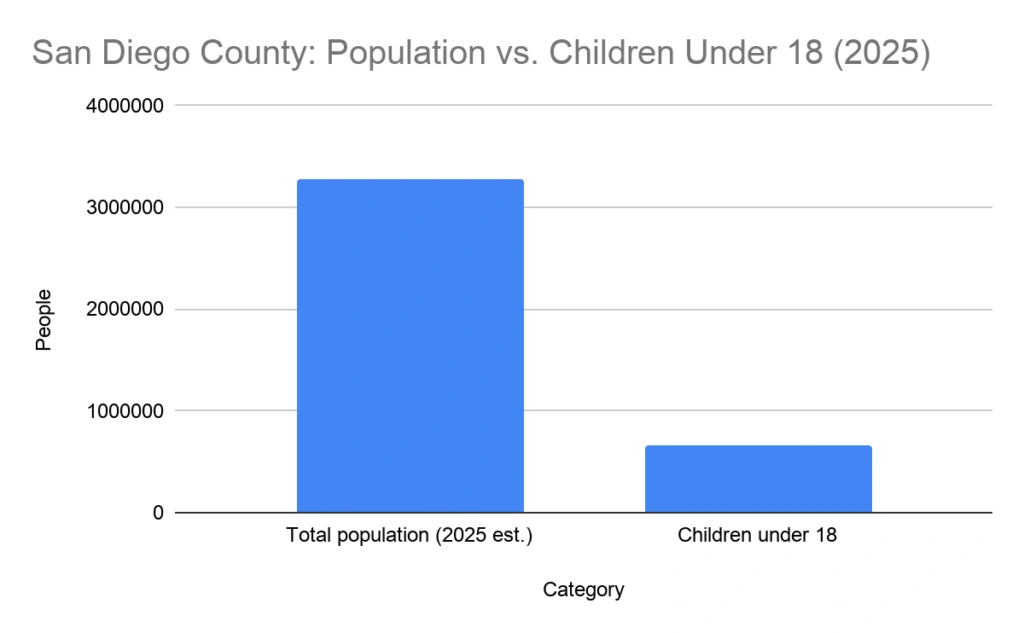
San Diego County is home to more than 3.28 million residents, and roughly one in five, or approximately 671,600 children, are under the age of 18, according to the latest U.S. Census Bureau estimates.
The county also includes more than 1.17 million households. With a population this size, San Diego Superior Court’s family law division processes an enormous volume of custody, divorce, and support filings every year, spread across four separate courthouse divisions. Understanding the scale of the local court system helps explain why preparation matters so much. A case that is missing paperwork or filed in the wrong division can lose weeks or months of momentum, time that matters when a parenting schedule is in limbo.
Source: U.S. Census Bureau, QuickFacts San Diego County, California, 2025 population estimates.
How Custody Cases Proceed Through San Diego Superior Court
San Diego Superior Court hears family law matters, including custody, at four locations, the Central Division on Union Street in downtown San Diego, the North County Division in Vista, the East County Division in El Cajon, and the South County Division in Chula Vista. Which courthouse handles your case generally depends on where you or the other parent lives, so one of the first things we confirm for a new client is proper venue.
Once a custody request is filed, San Diego follows a process outlined in the court’s Local Rules, Division V. If the parents cannot agree on custody or a parenting schedule, the court will not go straight to a contested hearing. Instead, under Family Code section 3170, the parties are ordered to participate in mediation through the court’s Family Court Services department before a judge will decide the disputed issues. This mediation step is mandatory, not optional, and it is generally not skipped when custody or visitation is contested.
After Family Court Services, the court may issue temporary orders to cover the period while the case is pending. These temporary orders often set the practical schedule for months, so we push hard to make sure our clients are prepared before that hearing rather than after. If the parents still cannot reach a full agreement, the case proceeds toward a trial, though most San Diego custody cases resolve before ever reaching that stage.
San Diego’s Recommending Model for Child Custody Counseling
One detail that surprises many parents new to the San Diego family court system is how Family Court Services actually works here. California law allows each county to choose between two mediation models. In a confidential, non-recommending county, the mediator’s discussions stay private, and the mediator does not tell the judge what should happen if the parents disagree.
San Diego, however, uses the child custody recommending counseling model authorized under Family Code section 3183. This means that if you and the other parent cannot reach an agreement during your session, the Family Court Services counselor can submit a written recommendation directly to the judicial officer handling your case.
This distinction matters enormously for how a parent should prepare. Because the recommending counselor’s report can directly influence the outcome, walking into that session without a clear, organized picture of your parenting history and your proposed schedule can put you at a real disadvantage. We prepare our clients before every Family Court Services appointment so that the information they present is accurate, well organized, and focused on the child’s day-to-day needs.
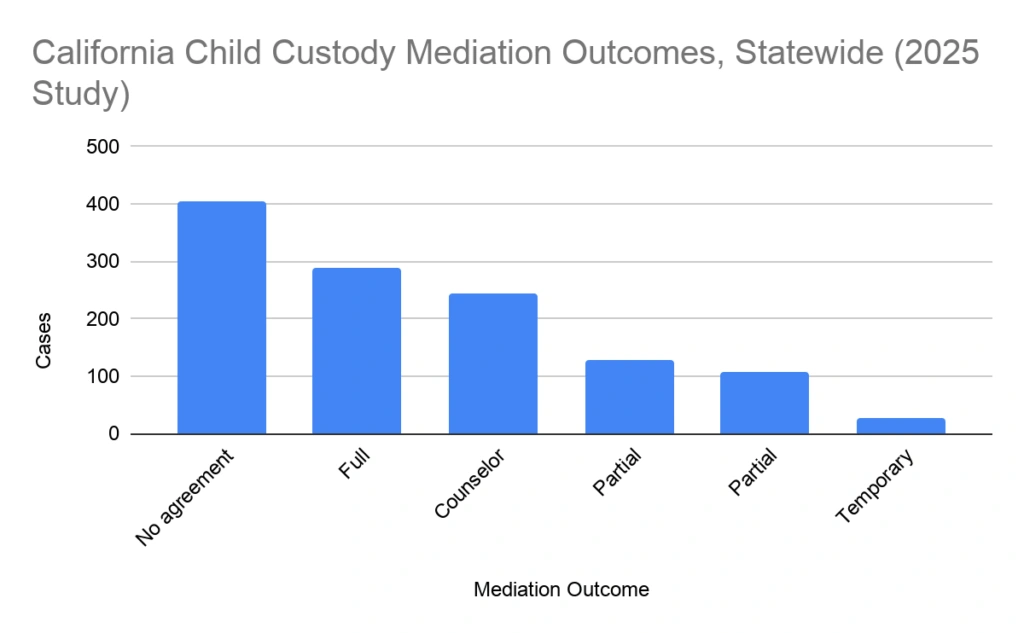
A December 2025 study by the Judicial Council of California’s Center for Families, Children and the Courts looked at outcomes across courts using both mediation models statewide. Of the completed sessions reviewed, no agreement was reached in roughly one third of cases, meaning the matter proceeded toward a judicial decision, while the rest resulted in some form of full, partial, or temporary agreement, or, in recommending counties like San Diego, a formal recommendation to the court. The chart below breaks down those statewide outcomes in more detail.
Source: Judicial Council of California, Center for Families, Children and the Courts, 2025 Child Custody Mediation Outcomes Study Quick Facts, December 2025.
What to Expect at Your Family Court Services Appointment
Many parents feel anxious before their first Family Court Services session, and knowing what to expect can make a real difference. Sessions in San Diego are scheduled in several formats, including virtual on demand appointments, sessions calendared at the time of filing, and, less often, same day sessions ordered directly from a court hearing. Most appointments last about an hour, though more complex cases can take longer. If there is a history or current allegation of domestic violence between the parents, California law requires that the parents be interviewed separately rather than together in the same room.
Before an appointment, we help our clients organize a short, factual summary of the current parenting schedule, any specific concerns about the other parent’s home, and a realistic proposed plan going forward. Bringing a calendar showing the actual time each parent has spent with the child is often more persuasive than a general description, since the counselor is trying to understand the child’s real routine rather than what either parent believes that routine should be.
Custody and Military Families in San Diego
San Diego is home to one of the largest concentrations of active duty military personnel in the country, and a significant share of the custody cases we handle involve a parent stationed at Naval Base San Diego, Marine Corps Recruit Depot, Marine Corps Base Camp Pendleton, or Naval Base Point Loma. California law recognizes the unique challenges deployment creates for parenting schedules.
Family Code section 3047 allows a court to issue a temporary custody order to account for a parent’s deployment, and generally requires that any custody or visitation rights the deployed parent held before leaving be restored once they return, unless doing so would not serve the child’s best interest. We regularly draft parenting plans that build in deployment contingencies from the start, rather than waiting for orders to leave and forcing a family back into court.


How Custody Arrangements Look Nationwide
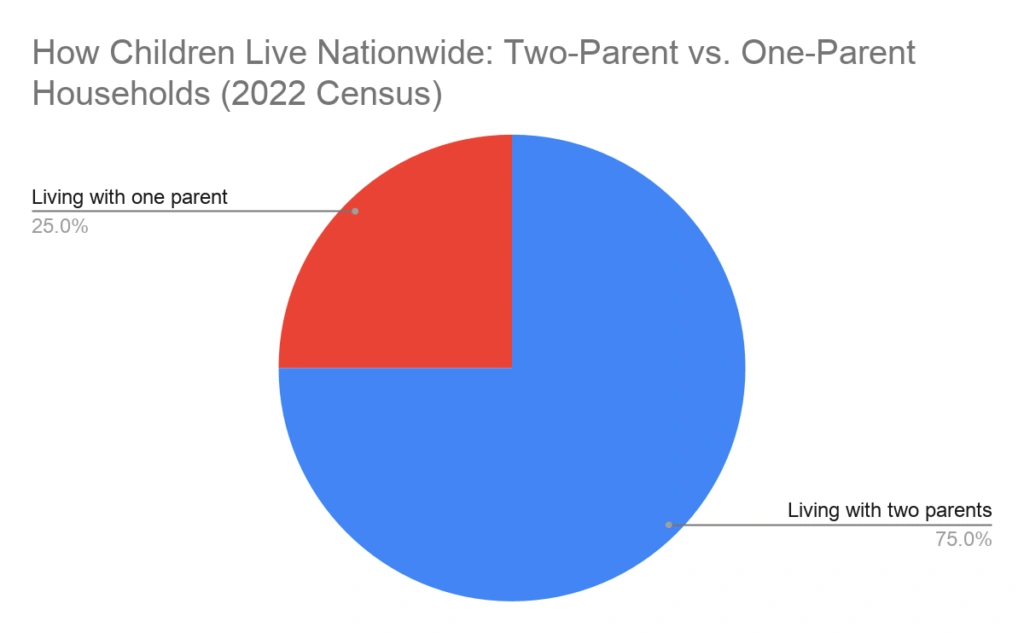
San Diego families are, in many ways, a reflection of broader national trends. According to the U.S. Census Bureau’s most recent Current Population Survey data on custodial parents, about one in four children under 21 lived with only one parent in 2022, while the remaining children lived in a household with two parents. Nationally, a large share of custodial parents report some form of joint legal or physical custody arrangement with the other parent, reflecting the same policy preference for shared parenting that California has written directly into its Family Code. The chart below illustrates this national split.
Source: U.S. Census Bureau, Custodial Parents and Their Child Support 2022, Current Population Survey Child Support Supplement.
Local Resources for San Diego Parents
Not every parent needs, or can afford, a private attorney for every step of a custody case, and we believe San Diego parents should know what free and low cost help is available.
- San Diego Superior Court Family Law Facilitator’s Office: free, self-help assistance with forms and procedures at the Central, East County, North County, and South County courthouses, reachable at (619) 844-2200.
- Family Court Services: handles the mandatory child custody recommending counseling described above for parents who cannot agree on a parenting plan.
- San Diego Volunteer Lawyer Program: offers free legal advice and, for eligible applicants, representation in qualifying custody and family law cases.
- San Diego County Bar Association Lawyer Referral and Information Service: connects residents with local attorneys, including reduced fee consultations.
- Guide and File: the court’s online interview system that helps self-represented parents prepare custody related forms before filing.
California Custody Laws We Rely On For Your Case
Every custody strategy we build starts with the specific Family Code sections that will govern how a San Diego judge evaluates your case.
- Family Code section 3011 lists the health, safety, and welfare factors a court must weigh, including any history of abuse, habitual or continual substance abuse by either parent, and the nature of the child’s contact with both parents.
- Family Code section 3020 sets the legislature’s policy that children have frequent and continuing contact with both parents when safe to do so.
- Family Code section 3040 establishes the order of preference courts follow when awarding custody, generally favoring joint arrangements where appropriate.
- Family Code section 3111 allows a court to appoint a child custody evaluator to conduct an in-depth investigation and report recommendations in more complex or high-conflict cases.
- Family Code section 3170 requires mandatory mediation through Family Court Services whenever parents cannot agree on custody or visitation.
- Family Code section 3047 addresses temporary custody orders tied to a parent’s military deployment.
Because these statutes leave room for judicial discretion, how the facts of your case are presented often matters as much as the law itself.
Frequently Asked Questions About San Diego Child Custody
Let Us Help You Protect Your Relationship With Your Child
Custody cases affect the most important relationships in your life, and the procedures that apply in San Diego are not always intuitive, even for parents who have been through the family court system before.
We have built our practice around preparing San Diego parents for every stage of that process, from a first Family Court Services appointment through a contested hearing. If you are facing a custody dispute anywhere in San Diego County, call Wade Litigation at 408-214-5225 for a free, confidential case evaluation, or complete our online intake form to get started. Whether you are just beginning to consider a custody filing or you already have an order that needs to change, our team is ready to talk through your options and help you take the next step with confidence.