Losing a case at trial does not always mean the story is over. If the trial court made a legal or procedural error, California law allows you to ask a higher court to review that decision. But appeals move on a completely different track than trial work, with strict jurisdictional deadlines, a fixed record, and a written-argument process that rewards precision over persuasion in the courtroom sense.
At Wade Litigation, our San Diego appeals attorneys represent individuals and businesses seeking to appeal civil, family law, probate, and business court rulings before California’s Fourth District Court of Appeal. We also help clients respond to an appeal filed against them. Call 408-214-5225 today for a free, confidential case review.

Key Takeaways
- Appeal deadlines are jurisdictional and absolute. Under California Rules of Court, Rule 8.104, most unlimited civil appeals must be filed within 60 days of notice of entry of judgment, and courts cannot extend this deadline.
- San Diego appeals go to the Fourth District Court of Appeal, Division One. This court reviews civil, family, probate, and felony matters from San Diego and Imperial Counties.
- Reversal is the exception, not the rule. Statewide, roughly 70 percent of civil appeals decided by written opinion are affirmed in full, meaning careful case selection matters before filing.
- An appeal is not a new trial. The appellate court reviews the existing trial record for legal error. New evidence and new witnesses generally are not allowed.
- Limited civil cases follow a shorter, different timeline. Cases under the limited civil threshold appeal to the Appellate Division of the Superior Court, not the Court of Appeal, and carry a 30-day filing deadline.
- The process is long. Statewide, civil appeals typically take well over a year from the notice of appeal to a written decision.
- A writ may sometimes provide a faster path. In limited circumstances, a writ petition can seek review of a trial court order before a final judgment is even entered.
Don’t let a filing deadline pass. Call Wade Litigation today at 408-214-5225 for a free case review.
What Does a San Diego Appeals Attorney Do?
An appeals attorney, sometimes called an appellate attorney, represents clients seeking review of a trial court’s decision, or defends a favorable judgment against an appeal filed by the other side. This work is fundamentally different from trial litigation. Our attorneys help clients:
- Evaluate whether a trial court ruling contains an appealable legal or procedural error
- Calculate and protect the filing deadline for a notice of appeal
- Order and review the trial record, including transcripts and exhibits
- Research and draft appellate briefs
- Present oral argument before the Court of Appeal
- Respond to an appeal filed against a favorable judgment
- Pursue a writ petition when appropriate
This page focuses specifically on the appellate process for San Diego County matters. For a broader look at California’s appellate districts, standards of review, and the appeals process statewide, visit our main California appeals lawyer page.
When Do You Need an Appeals Attorney in San Diego?
Not every unfavorable ruling supports an appeal. Disagreeing with the outcome, or believing the judge got it wrong as a matter of fairness, is not enough on its own. You should consider speaking with an appeals attorney if your situation involves any of the following:
- A judge misapplied the law. The court used the wrong legal standard, misinterpreted a statute, or made an incorrect ruling on a motion.
- A significant procedural error occurred. Improper jury instructions, wrongly admitted or excluded evidence, or a violation of your due process rights.
- A summary judgment was granted or denied in error. Summary judgment rulings are reviewed independently by the Court of Appeal, without deference to the trial court’s decision.
- You were served with an appeal. The opposing party has filed a notice of appeal against a judgment in your favor, and you need to defend it.
- A family law, probate, or business ruling has significant consequences. Custody orders, trust and estate disputes, and business judgments often carry outcomes worth appealing.
Because the deadline to appeal is jurisdictional, meaning the court loses the power to hear a late appeal no matter how strong the underlying argument is, we recommend contacting an attorney immediately after an adverse ruling rather than waiting to see how things unfold.
California’s Appellate Court Structure in San Diego
San Diego Superior Court decisions are reviewed by the Fourth District Court of Appeal, Division One, located at 750 B Street, Suite 300, San Diego, CA 92101. This division has jurisdiction over appeals from San Diego and Imperial Counties, covering civil, family, probate, and felony criminal matters. Traffic, misdemeanor, and limited civil appeals instead go to the Appellate Division of the San Diego Superior Court, a separate and faster track heard by a panel of superior court judges rather than the Court of Appeal.
Most civil appeals do not end in reversal. According to the Judicial Council of California’s 2024 Court Statistics Report, roughly 70 percent of civil appeals resolved by written opinion statewide are affirmed in full, with another 9 percent affirmed with modification.
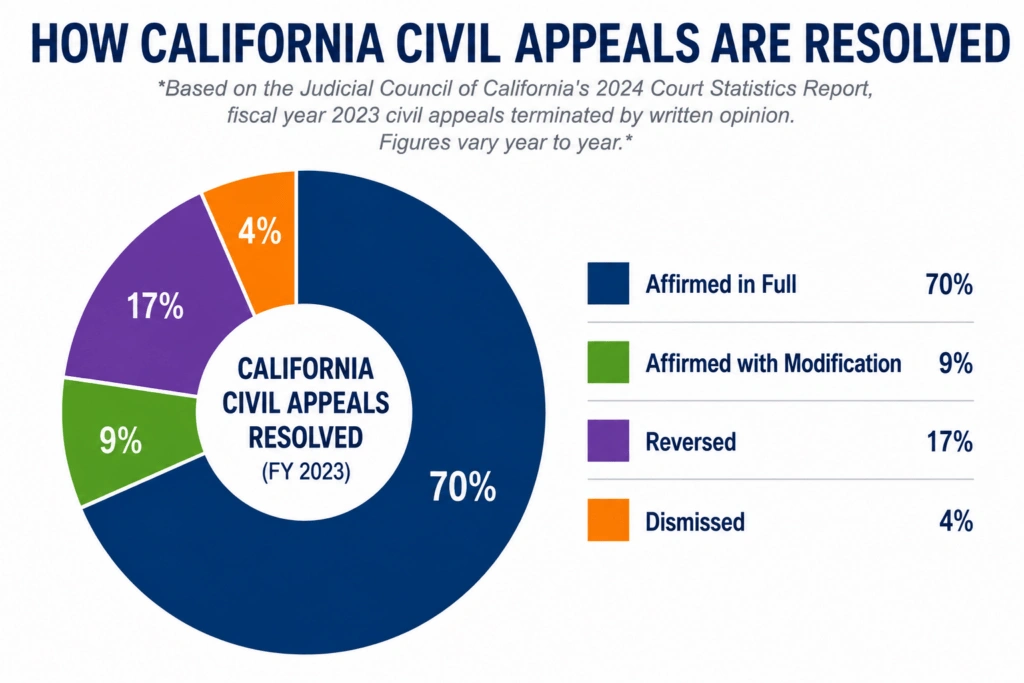
California civil appeals resolved by written opinion, based on Judicial Council of California 2024 court statistics
This is one reason a careful, honest evaluation of the trial record before filing matters as much as the appeal itself. An appeal built on a genuine legal error has a real chance. An appeal built only on disagreement with the outcome rarely succeeds.
Types of Appeals We Handle
Appellate work spans a wide range of underlying case types. Our San Diego appeals attorneys regularly handle the following categories.
Civil Judgment Appeals
Civil appeals may challenge a judgment following trial, a summary judgment ruling, a demurrer that dismissed a case, or a post-trial motion denial. These cases often involve contract disputes, business litigation, real estate disputes, and personal injury judgments. Because summary judgment rulings receive independent review rather than deferential review, they are often strong candidates for appeal when the legal analysis was flawed.
Family Law Appeals
Family law appeals may involve custody and visitation orders, property division rulings, spousal support determinations, or domestic violence restraining orders. These cases move on the same appellate timeline as other civil matters, but often carry added urgency because custody and support orders continue to affect a family while the appeal is pending. Our family law team can help determine whether a specific order qualifies for appeal.
Probate and Trust Appeals
Probate appeals may challenge a will contest ruling, a trustee removal decision, a trust interpretation, or an accounting dispute. Because these cases often involve family relationships and inherited assets, we work to keep the appellate process focused and efficient while the underlying probate matter remains open.
Business and Commercial Appeals
Business appeals may involve contract disputes, partnership dissolutions, fraud judgments, or injunctive relief. A business judgment can affect operations and finances long after the trial ends, which makes a clear-eyed evaluation of appellate strategy especially important.
Writs and Post-Trial Motions
In certain circumstances, a writ petition can seek review of a trial court order before a final judgment is entered, which may be faster than waiting for a full appeal. We also handle post-trial motions, such as motions for a new trial or motions to vacate, which can extend the deadline to appeal when properly and timely filed.
Appeal Filing Deadlines: What San Diego Litigants Need to Know
California’s appellate deadlines are among the least forgiving in the legal system. Courts of Appeal cannot grant extensions for a late notice of appeal, and a single missed deadline permanently forecloses the right to appellate review, regardless of the merits of the underlying case.
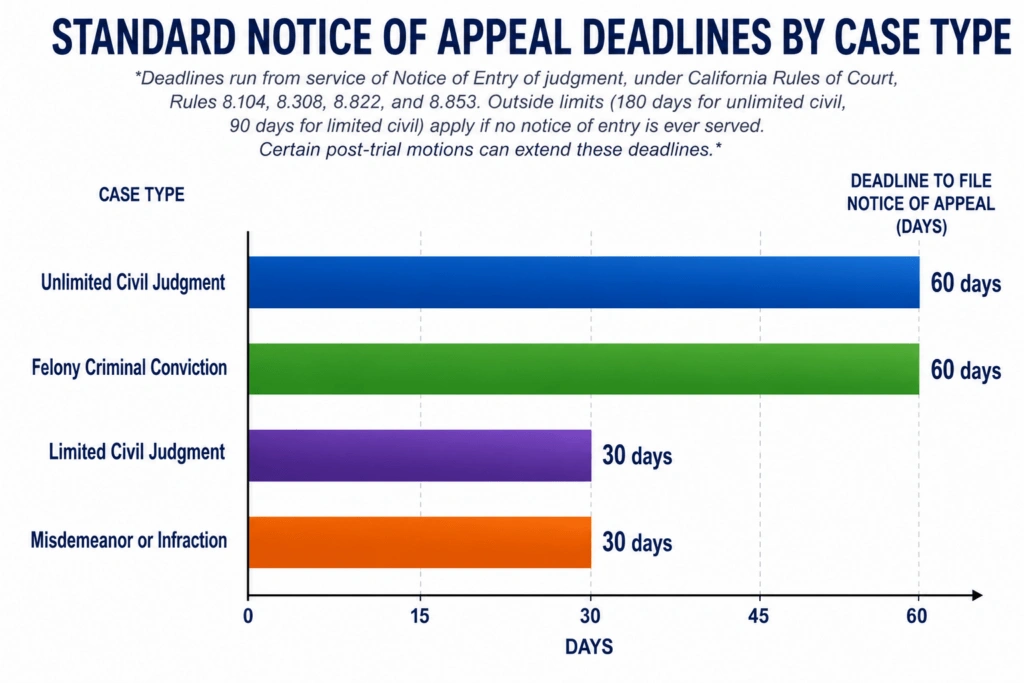
Standard California notice of appeal deadlines vary by case type.
Because the trigger for these deadlines depends on exactly how and when notice of entry was served, and because a technical defect in that notice can change the calculation entirely, we recommend having an attorney confirm your deadline as soon as an adverse ruling is issued rather than calculating it yourself.
Filing Your Notice of Appeal in San Diego
Where you file a Notice of Appeal depends on which division of San Diego Superior Court heard your original case.
| Division Where Case Was Heard | Where to File Notice of Appeal | Address |
|---|---|---|
| Central, East, or South County Division | Superior Court Appeals Office, (619) 844-2348 | Central Courthouse, 2nd Floor, 1100 Union Street, San Diego, CA 92101 |
| North County Division | North County Regional Center | 325 South Melrose Drive, Vista, CA 92081 |
Once filed, most civil and felony appeals are then reviewed by the Fourth District Court of Appeal, Division One, at 750 B Street, Suite 300, San Diego, CA 92101. Court contact information and filing procedures can change, so we recommend confirming current details with the San Diego Superior Court Appeals office or with our office before filing.
What Happens During the Appellate Process?
Appeals move through a structured sequence of stages that looks very different from trial litigation. There is no jury, no witnesses, and generally no new evidence. The process is built almost entirely around the existing trial record and written legal argument.
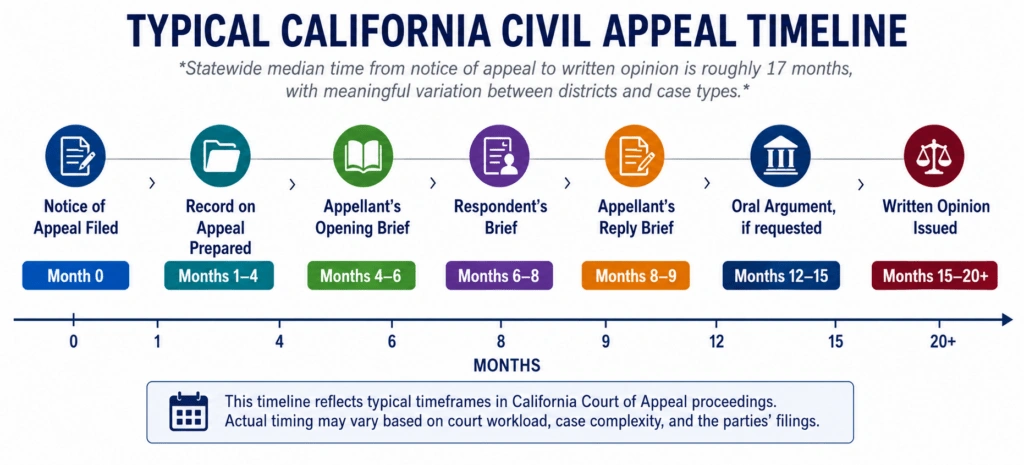
Typical timeline for a California civil appeal from filing the notice of appeal to a written opinion.
- Filing the notice of appeal. This starts the clock and must be filed within the jurisdictional deadline.
- Preparing the record on appeal. The trial court record, including transcripts and exhibits, is compiled and certified for the Court of Appeal.
- Briefing. The appellant files an opening brief explaining the claimed errors, the respondent files a brief defending the judgment, and the appellant may file a reply.
- Oral argument. Either side may request oral argument before the panel of appellate justices, though many appeals are decided on the briefs alone.
- The written opinion. The Court of Appeal issues a written decision affirming, reversing, or modifying the judgment, or remanding the case back to the trial court.
- Further review, if sought. A party may petition the California Supreme Court for review, though the Supreme Court grants only a small fraction of these petitions.
What Does an Appeal Cost in San Diego?
Appellate costs vary significantly based on the length and complexity of the trial record, the number of legal issues raised, and whether oral argument and further Supreme Court review become part of the process. We discuss projected costs, and whether the underlying issues justify the investment of an appeal, during your free case review.
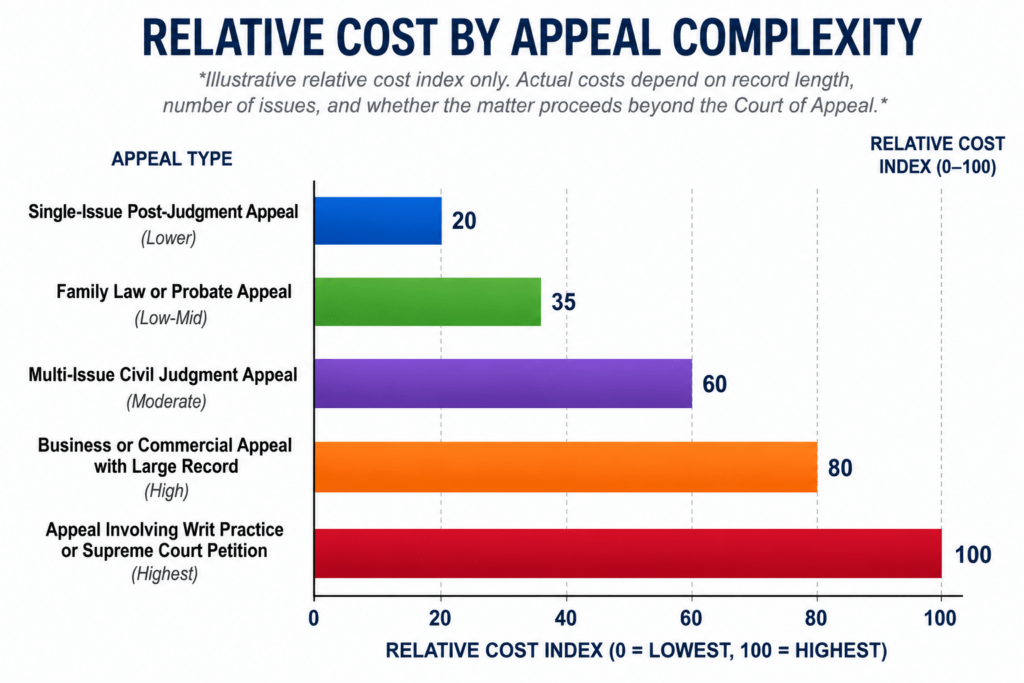
Illustrative comparison of relative costs across different types of appeals.
Can an Appeal Be Resolved Without a Full Appellate Decision?
Yes, in some circumstances. Parties can settle a pending appeal at any point before the Court of Appeal issues its decision, which ends the case and can avoid the cost and delay of full briefing and oral argument. In addition, a money judgment generally is not automatically paused while an appeal is pending, so many appellants also need to address a bond or stay of enforcement early in the process. Our team helps clients evaluate:
- Whether settlement during the appeal is realistic and worthwhile
- Whether a stay or supersedeas bond is needed to pause enforcement of the judgment
- The strength of the claimed legal errors
- The time and cost of pursuing the appeal through to a final decision
- Whether a writ petition offers a faster alternative in the right circumstances
Local San Diego Appellate Resources
Beyond hiring an attorney, San Diego litigants have access to several local and regional resources related to the appeals process.
- Fourth District Court of Appeal, Division One. Located at 750 B Street, Suite 300, San Diego, CA 92101, phone (619) 645-2760, this court hears civil, family, probate, and felony appeals from San Diego and Imperial Counties.
- San Diego Superior Court Appeals FAQ and Self-Help Resources. Offers general guidance on notice of appeal deadlines and filing procedures for both the Appellate Division and the Court of Appeal.
- San Diego Law Library. Provides a civil appeals research guide and general reference assistance for parties navigating the appellate process.
- San Diego County Bar Association Lawyer Referral Service. Connects residents with local attorneys experienced in appellate practice.
- Appellate Defenders, Inc. A San Diego-based nonprofit that coordinates appointed counsel for indigent criminal appeals in the Fourth District. Note this resource applies specifically to criminal, not civil or family, matters.


Why San Diego Clients Choose Wade Litigation
- Direct attorney access. You work directly with our attorneys throughout your San Diego appeal rather than a rotating team of case managers.
- An investigator’s eye for the record. Our founder’s background in law enforcement brings a detail-oriented approach to digging through trial records for overlooked errors.
- Honest case evaluation. We tell clients directly whether the trial record supports a strong appeal, rather than taking every case regardless of its chances.
- Experience across case types. We handle civil, family law, probate, and business appeals, giving us a broad view of how appellate courts treat different kinds of trial court error.
- Clear, steady communication. Given how long appeals take, we keep clients informed at each stage rather than leaving them wondering where things stand.
Ready to talk about your San Diego appeal? Call Wade Litigation at 408-214-5225 for a free, confidential case review.
Frequently Asked Questions About San Diego Appeals
Talk With a San Diego Appeals Attorney Today
An unfavorable ruling does not have to be the final word, but the path to appellate review is narrow, deadline-driven, and unforgiving of mistakes. Whether your case involves a civil judgment, a family law order, a probate dispute, or a business ruling, the attorneys at Wade Litigation can help you understand whether an appeal is the right path and build a strategy suited to your goals.
We represent clients throughout San Diego County before the Fourth District Court of Appeal and the Appellate Division of the Superior Court. Call 408-214-5225 today to schedule your free, confidential case review.
This page is for general informational purposes only and does not constitute legal advice. Every appeal is different, and past results do not guarantee future outcomes.