Wade Litigation represents Riverside County residents in divorce, child custody, child support, and spousal support matters. The firm’s cases are filed at the Riverside Family Law Courthouse, the Larson Justice Center in Indio, or the Southwest Justice Center in Murrieta, depending on where a client lives. Call 866-925-4552 to schedule a case evaluation and discuss your needs.
A Riverside family law attorney at Wade Litigation helps residents throughout Riverside County resolve divorce, child custody, child support, and spousal support matters through negotiation, mediation, or litigation when needed. The firm represents clients filing at the Riverside Family Law Courthouse, the Larson Justice Center in Indio, and the Southwest Justice Center in Murrieta, the three family law venues that serve most of the county. Every case is handled with attention to the residency and procedural rules governing California family law, from the initial petition through the final judgment.
Family Law Services for Riverside County Residents
Wade Litigation’s Riverside family law practice covers the full range of matters that arise when a marriage or family relationship changes. The firm’s attorneys handle contested and uncontested cases, working toward settlement where possible and litigating when a fair resolution requires it.
- Divorce: Filing and responding to petitions for dissolution of marriage, including property division and spousal support. Full detail is available on the Riverside divorce attorney page.
- Child Custody: Legal and physical custody arrangements, parenting plans, and post-judgment modifications, covered in depth on the Riverside custody attorney page.
- Child Support: Establishing, modifying, and enforcing child support orders under California’s statewide guideline formula, detailed on the Riverside child support attorney page.
- Spousal Support: Requesting or contesting temporary and long-term spousal support, including modification of existing orders when income or circumstances change.
- Domestic Violence Restraining Orders: Representation for clients seeking or defending against a domestic violence restraining order, covered on the Riverside restraining order attorney page.
- Adoption and Parentage: Establishing legal parentage and completing stepparent or relative adoptions where family circumstances call for it.
Property Division in a Riverside Divorce
California is a community property state, which means that most assets and debts acquired during the marriage are divided equally between the spouses under Family Code § 2550. Separate property, generally anything owned before the marriage or received individually by gift or inheritance, is not subject to this equal division, though disputes often arise over whether an asset has been commingled with community funds during the marriage.
In Riverside County, property division disputes frequently involve real estate, since home values vary widely across the county, from desert communities like Palm Springs and Palm Desert to inland cities like Corona and Moreno Valley. Retirement accounts, business interests, and vehicles are also commonly divided assets that require an accurate valuation before a fair split can be reached. When a family home cannot be practically divided, the parties typically choose among one spouse buying out the other’s share, selling the property and dividing the proceeds, or, in some cases, deferring the sale until a later date, such as when minor children finish school.
Debt is divided under the same community property framework as assets, which means a debt incurred during the marriage, including credit card balances and joint loans, is generally split equally regardless of whose name is on the account. Debt incurred before the marriage or clearly tied to one spouse’s separate property generally remains that spouse’s responsibility.
How Spousal Support Is Determined
Unlike child support, California spousal support is not set by a fixed formula for long-term orders. Family Code § 4320 requires a judge to weigh a list of statutory factors before ordering support, including:
- Each spouse’s earning capacity and the marketable skills needed to maintain the marital standard of living
- Whether one spouse’s earning capacity was reduced by time spent on domestic duties or supporting the other spouse’s career or education
- The supporting spouse’s ability to pay, based on earning capacity, income, and assets
- The needs of each spouse based on the standard of living established during the marriage
- The duration of the marriage, since longer marriages typically support a longer period of spousal support
- The age and health of both spouses
- Any documented history of domestic violence between the parties
- The tax consequences of a proposed support order for each spouse
- The goal that a supported spouse become self-supporting within a reasonable period, generally referenced against half the length of a marriage under ten years
No single factor controls the outcome, and how well each factor is documented and presented to the court often has as much influence on the result as the underlying facts themselves.
How Child Custody Decisions Are Made
Riverside County family courts decide custody and visitation based on the best interest of the child standard set out in Family Code § 3011. Judges consider the health, safety, and welfare of the child, any history of abuse by either parent, the nature and frequency of each parent’s contact with the child, and any habitual or continual use of alcohol or controlled substances by either parent. By statute, a parent’s sex, gender identity, gender expression, or sexual orientation cannot be a factor in the court’s decision.
Legal custody determines who makes decisions about a child’s health care, education, and welfare, while physical custody determines where the child primarily lives. Riverside County courts can award either on a sole or joint basis depending on the facts of the case, and either type of order can later be modified if circumstances change significantly.

Riverside County Family Law Courts
Riverside County Superior Court hears family law matters at several locations, and where a case is filed depends on where the parties live within the county.
Courthouse | Address | Self-Help Contact |
Riverside Family Law Courthouse | 4175 Main Street, 3rd Floor, Riverside, CA 92501 | (951) 274-4499 |
Larson Justice Center (Indio) | 46-200 Oasis Street, Indio, CA 92201 | (760) 393-2617 |
Southwest Justice Center (Murrieta) | 30755-D Auld Road, Murrieta, CA 92563 | (951) 704-7634 |
Clients in the western part of the county, including the city of Riverside, Corona, and Moreno Valley, typically file at the Riverside Family Law Courthouse. Desert-area clients in Indio, Palm Springs, Palm Desert, Cathedral City, Coachella, and La Quinta generally file at the Larson Justice Center. Southwest county residents in Murrieta, Temecula, Menifee, Lake Elsinore, and Wildomar generally file at the Southwest Justice Center. Wade Litigation appears at all three venues on behalf of Riverside County clients.
Communities Served Throughout Riverside County
Wade Litigation represents family law clients across Riverside County, including:
Banning, Beaumont, Blythe, Cathedral City, Coachella, Corona, Desert Hot Springs, Eastvale, Hemet, Indio, Jurupa Valley, La Quinta, Lake Elsinore, Menifee, Moreno Valley, Murrieta, Norco, Palm Desert, Palm Springs, Perris, Riverside, San Jacinto, Temecula, and Wildomar.
How a Riverside Divorce Case Moves Through Court
California divorce cases follow the same statutory sequence statewide, though the local filing location depends on where a Riverside County resident lives.
Step | What Happens | Legal Basis |
Confirm residency | One spouse must have lived in California for six months and in Riverside County for three months before filing. | Fam. Code § 2320 |
File the petition | Submit Form FL-100, a summons, and Form FL-105 if children are involved. The filing fee is $435, or a fee waiver can be requested with Form FW-001. | Fam. Code § 2320 |
Serve the respondent | Someone over 18 who is not a party to the case serves the other spouse. Automatic temporary restraining orders take effect on both parties at filing. | Fam. Code § 2040 |
Respondent replies | The respondent has 30 days to file Form FL-120. Failure to respond can lead to a default judgment. | Fam. Code § 2336 |
Exchange disclosures | Both spouses exchange Preliminary Declarations of Disclosure, Forms FL-140, FL-150, and FL-142, within 60 days of filing. | Fam. Code §§ 2104 to 2105 |
Mandatory waiting period | No judgment can be entered until six months and one day have passed from the date the respondent was served. | Fam. Code § 2339 |
Final judgment | The court enters judgment once the waiting period has passed and property, support, and custody issues are resolved or ordered. | Fam. Code § 2340 |
This timeline cannot be shortened even in a fully uncontested case, though it can extend well past six months when custody, support, or property issues are contested. A local attorney familiar with the Riverside, Indio, and Murrieta family law departments can help a case move through each step without avoidable delays.
Modifying an Existing Custody, Support, or Spousal Support Order
Family law orders in Riverside County are not necessarily permanent. Custody, child support, and spousal support orders can all be modified after judgment when a party can show a significant change in circumstances since the original order was made. Common examples include a parent relocating within or outside Riverside County, a substantial change in either parent’s income, a child’s changing school or medical needs, or a remarriage that affects the household finances of either party.
A modification request generally requires filing a Request for Order with the same Riverside County courthouse that issued the original order, along with supporting financial or factual documentation. The court applies the same best interest standard to custody modifications and the same statutory factors to support modifications that governed the original order, which means a modification is rarely automatic even when circumstances have clearly changed.
Domestic Violence and Restraining Orders in Family Law Cases
Domestic violence issues frequently intersect with divorce and custody cases in Riverside County. A domestic violence restraining order can be requested on an emergency basis and, once granted, can affect custody, visitation, and property control while the underlying family law case is pending. Family Code § 3011 specifically requires the court to consider any documented history of abuse when making custody and visitation orders, and a finding of domestic violence can create a rebuttable presumption against awarding custody to the abusive parent under related provisions of the Family Code.
Clients who need to request or respond to a restraining order in a Riverside family law case can find more detail on the firm’s Riverside restraining order attorney page. Riverside County’s Self-Help Legal Services program also runs a Domestic Violence Clinic at the Riverside Family Law Courthouse for individuals who need assistance with restraining order paperwork.
Preparing for a Case Evaluation
A Riverside family law case moves more efficiently when the basic facts and documentation are organized before the first call. Clients preparing for a case evaluation with Wade Litigation generally benefit from having the following on hand, where applicable:
- Marriage certificate or registered domestic partnership documentation
- Recent pay stubs or income documentation for both spouses
- A general list of significant assets and debts, including real estate, retirement accounts, and vehicles
- Any existing custody, support, or restraining order paperwork already filed with the court
- Contact information and address history establishing residency in Riverside County
None of this documentation is required to schedule a case evaluation, and the firm can advise on what still needs to be gathered once the basic facts of a case are understood.
Divorce Versus Legal Separation in Riverside County
Some Riverside County residents file for legal separation instead of divorce, often because they have not yet met the residency requirement under Family Code § 2320, or because they want the court to resolve property, custody, and support issues without formally ending the marriage. Legal separation carries the same $435 filing fee and resolves the same categories of issues as a divorce, but it has no residency requirement and no six-month waiting period, since the marriage itself is not being dissolved. A legal separation case can later be amended to a dissolution once residency requirements are met, without paying a second filing fee.
Riverside County by the Numbers
Riverside County is one of California’s largest and fastest-growing counties, which shapes both the volume of family law cases the county’s courts handle and the caseloads its judges carry.
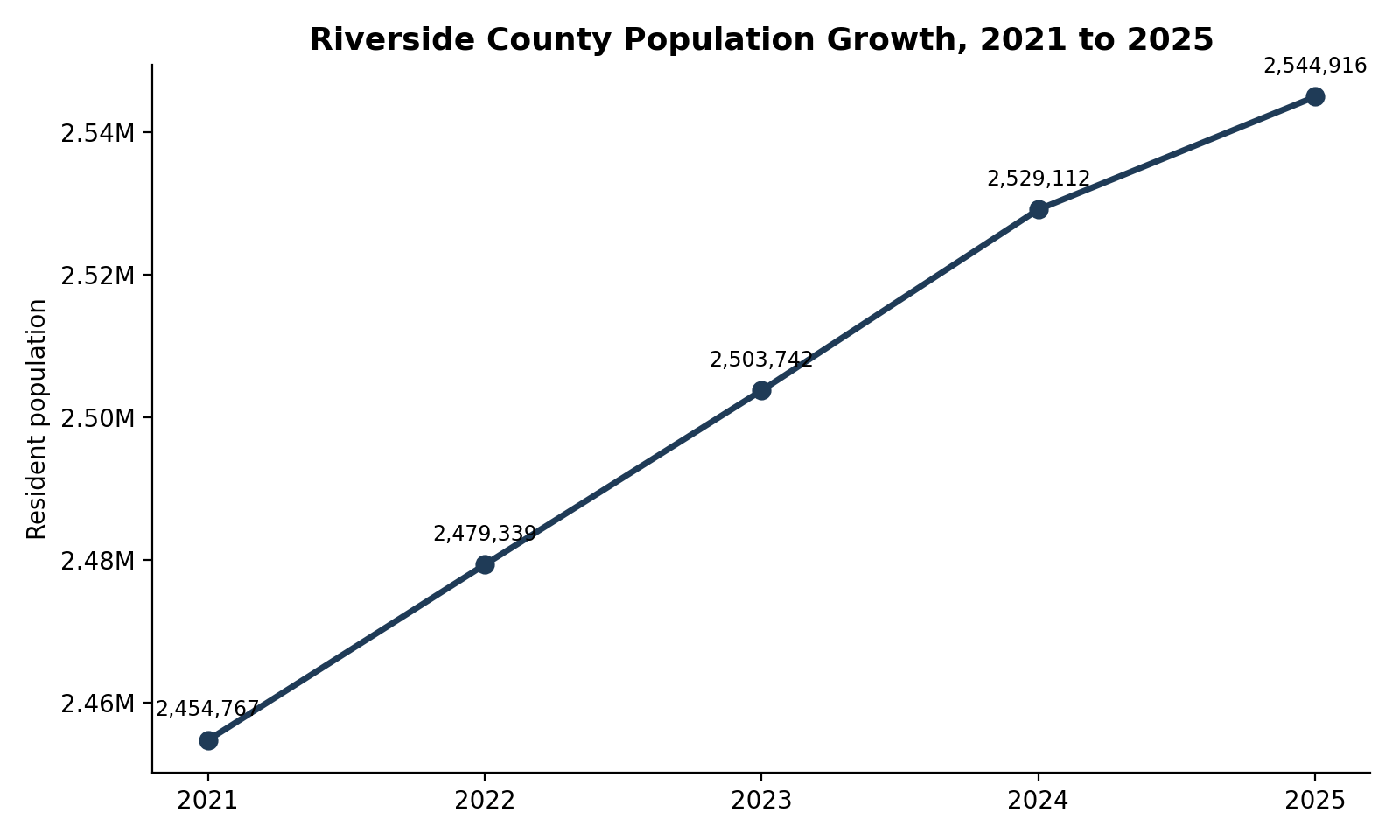
Riverside County’s population grew from about 2.45 million in 2021 to roughly 2.54 million in 2025, an increase of more than 90,000 residents in four years, according to U.S. Census Bureau estimates. That growth has translated into one of the busiest trial court systems in the state. According to the Judicial Council of California’s 2022 Court Statistics Report, Riverside County Superior Court logged 3,515 filings per judicial position, the third-highest caseload per judge of any of California’s 58 superior courts. A busy court system makes it more important, not less, for a family law case to be filed correctly and prepared thoroughly the first time.
Why Riverside County Residents Choose Wade Litigation
Amiel Wade founded Wade Litigation with more than twenty-five years of California legal experience and has been recognized as a Top Ten California Family Law Attorney by the National Academy of Family Law Attorneys in both 2021 and 2022. The firm has also been named a Top-Rated Family Law Attorney by the American Institute of Family Law Attorneys and has handled family law, civil litigation, probate, business litigation, and real estate litigation matters for clients across California, with a track record of more than 300 resolved cases. Riverside County clients work with attorneys who are familiar with the Riverside, Indio, and Murrieta family law departments and the practical differences in how each courthouse handles scheduling and local procedure.
Frequently Asked Questions
How long does a divorce take in Riverside County?
At minimum, six months and one day from the date the other spouse is served, under Family Code § 2339. Uncontested cases in Riverside County are often finalized close to that minimum. Contested cases involving custody, support, or property disputes typically take 12 to 18 months or longer, depending on the court’s calendar and how many issues remain unresolved.
What are the residency requirements to file for divorce in Riverside County?
One spouse must have lived in California for at least six months and in Riverside County for at least three months immediately before filing, under Family Code § 2320. If neither spouse meets this requirement yet, a legal separation can be filed first and later amended to a divorce once residency is established.
Where do I file a family law case in Riverside County?
Filing location depends on where the parties live. Most cases from the city of Riverside, Corona, and Moreno Valley file at the Riverside Family Law Courthouse at 4175 Main Street. Desert-area residents generally file at the Larson Justice Center in Indio, and southwest county residents generally file at the Southwest Justice Center in Murrieta.
How much does it cost to file for divorce in California?
The initial filing fee is $435. A fee waiver is available to people who qualify financially by submitting Form FW-001, along with proof of income and expenses.
What is the difference between legal custody and physical custody?
Legal custody is the right to make decisions about a child’s health care, education, and general welfare. Physical custody determines where the child primarily lives. Riverside County courts can award either type of custody solely to one parent or jointly to both, depending on what the evidence shows is in the child’s best interest.
How is child support calculated in California?
California uses a statewide guideline formula that accounts for both parents’ incomes, the amount of time each parent spends with the child, and certain deductions such as health insurance and mandatory retirement contributions. The formula produces a presumptively correct support amount, though it can be adjusted in special circumstances.
Can I get help with my case if I cannot afford an attorney?
Riverside County Superior Court operates a Self-Help Legal Services program that provides free assistance with forms and procedures, though staff cannot give legal advice or represent either party. Wade Litigation also discusses payment options during a case evaluation for clients who want representation but are concerned about cost.
What happens if my spouse does not respond to the divorce petition?
The respondent has 30 days to file a response after being served. If no response is filed, the petitioning spouse can request a default judgment under Family Code § 2336, though financial disclosures and the six-month waiting period still apply.
Does Wade Litigation handle cases outside the city of Riverside?
Yes. The firm represents family law clients throughout Riverside County, including Corona, Moreno Valley, Murrieta, Temecula, Indio, Palm Springs, Palm Desert, Hemet, and the other communities listed above, in addition to the city of Riverside itself.
Can spousal support be changed after the divorce is final?
Long-term spousal support orders can generally be modified when either spouse experiences a significant change in circumstances, such as a job loss, a substantial pay increase, or the supported spouse remarrying. Whether a specific order can be modified depends on the language of the original judgment, since some settlement agreements specifically waive the right to later modification.
Common Questions Before Hiring a Family Law Attorney
Cost is often the first concern for someone considering a family law attorney. Wade Litigation discusses fees directly during a case evaluation, and the firm’s billing page explains how clients are billed before any engagement begins.
A second common concern is uncertainty about outcome, particularly in custody matters. No attorney can guarantee a specific result in a contested family law case, since judges retain broad discretion under the best interest standard. What a Riverside family law attorney can control is how thoroughly a case is prepared, how clearly a client’s position is presented, and whether deadlines, such as disclosure and response windows, are met without costly mistakes.
A third concern is the emotional weight of the process itself. Family law disputes affect children, finances, and living arrangements simultaneously, and it is reasonable to want a clear sense of what happens next at each stage before committing to a course of action. A short initial call can usually answer that question without any obligation.
What Happens When You Call
A call to Wade Litigation starts with a case evaluation. A member of the team gathers basic information about the case, including where the parties live in Riverside County, whether children are involved, and the stage of the matter. The call is used to identify which venue the case belongs in, whether any deadlines are approaching, and what documentation will be needed. There is no cost for this initial call, and it does not commit a caller to hiring the firm.