


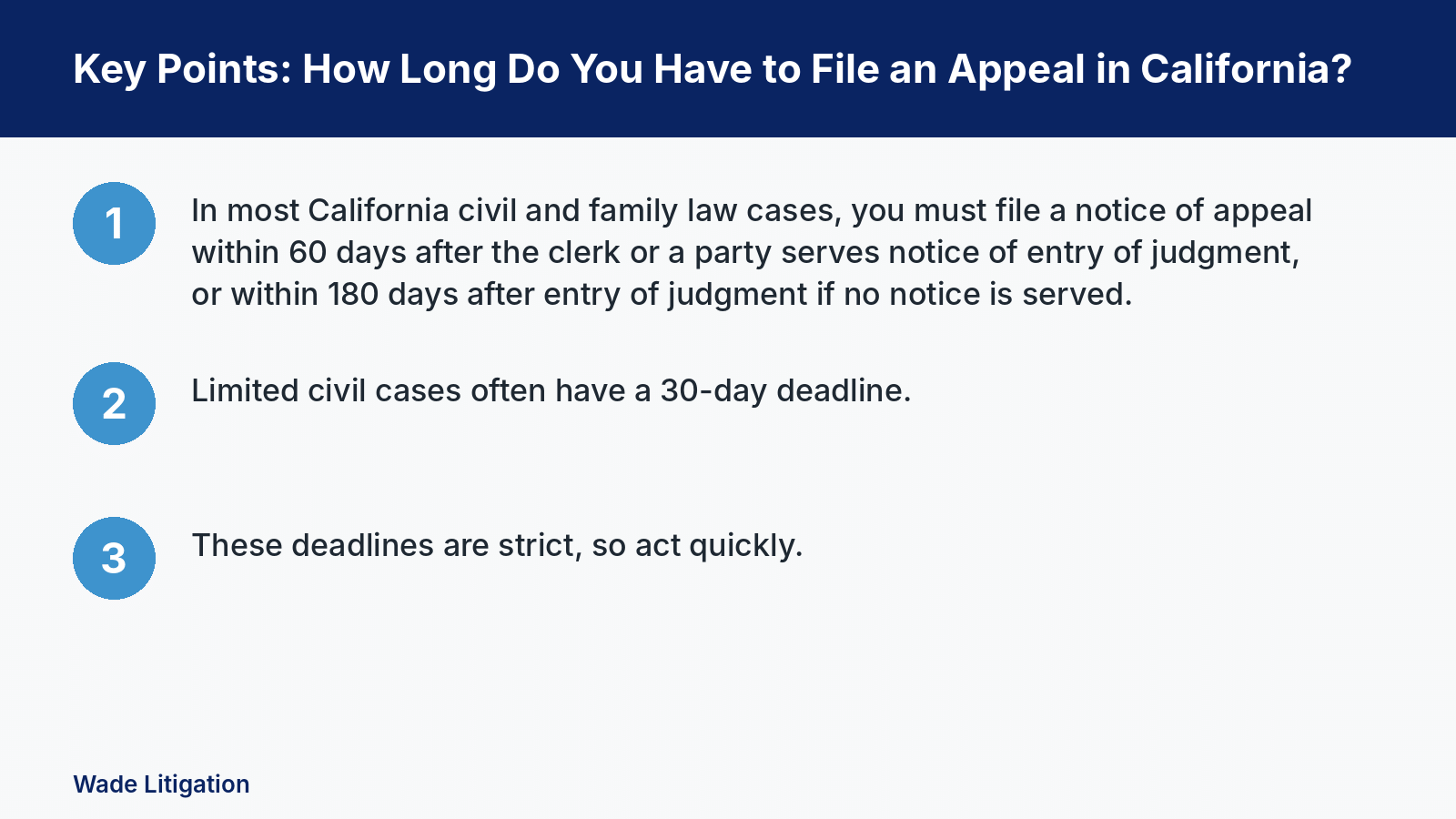
In most California civil and family law cases, you must file a notice of appeal within 60 days after the clerk or a party serves notice of entry of judgment, or within 180 days after entry of judgment if no notice is served. Limited civil cases often have a 30-day deadline. These deadlines are strict, so act quickly.
Losing at trial does not always end a case. California allows parties to ask a higher court to review legal errors. But the right to appeal comes with one of the strictest deadlines in civil practice. A notice of appeal filed even one day late usually cannot be accepted, and the court of appeal generally lacks power to extend the time.
Here is what you need to know about appeal deadlines in California.
The General Rule: 60 Days or 180 Days
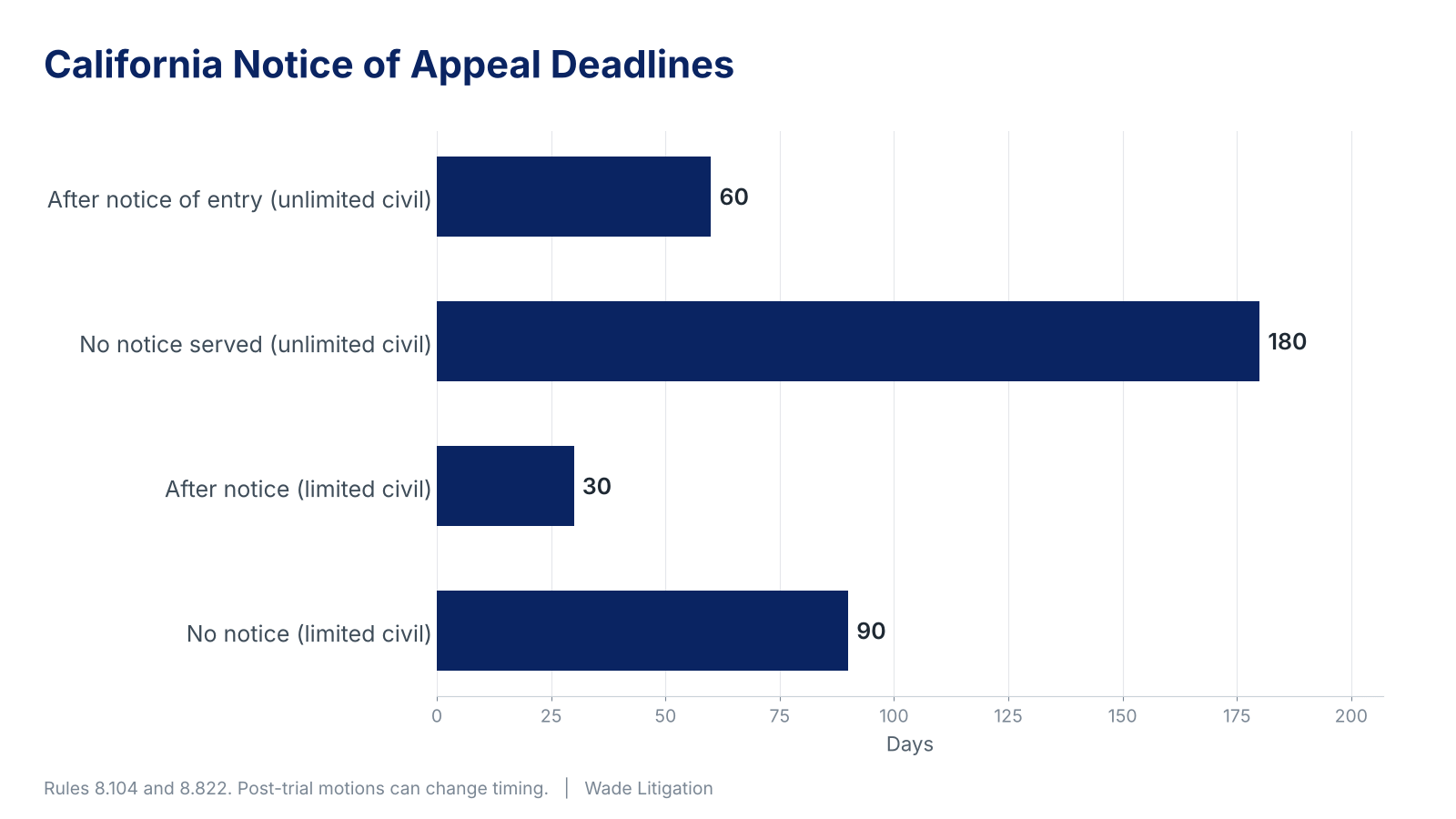
For unlimited civil cases and most family law judgments, California Rules of Court rule 8.104 sets the deadline. You must file the notice of appeal by the earliest of these dates:
- 60 days after the superior court clerk serves a notice of entry of judgment or a filed copy of the judgment
- 60 days after a party serves a notice of entry of judgment or a filed copy of the judgment
- 180 days after entry of judgment
The 180-day outer limit applies when nobody serves notice. Because service can start the shorter clock without much warning, many attorneys calendar the 60-day date from the moment a judgment is entered.
Limited Civil Cases
Limited civil cases, generally those involving $35,000 or less, are appealed to the appellate division of the superior court. Under rule 8.822, the deadline is typically 30 days after notice of entry is served, or 90 days after entry of judgment if no notice is served.
Family Law Appeals
Final family law judgments, such as a judgment of dissolution, follow the same general 60-day and 180-day rules. Some post-judgment orders, such as orders modifying custody or support, may also be appealable on their own. Learn more about appealing a family court decision in California. Temporary orders usually are not appealable, though a writ petition may be available in limited situations. Wade Litigation handles these questions through its appeals practice.
Post-Trial Motions Can Extend the Deadline
A timely motion for a new trial, a motion to vacate the judgment, or certain other post-trial motions can extend the time to appeal under rule 8.108. The extension depends on when the motion is decided or denied. These rules are technical, so it is safer not to rely on an extension without careful review.
The motions most often involved are a motion for a new trial, a motion for judgment notwithstanding the verdict, a motion to vacate the judgment, and a motion to reconsider an appealable order. Each must itself be filed on time, and each has its own effect on the appeal clock under rule 8.108.
If a valid motion is filed, the time to appeal is generally extended until a short period after the court rules on it or the motion is denied by operation of law, but never beyond the outside limits set by the rule. Because the extended deadline depends on several dates, many attorneys still file the notice of appeal early rather than rely on the extension.
What Can Be Appealed
Appeals generally review legal errors, not whether the trial court believed the right witness. Common grounds include:
- Misapplying the law
- Admitting or excluding evidence improperly
- Jury instruction errors
- Lack of substantial evidence to support a finding
- Procedural errors that affected the outcome
An appeal is not a new trial. The court of appeal reviews the trial court record, which is why preserving objections during trial matters.
What Happens After You File
After the notice of appeal, the appellant designates the record, which includes transcripts and documents. Briefs follow, and the court may hear oral argument. Many civil appeals in California take a year or more from notice to decision. Filing an appeal does not always stop enforcement of a money judgment, and a bond may be needed to stay enforcement.
Appeals Versus Writ Petitions
Not every ruling can be appealed right away. California generally follows a one final judgment rule, which means most orders must wait until the case ends. A writ petition asks the court of appeal to step in sooner, but writs are discretionary and granted only in limited situations, such as when a ruling would cause harm that an appeal could not fix. Writ petitions also have short practical deadlines, often around 60 days.
What If You Missed the Deadline
If the deadline has passed, the right to appeal is usually lost. In rare cases, other remedies, such as a motion to set aside the judgment or a writ petition, may be possible, but they have their own requirements. The best protection is to consult an appellate attorney as soon as judgment is entered.
Common Mistakes When Filing an Appeal
Several mistakes come up again and again in California appeals:
- Counting from the wrong date, such as the hearing date instead of the date notice of entry was served
- Assuming a post-trial motion automatically extends the deadline
- Appealing an order that is not appealable, or waiting to appeal an order that had to be appealed right away
- Failing to object or make a record at trial, which can forfeit issues on appeal
- Not designating the transcripts and documents the court needs to review the error
Calendaring the 60-day and 180-day dates the day judgment is entered, and reviewing the record with an appellate attorney early, prevents most of these problems.
Frequently Asked Questions
How long do you have to file an appeal in California?
Usually 60 days after notice of entry of judgment is served, or 180 days after entry if no notice is served.
Can the deadline to file a notice of appeal be extended?
Generally no, though certain timely post-trial motions can extend the time.
How long does a California civil appeal take?
Many take a year or longer from the notice of appeal to a decision.
Can I appeal a temporary family law order?
Usually not, although a writ petition may be possible in limited cases.
Does filing an appeal stop collection of a judgment?
Not always. A bond is often required to stay enforcement of a money judgment.
How much does it cost to file an appeal in California?
There is a court filing fee of several hundred dollars, plus costs for the record, such as reporter’s transcripts, which can be significant after a long trial. Attorney fees depend on the length of the record and the number of issues.
Talk to a California Appeals Attorney
Wade Litigation represents clients in civil and family law appeals throughout California. When you call (408) 214-5225 for a free evaluation, our team will ask about the judgment, the date it was entered, and any notices you received, then explain your deadline and options. Learn more about our civil litigation services.