Wade Litigation represents individuals and businesses throughout Riverside County in civil disputes, including breach of contract, real estate conflicts, and partnership or business disagreements. Civil cases are generally filed at the Riverside Historic Courthouse, though the county also hears civil matters through its Southwest and Palm Springs divisions depending on where the parties are located. Call 866-925-4552 to schedule a case evaluation and discuss a specific dispute.
A Riverside civil litigation attorney at Wade Litigation helps individuals and businesses resolve civil disputes throughout California, including disputes over contracts, property, and business relationships when informal resolution has broken down. Most civil disputes never reach a jury. They are resolved through negotiation, mediation, or another form of alternative dispute resolution well before trial, though having a lawyer prepared to litigate from the outset tends to produce better settlement terms than negotiating without that option in reserve. The firm represents clients whose cases are filed at the Riverside Historic Courthouse and at the county’s Southwest and Palm Springs civil divisions, depending on where the dispute and the parties are located.
Common Civil Disputes in Riverside County
Civil litigation covers a wide range of non-criminal disputes between individuals, businesses, or both. In Riverside County, the disputes that most often end up in front of a judge include contract disputes, where one party claims the other failed to perform under a written or verbal agreement, and property conflicts, including boundary disagreements between neighbors and encroachment or adverse possession claims, along with title disputes and landlord-tenant claims. Business and partnership disagreements are also common, particularly disputes over profit distribution, management authority, or a partner’s fiduciary obligations to the business. Fraud and misrepresentation claims round out the most frequent categories, arising when one party alleges reliance on false statements during a transaction.
Statutes of Limitations for Civil Claims in California
California sets firm deadlines, called statutes of limitations, for filing most types of civil claims. Missing the deadline generally bars the claim permanently, regardless of how strong the underlying case is, which makes early legal advice valuable even before a lawsuit is filed.
Claim Type | Deadline | Legal Basis |
Breach of a written contract | 4 years from the breach | C.C.P. § 337 |
Breach of an oral contract | 2 years from the breach | C.C.P. § 339 |
Fraud or intentional misrepresentation | 3 years from discovery | C.C.P. § 338(d) |
Injury to real property | 3 years from the injury | C.C.P. § 338(b) |
Negligence claims | 2 years from the injury | C.C.P. § 335.1 |
A single dispute can raise more than one of these claims at once, each running on its own clock. A property sale gone wrong, for example, might support a breach-of-contract claim, a fraud claim for an undisclosed defect, and a negligence claim, each with a different filing deadline calculated from a different triggering date.
Being Partly at Fault Does Not Automatically End a Case
California follows a pure comparative fault rule, meaning a party who is partly responsible for a dispute or an injury can still recover damages, reduced by their own percentage of fault. This differs from states that cut off recovery entirely once a plaintiff crosses a certain fault threshold. In a Riverside County contract or property dispute, this often comes up when both sides made mistakes or missed obligations along the way, and it means a case is rarely worth abandoning simply because the other side points to something the client also got wrong.
How a Riverside County Civil Case Moves Through Court
A civil lawsuit begins with a complaint filed with the court and served on the defendant, who generally has thirty days to file a response. From there, both sides exchange information and evidence during discovery, which can include written questions called interrogatories, requests for production of documents, requests for admission, and depositions, in which a witness answers questions under oath outside of court. Either side can file pretrial motions, including a motion to dismiss weak claims early or a motion for summary judgment when the undisputed facts favor one side and no trial is actually needed to resolve the legal question.
Riverside County actively encourages resolution before trial through mediation, arbitration, and settlement conferences, and offers an expedited jury trial option for cases where both sides agree to a shorter, less costly one-day trial format instead of a traditional jury trial. Complex cases involving multiple parties or particularly technical issues are assigned to a single specialized department regardless of which of the county’s three civil divisions the case originates from.
Business and Partnership Disputes
Business disputes between partners, shareholders, or LLC members often involve claims that a partner engaged in self-dealing, misused company funds, or withheld financial information to which the other owners were entitled. These situations frequently raise questions about what remedies are available once trust between partners has broken down, ranging from an accounting of the partnership’s finances to a forced buyout or, in serious cases, dissolution of the business entity. Riverside County business owners dealing with a partner who will not cooperate, or who has already taken funds or opportunities that belonged to the business, often benefit from a clear-eyed look at whether the relationship can be salvaged or whether a formal exit is the more realistic outcome before spending significant time or money on either path.
Real Estate and Property Disputes
Riverside County’s mix of established western cities, growing desert communities, and newer southwestern developments produces a steady stream of property disputes, from breaches of purchase agreements and undisclosed defects to disagreements between neighbors over where one property ends and another begins. A boundary or encroachment dispute can be resolved through a survey and negotiation in some cases, while in others it requires a quiet title action or a formal court order to settle ownership or usage rights once and for all. Landlord-tenant disputes over unpaid rent, lease violations, or habitability issues also fall within this category and follow their own procedural rules, separate from those of a standard breach of contract case.
Litigation Is Often the Last Step, Not the First
The vast majority of civil disputes in Riverside County resolve before a jury ever hears the case, through direct negotiation, mediation, or arbitration. Many contracts require mediation or arbitration before a lawsuit can even be filed, and even where they do not, resolving a dispute outside of court is often faster and less expensive than litigating it to a verdict. That said, alternative dispute resolution only works when both sides are negotiating in good faith. When the other party refuses to engage seriously, delays indefinitely, or ignores a valid contractual obligation, filing suit is often what finally brings the other side to a realistic negotiating position.


Fraud and Misrepresentation Claims
A fraud claim generally requires showing that the other party made a false statement of fact, knew or should have known it was false, intended for the claimant to rely on it, that the claimant actually relied on it, and that the reliance caused measurable harm. Common Riverside County examples include a seller who conceals a known property defect, a business partner who misrepresents the company’s finances to induce an investment, or a contractor who falsely claims to hold a required license. Fraud claims can be harder to prove than a straightforward breach of contract claim, since they require evidence of the other party’s knowledge and intent rather than simply showing a broken promise, but they can also open the door to remedies, including punitive damages in cases involving particularly egregious conduct, that are not available for an ordinary contract breach.
Employment-Related Civil Disputes
Civil litigation in Riverside County also covers workplace disputes, including wage-and-hour claims, wrongful termination, and challenges to the enforceability of non-compete or confidentiality agreements. These cases often move through a different procedural track than a standard contract dispute, since many employment claims first require exhausting an administrative process with a state or federal agency before a lawsuit can be filed. An employer facing a former employee’s claim, or an employee whose wages or termination raise legal questions, both benefit from an early review of the specific facts, since employment law includes numerous statutory deadlines and requirements that do not apply to ordinary civil claims.
Collecting on a Judgment
Winning a civil case in Riverside County is sometimes only half the battle, since a money judgment does not collect itself. California gives a prevailing party several tools to enforce a judgment against a debtor who does not pay voluntarily, including wage garnishment, bank levies, and liens against real property the debtor owns. A judgment generally remains enforceable for ten years and can be renewed before it expires, which matters for a debtor who currently has few collectible assets but may acquire them later. Enforcement becomes more involved when a debtor’s assets are spread across multiple counties or states, or when a debtor attempts to shield assets through transfers made after a judgment becomes likely.
Preparing for a Case Evaluation
A Riverside County civil case moves more efficiently when relevant documents are organized before the first call. Clients preparing for a case evaluation with Wade Litigation generally benefit from having the following on hand, where applicable:
- Any written contract, lease, or agreement at the center of the dispute
- Correspondence with the other party, including emails, texts, or demand letters already exchanged
- Financial records showing the loss or damages involved
- Any prior court filings, if litigation has already begun
- A general timeline of when key events occurred, since statute of limitations deadlines are calculated from specific dates
None of this documentation is required to schedule a case evaluation, and the firm can advise on what still needs to be gathered once the basic facts of a case are understood.
Demand Letters and Notice Before a Lawsuit
Many Riverside County civil disputes start with a demand letter rather than a lawsuit, laying out the claim, the amount or action sought, and a deadline to respond before litigation follows. A well-prepared demand letter does more than announce dissatisfaction. It signals that the sender understands the legal basis for the claim and is prepared to file suit if necessary, which sometimes prompts a resolution that avoids litigation entirely. Some claims also carry a formal pre-suit notice requirement under statute, particularly certain claims against government entities and some consumer protection claims, where skipping the required notice can delay or even bar the case regardless of its underlying merit.
Where Riverside County Civil Cases Are Filed
Riverside County Superior Court handles civil cases through three geographic divisions, and which division a case belongs to depends on where the dispute arose or where the parties are located.
Courthouse | Address | Division |
Riverside Historic Courthouse | 4050 Main Street, Riverside, CA 92501 | Western |
Southwest Justice Center (Murrieta) | 30755-D Auld Road, Murrieta, CA 92563 | Mid-County |
Palm Springs Courthouse | 3255 E. Tahquitz Canyon Way, Palm Springs, CA 92262 | Eastern |
Civil cases are also classified by the amount in controversy. Limited civil cases involve $35,000 or less, while unlimited civil cases involve more than $35,000 or seek equitable relief, such as an injunction or a declaratory judgment. Small claims cases, which do not require an attorney, are capped at $12,500 for an individual and $6,250 for a business, and are generally handled outside the Historic Courthouse at regional venues such as the Corona Courthouse or the Southwest Justice Center.
Communities Served Throughout Riverside County
Wade Litigation represents civil litigation clients across Riverside County, including Banning, Beaumont, Blythe, Cathedral City, Coachella, Corona, Desert Hot Springs, Eastvale, Hemet, Indio, Jurupa Valley, La Quinta, Lake Elsinore, Menifee, Moreno Valley, Murrieta, Norco, Palm Desert, Palm Springs, Perris, Riverside, San Jacinto, Temecula, and Wildomar.
Riverside County by the Numbers
Riverside County’s rapid population growth has shaped both the volume of civil cases the county’s courts handle and how quickly cases move through the system.
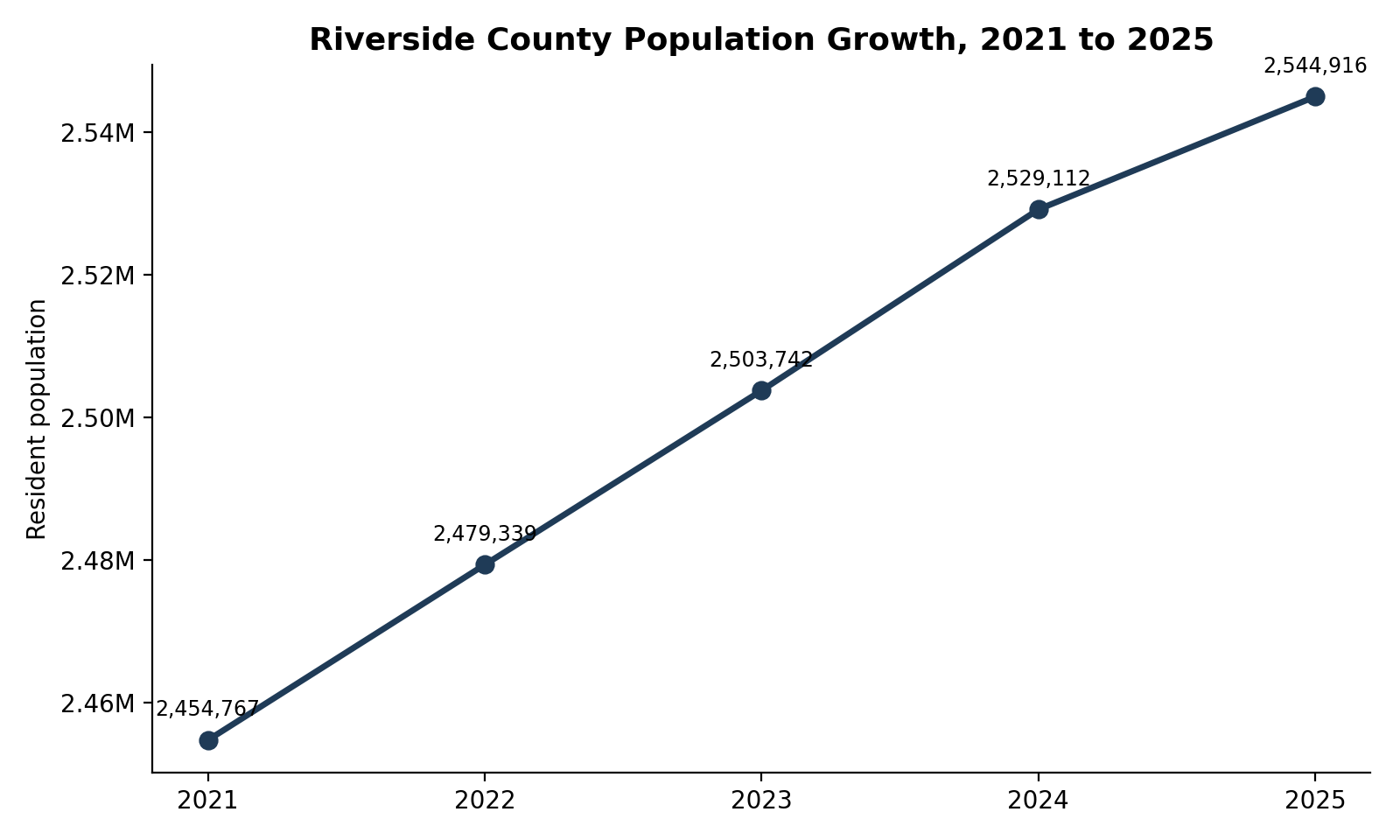
Riverside County’s population grew from about 2.45 million in 2021 to roughly 2.54 million in 2025, an increase of more than 90,000 residents in four years, according to U.S. Census Bureau estimates. According to the Judicial Council of California’s 2022 Court Statistics Report, Riverside County Superior Court logged 3,515 filings per judicial position, the third-highest caseload per judge among California’s 58 superior courts. A crowded civil docket is another reason early, well-documented filings tend to move faster than cases that require correction or refiling after the fact.
Why Riverside County Clients Choose Wade Litigation
Amiel Wade founded Wade Litigation with more than 25 years of California legal experience, including work as a former San Jose Police Officer before entering practice, and has been recognized with honors such as Lawyer of the Year in Civil Litigation and a superb rating from Avvo. The firm describes a record of high-value outcomes in business, probate, real estate, and personal injury cases, along with more than 150 five-star client reviews. Riverside County clients work with attorneys familiar with the Historic Courthouse, the Southwest Justice Center, and the Palm Springs Courthouse and with how each division handles scheduling and local procedure.
Civil litigation cases vary widely in scope, from a straightforward unpaid invoice to a multi-party business dissolution involving years of financial records, and the right approach depends on matching the strategy to the actual stakes. A dispute worth a few thousand dollars generally does not justify the cost of extensive discovery and motion practice, while a case involving a business’s ownership structure or a significant property interest often calls for a more thorough and aggressive approach from the outset. Part of an early case evaluation is sorting out which category a given dispute falls into before committing to a strategy.
Frequently Asked Questions
Common Questions Before Hiring a Civil Litigation Attorney
Cost is often the first concern for someone considering a civil litigation attorney. Wade Litigation discusses fees directly during a case evaluation and explains how clients are billed before any engagement begins.
A second common concern is how long a dispute will take to resolve. Straightforward matters that settle through negotiation or mediation can wrap up in a matter of months, while contested cases that proceed through full discovery and toward trial can take a year or more, particularly on a crowded court calendar.
A third concern, especially for a business owner, is whether pursuing a claim will do more harm than good to an ongoing relationship or reputation. That is a legitimate question, and the right answer depends heavily on the specific facts. In some cases, a firm but measured demand letter resolves the issue without ever needing to file suit. In others, particularly where a partner or counterparty has already acted in bad faith, prompt legal action protects a position that would otherwise keep eroding.
What Happens When You Call
A call to Wade Litigation starts with a case evaluation. A member of the team gathers basic information about the dispute, including when it arose, what documentation exists, and whether any deadlines, such as a statute of limitations or a response due date, are approaching. The call is used to identify the right venue, the applicable filing deadlines, and what evidence will matter most going forward.