A San Jose child custody attorney represents parents in Santa Clara County family court on legal custody, physical custody, visitation schedules, and relocation disputes. California courts decide custody based on the child’s best interests, not on which parent earns more or which parent moved out first. Wade Litigation offers a case evaluation to review your parenting plan, your custody goals, and what evidence the court will expect to see.
As the largest city in Santa Clara County, San Jose sees custody disputes that span an unusually wide range: parents navigating shared custody across sprawling suburban neighborhoods where a school-district boundary can determine which parent’s home makes more practical sense, tech workers whose schedules include travel and after-hours availability, and families where English is a second language and a custody evaluation needs to account for that without penalizing either parent. Family courts do not treat any of these circumstances as disqualifying on their own, but they do expect both parents to show they can provide a stable, consistent home environment.
How California Decides Custody
California Family Code sections 3003 and 3004 authorize courts to award joint or sole legal custody and joint or sole physical custody, and these two categories are evaluated separately, a distinction we cover in more depth in our guide to the different types of child custody arrangements in California. Legal custody determines who makes major decisions about the child’s health, education, and welfare. Physical custody determines where the child primarily lives and the parents’ time-share schedule. A parent can have joint legal custody while the other parent has primary physical custody, and the two do not have to match.
California courts govern every custody decision by the best-interest-of-the-child standard. Courts consider the child’s health and safety, the stability of each proposed living situation, each parent’s willingness to support the child’s relationship with the other parent, and, when the child is old enough, the child’s preference. A documented history of domestic violence or substance abuse weighs heavily against the parent involved and can override other factors entirely.
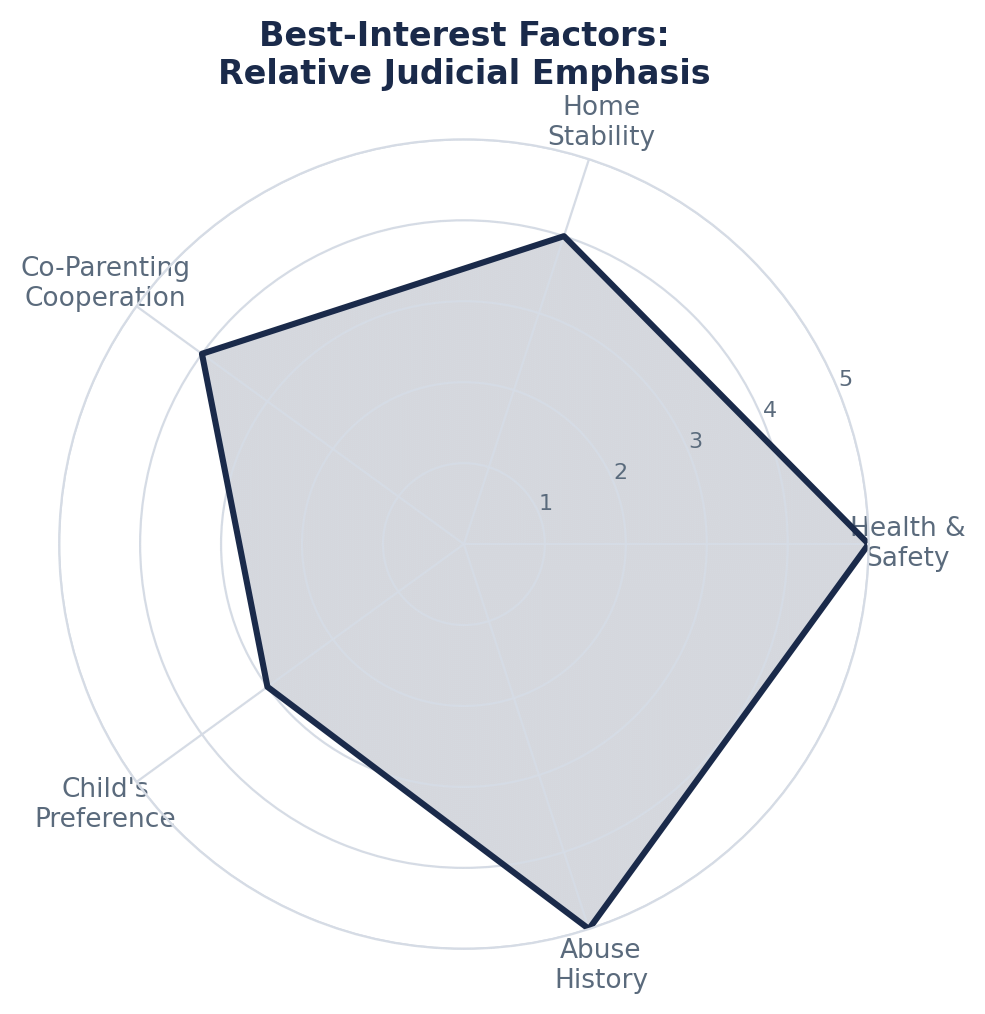
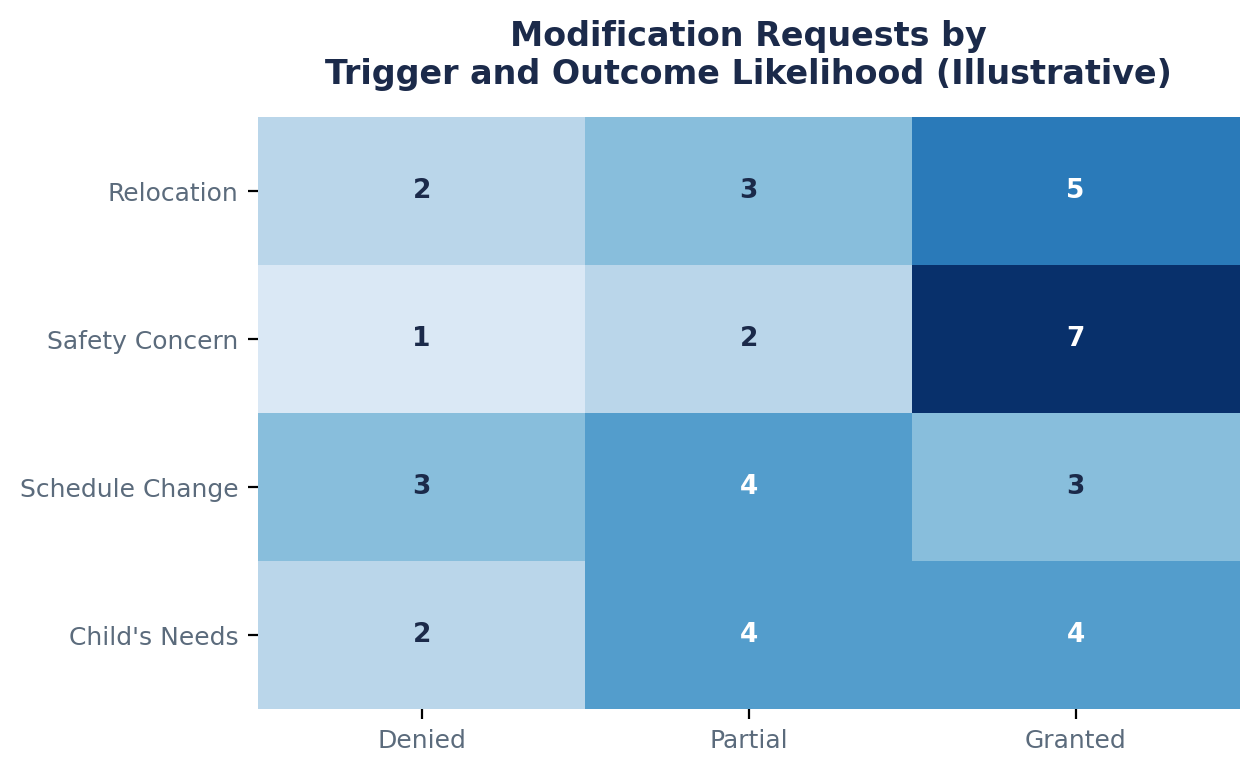
Figure 1: Illustrative judicial emphasis across common best-interest factors in family court custody determinations.
Where San Jose Custody Matters Are Heard
Custody filings for San Jose families, including custody petitions and requests for order, are handled through the Superior Court of California, County of Santa Clara, at the Family Justice Center on West Hedding Street. Because San Jose is the county seat, families here have more direct access to the courthouse than residents of smaller Santa Clara County cities, whose family law matters are also consolidated at the same downtown location.
How a Contested Custody Case Actually Moves
Most custody disputes do not go all the way to trial. A typical contested case narrows considerably at each stage: many resolve after mandatory mediation, others settle once a custody evaluation clarifies the likely outcome, and only a small share ultimately require a trial before a judge makes the final decision.
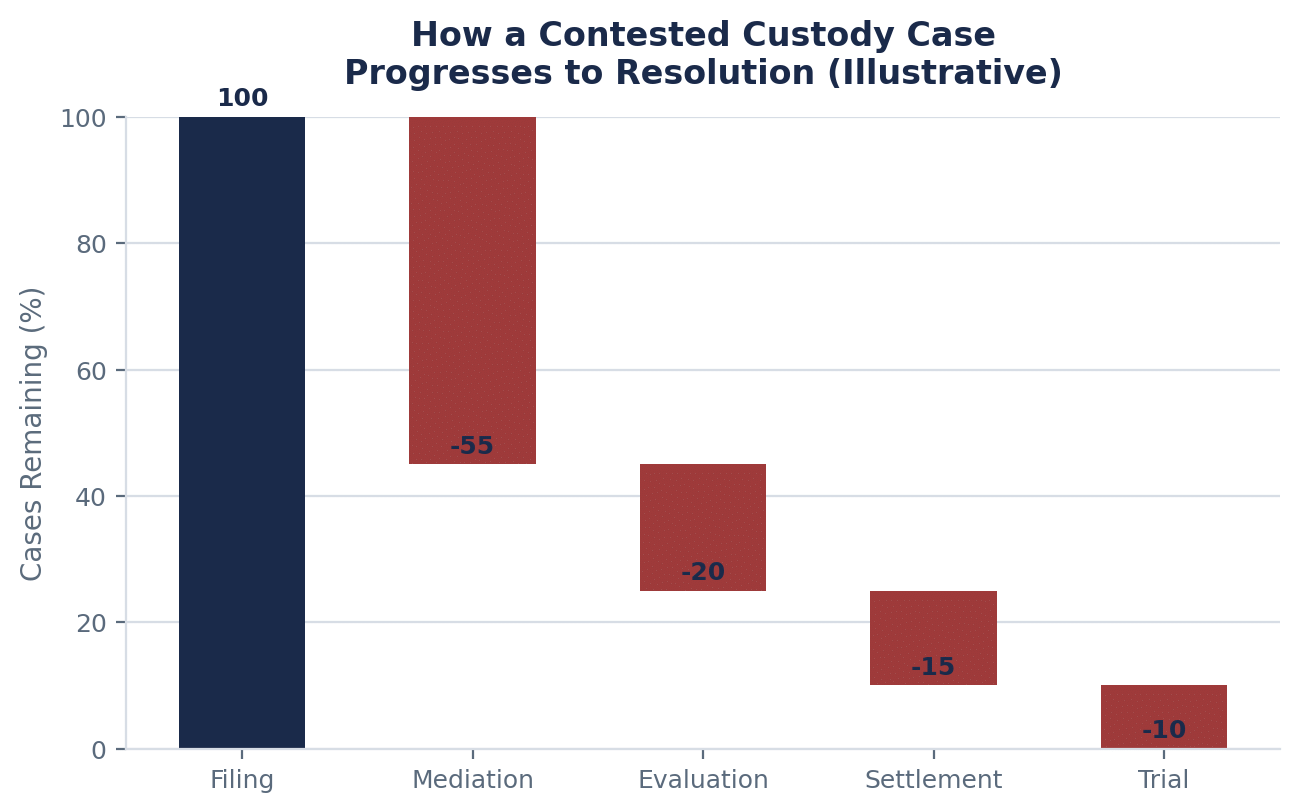
Figure 2: Illustrative progression of a contested custody case from filing to resolution.
Common Custody Dispute Triggers in Santa Clara County
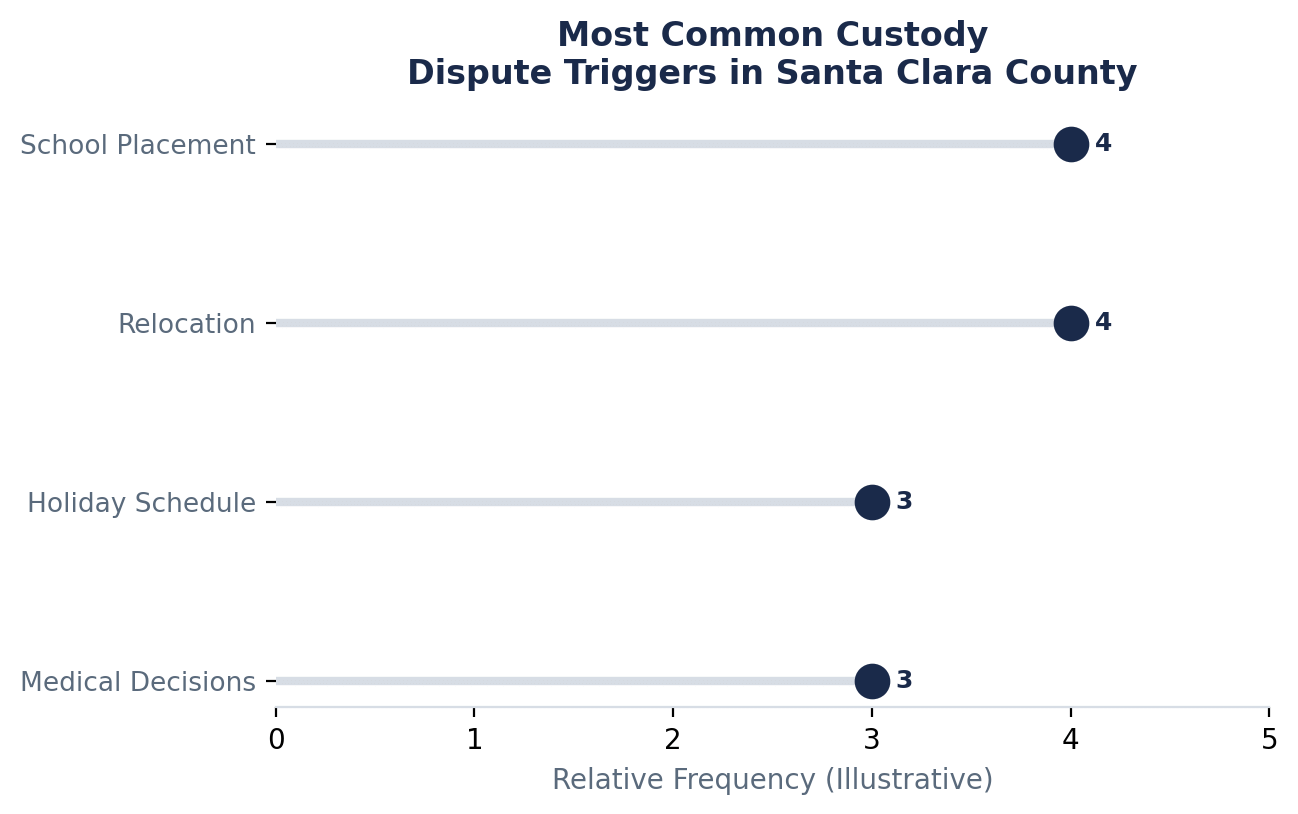
Figure 3: Most common triggers for custody disputes in Santa Clara County family court practice (illustrative).
Modifying an Existing Custody Order
A custody order is not permanent. Either parent can request a modification, but California requires the requesting parent to show a significant change in circumstances since the last order. Common grounds in San Jose cases include a parent relocating for a new job, a change in work schedule that no longer fits the existing time-share, a documented safety concern, or a shift in the child’s needs as they get older, such as a change between schools that affects which parent’s home is more practical for the daily commute.
How courts actually respond to a modification request often depends heavily on the specific trigger behind it, with safety concerns receiving the most consistent responsiveness and scheduling changes producing more mixed outcomes.
Figure 4: Modification requests by trigger and outcome likelihood in family court practice (illustrative).
Legal Custody Disputes Over Education and Medical Decisions
Even parents who agree on a physical custody schedule can end up in dispute over legal custody decisions, particularly around school placement given San Jose’s wide range of school district boundaries, or around medical decisions involving therapy, medication, or elective procedures. When joint legal custody parents cannot agree, either parent can ask the court to resolve the specific dispute or, in more contentious cases, request a shift to sole legal custody over the disputed decision area.
Custody Evaluations and the Role of Family Court Services
In contested custody cases, Santa Clara County Family Court Services may order the parents to attend mediation before the matter goes in front of a judge, and in more disputed cases, the court can appoint a child custody evaluator to interview the parents, observe the children, and issue a written recommendation. These evaluations carry substantial weight with the judge, so how a parent presents during the evaluation process, and how well their attorney has prepared them for it, often shapes the outcome as much as the underlying facts of the case.
Wade Litigation prepares clients for custody evaluations by reviewing what evaluators typically look for: consistency between the parent’s stated parenting philosophy and their actual daily involvement, the condition and appropriateness of the home environment, and the parent’s ability to speak about the other parent without hostility in front of the child. Parents who go into an evaluation unprepared often unintentionally undermine their own position by focusing on grievances against the other parent rather than on the child’s needs.
Comparison: Mediated Custody Agreement vs. Litigated Custody Order
| Factor | Mediated Agreement | Litigated Order |
| Typical Duration | 2 to 5 months | 8 to 14 months |
| Decision-Maker | Both parents | Judge |
| Flexibility | Custom schedule terms | Standardized order language |
| Ongoing Cooperation | Often improves | Can remain adversarial |
Grandparent and Third-Party Visitation
Grandparent visitation rights in California are narrower than many people expect. A grandparent generally cannot petition for visitation while the child’s parents are married and living together, absent specific exceptions such as a parent’s incarceration or a lengthy separation between the parents. Once parents are divorced, separated, or one parent has died, a grandparent’s petition becomes more viable, but the court still applies the best-interest standard and gives significant weight to a fit parent’s own wishes regarding who has contact with their child. San Jose’s large multigenerational households, where grandparents sometimes play a substantial caregiving role, make these disputes more common here than in areas with less extended-family involvement in day-to-day parenting.

Holiday Schedules and Travel Provisions
A surprising share of post-judgment custody disputes trace back to vague or missing language around holidays, school breaks, and travel notice rather than the core weekly schedule. Families with international ties, common in a global tech hub like San Jose, often need travel provisions that address passport control, advance notice requirements, and how longer trips interact with the standard time-share. Building these terms into the original custody order, rather than leaving them to informal agreement, prevents a large share of the disputes that otherwise end up back in front of a judge.
Enforcing a Custody Order When the Other Parent Does Not Comply
A custody order only works if both parents follow it, and San Jose family court sees a steady share of enforcement disputes when one parent withholds visitation, repeatedly shows up late for exchanges, or unilaterally deviates from the agreed schedule. California allows the aggrieved parent to file a request for order seeking to enforce the existing terms, and in serious or repeated violations, to seek makeup parenting time or, in extreme cases, a modification of the underlying custody arrangement. Documenting violations as they happen, rather than relying on memory months later, makes a substantial difference in how persuasive an enforcement request looks to the court.
Working With a Child Custody Evaluator’s Recommendation
Once a custody evaluator issues a written recommendation, the court gives it substantial weight, but the recommendation is not automatically adopted as the final order. Either parent can challenge specific findings, request a hearing to cross-examine the evaluator, or present additional evidence the evaluator may not have considered. Wade Litigation reviews an unfavorable evaluation closely for factual errors, unsupported conclusions, or gaps in the evaluator’s process before deciding whether to challenge it or work within its framework toward a negotiated resolution.
Supervised Visitation and Safety-Related Custody Terms
When a parent has a documented history of substance abuse, domestic violence, or another safety concern, the court can order supervised visitation, requiring a neutral third party or professional monitor to be present during parenting time. Santa Clara County recognizes both professional supervised visitation providers and, in lower-risk situations, a mutually agreed non-professional monitor such as a family member. Supervised arrangements are typically intended as a step toward unsupervised time once the underlying concern is addressed, and the custody order should specify what conditions would allow the arrangement to be revisited, rather than leaving that question open-ended.
Co-Parenting Counseling and Parenting Coordinators
For high-conflict co-parenting relationships that do not rise to the level requiring supervised visitation, Santa Clara County family courts sometimes order co-parenting counseling or appoint a parenting coordinator to help the parties resolve day-to-day disagreements without returning to court for every dispute. A parenting coordinator can address recurring friction points, such as exchange logistics or minor schedule adjustments, through a faster and less formal process than a new court filing, though the coordinator’s authority is typically limited to implementing the existing order rather than making substantive changes to custody or visitation terms.
What This Means for Your Case
If you are heading into a custody dispute in San Jose, the strongest position is one built on documentation: a clear parenting plan proposal, a record of your involvement in the child’s daily life, and evidence addressing any safety or stability concerns before the other parent raises them. Wade Litigation helps parents build that record early rather than reacting to allegations after they are already in front of a judge.
Objections We Commonly Address
Parents sometimes hesitate to involve an attorney in a custody matter because they hope to resolve things informally with the other parent, or because they fear that hiring an attorney will make the dispute more adversarial. In practice, a well-structured parenting plan proposal drafted with legal guidance often resolves the matter faster than an informal agreement that later falls apart over an ambiguous term, since vague language about school breaks, holidays, or travel notice is one of the most common sources of renewed disputes.
What Happens When You Call
When you call Wade Litigation, the intake team will ask about your current custody arrangement, your children’s ages, and the specific issue prompting your call, whether that is a first-time custody filing, a modification request, or a relocation concern. During your case evaluation, an attorney will walk through your parenting plan goals and explain what documentation will strengthen your position before your next court date or negotiation session.
Explore Related San Jose Practice Areas
If custody is being decided alongside a divorce, see our San Jose divorce attorney page, or for the broader family law picture, our San Jose family law attorney page. You can also view our full San Jose office overview for every practice area we handle in the South Bay.
Frequently Asked Questions
Speak With a San Jose Child Custody Attorney
Amiel Wade, founding attorney and a recognized Top Ten California Family Law Attorney, has represented Santa Clara County parents through custody disputes ranging from first-time parenting plans to contested relocation cases. Call to schedule a case evaluation and get a clear view of your custody options.
Cta 2 –