

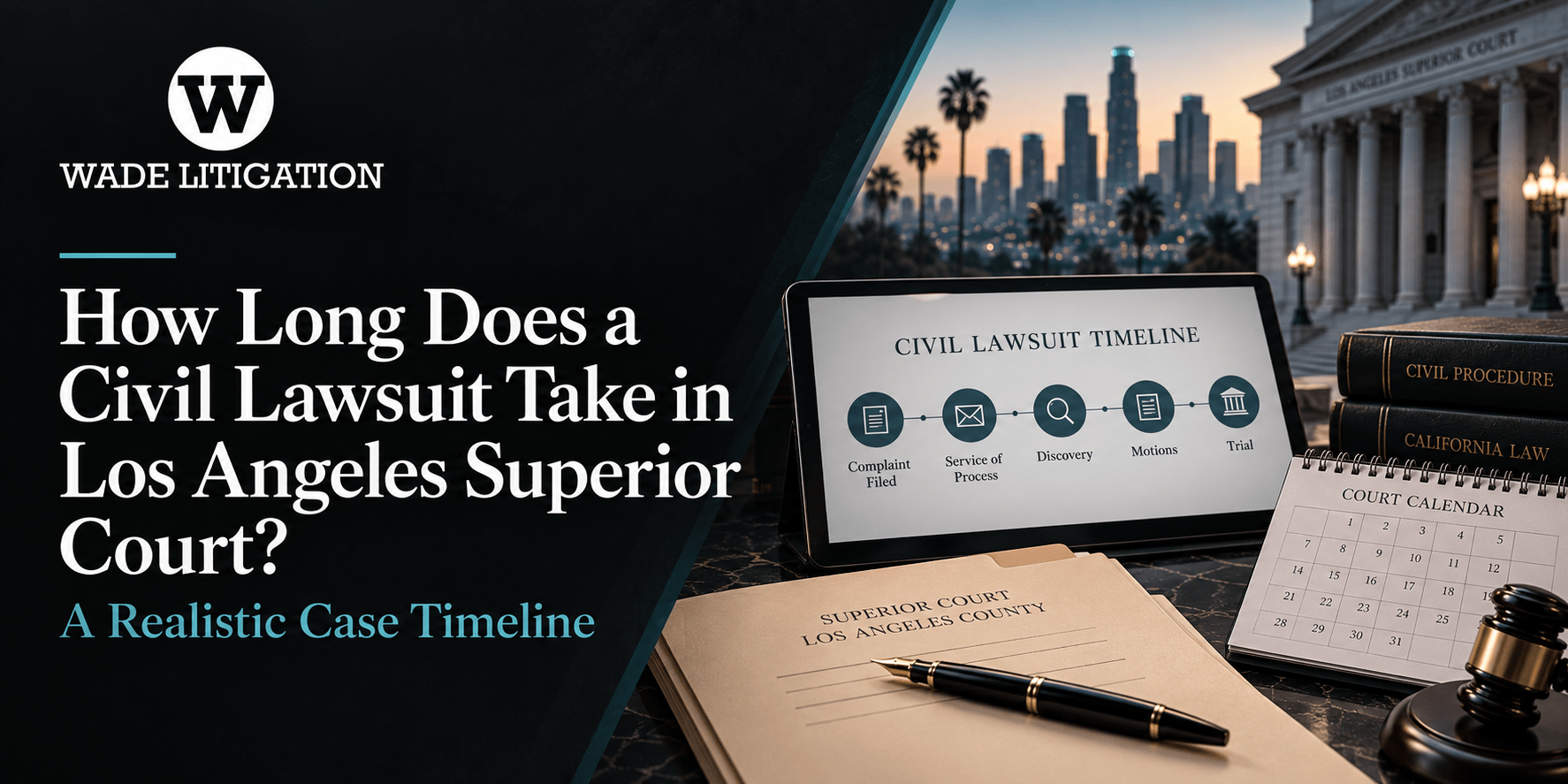
Everyone asks this question, and nobody likes the answer. A California civil case that goes to trial commonly takes well over a year, and complex matters take considerably longer.
The more useful question is what actually consumes that time, because most of it is not the court. It is the parties, and a substantial portion of it is controllable.
Before Anything Is Filed
Time runs before a complaint exists. Statutes of limitation set the outer boundary — commonly two years for personal injury, four years for breach of a written contract, two years for an oral contract, and three years for fraud, measured from when the claim accrued or was discovered.
Claims against public entities carry much shorter notice requirements, and missing one can end a claim before it starts.
Pre-filing investigations, demand letters, and settlement attempts also take weeks or months and are often worth the time. A case resolved by demand takes a fraction of the time and costs of one resolved by verdict.
The Pleading Stage
After a complaint is filed, the defendant must be served, and service is a more common source of delay than people expect when a defendant is evasive or hard to locate.
The defendant then responds, and that response is often not an answer but a challenge to the complaint — a demurrer or motion to strike. Those motions are briefed and heard, and if granted, the plaintiff usually gets leave to amend,d and the cycle repeats.
A case with two rounds of pleading challenges can spend the better part of a year before the parties have even joined issue on the facts. This is the stage where careful initial drafting pays for itself.
Case Management
The court holds a case management conference within months of filing, where the judge sets a schedule and often a trial date. In Los Angeles County, which handles an enormous civil volume, that date is real but is also subject to continuance.
Cases here are typically assigned to a single judge for all purposes, which is helpful — the judge learns the case and rulings stay consistent.
California also has a rule requiring cases to be brought to trial within five years of filing, subject to tolling. It is a genuine backstop, and it becomes relevant in cases that stall.
Discovery Is the Longest Phase
Discovery routinely consumes a year or more in a contested case, and it is where the bulk of both time and cost lives.
- Written discovery — interrogatories, document demands and requests for admission
- Document production, which in commercial cases means electronic records at scale
- Depositions of the parties, key witnesses and custodians of records
- Expert designation, expert reports and expert depositions
- Motions to compel, when one side does not produce what it should
Discovery disputes are the single largest avoidable cause of delay. A motion to compel takes weeks to brief and be heard, and a case with several of them loses months to arguments about process rather than substance.
Cooperative discovery is not a favor to the other side. It is the cheapest way to reach the point where the case can actually be evaluated.
Summary Judgment
A party may move for summary judgment or summary adjudication, arguing that there is no triable issue of material fact. California requires substantial advance notice for these motions, and they must be heard well before trial.
The briefing is heavy, and the preparation is expensive. A motion filed and denied has consumed months and significant fees. A motion granted ends the case or narrows it substantially. Deciding whether to bring one is a genuine strategic judgment rather than a default step.
Default Judgments and the Cases That End Early
Not every case runs the full course. A meaningful share ends within months because the defendant never responded.
Where a defendant fails to answer after proper service, the plaintiff can take a default and then a default judgment. The process has requirements that courts scrutinize, but a case that ends this way concludes in a fraction of the usual time.
Conversely, defendants who default and later seek relief can reopen a case that appeared finished. California permits relief from default in defined circumstances, particularly where the failure resulted from mistake, inadvertence, or excusable neglect, and a successful motion restarts the clock entirely.
Mediation and Settlement
The overwhelming majority of civil cases settle. Most courts require or strongly encourage mediation, and many cases resolve in mediation after discovery is substantially complete.
Timing matters enormously. Mediating too early, before either side understands the evidence, usually fails because the parties are negotiating over different pictures of the case. Mediating after depositions and expert disclosure, when both sides have seen the risk, succeeds far more often.
Costs Rise Unevenly
Time and cost are related, but they do not track each other. Expense concentrates in bursts rather than accruing steadily.
The pleading stage is comparatively inexpensive. Discovery is where cost accelerates, particularly once depositions begin and electronic records must be collected and reviewed. Expert work is the other major concentration, and it lands late.
This pattern matters for settlement strategy. A case settled before expert designation costs a fraction of one settled on the courthouse steps, even though the evidence supporting each is nearly identical. Parties who intend to settle eventually generally save a great deal by deciding when rather than drifting toward it.
Trial and What Follows
Trial dates move. Courts have finite courtrooms; criminal matters take priority, and a case can be tried or continued for reasons unrelated to the case.
The trial itself may run days or weeks depending on complexity. Afterward come post-trial motions, entry of judgment, and the question of fees and costs.
An appeal adds substantially more time. A California civil appeal commonly takes well over a year from notice of appeal to decision, and a judgment on appeal is not final until that process concludes.
Anti-SLAPP Motions Can Pause Everything
California has a statute allowing early dismissal of claims arising from protected speech or petitioning activity, and it appears in commercial disputes more often than people expect — in claims touching on statements to regulators, litigation conduct, or public communications.
Two features make it significant to timing. Discovery is generally stayed while the motion is pending, which can freeze a case for months. And an order denying the motion is immediately appealable, which can suspend the case for a year or more before it has properly begun.
A defendant with a viable motion of this kind holds real leverage over the schedule. A plaintiff drafting a complaint should think carefully about whether the allegations invite unnecessary scrutiny.
Complex Case Designation
Cases involving numerous parties, extensive documentary evidence, coordination with other actions, or novel legal issues may be designated complex and assigned to a specialized court.
The designation cuts both ways when it comes to timing. Complex cases receive more active judicial management and closer attention to scheduling, which can help. They are also complex for a reason, and the underlying issues take longer to resolve regardless of how well the case is managed.
There is also a cost element, since complex designation carries additional fees for each party.
What Actually Speeds a Case Up
- Realistic assessment early, rather than positions that harden before the evidence is in
- Prompt, complete document production instead of staged resistance
- Narrowing claims that will not survive rather than carrying them to trial
- Agreeing on facts that are not genuinely disputed
- Choosing mediation timing deliberately rather than treating it as a formality
- A client who responds quickly to their own attorney’s requests
That last item is underrated. Cases at Wade Litigation and everywhere else stall waiting for documents and answers from the client more often than anyone likes to admit.
If you are weighing whether to bring or defend a civil claim in Los Angeles, call Wade Litigation. We will give you a realistic timeline and cost estimate before you commit to either option.
Clients Throughout California
Fields Marked With An ”*” Are Required